Backwardation
Backwardation is a market condition where the current price (spot price) of a commodity or asset is higher than the future delivery price (futures price). It is most common in commodity markets during supply shortages. In forex, the equivalent concept involves the forward rate being lower than the spot rate, which occurs when the base currency's interest rate is higher than the quote currency's interest rate.
Understanding Backwardation
In most financial markets, prices for future delivery are higher than current prices. This is called contango — futures trade at a premium because they incorporate the cost of storage, insurance, and financing over time. Backwardation is the opposite: futures trade at a discount to spot. Spot is more valuable than future.
Backwardation typically signals that the market wants the commodity now — current demand is so high (or current supply so scarce) that participants pay a premium for immediate delivery rather than waiting. Classic examples: an oil shortage drives crude oil futures into backwardation; a crop failure drives grain futures below spot.
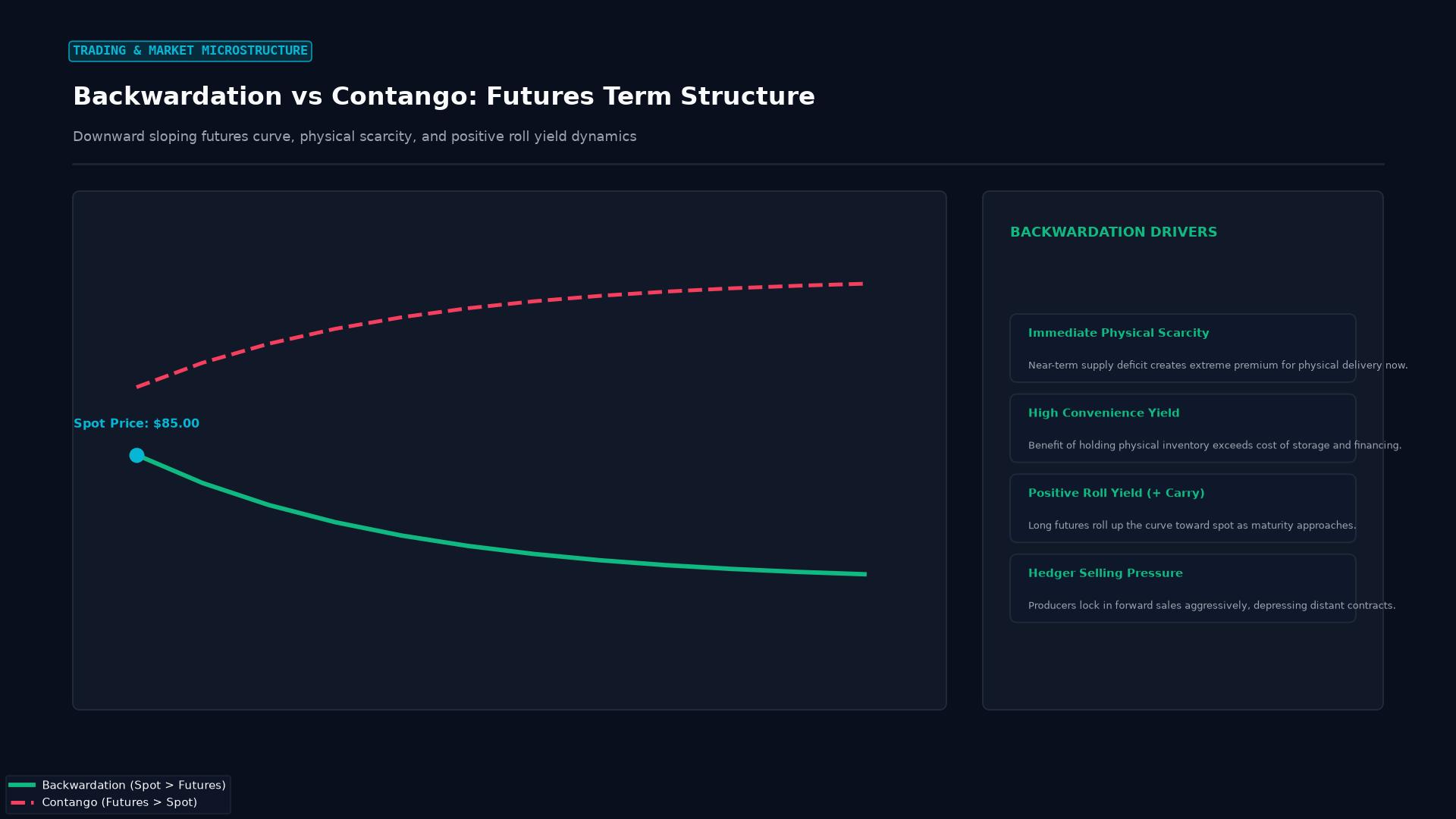 Figure: Downward sloping futures curve in backwardation: cash spot premium driven by immediate physical scarcity, high convenience yield, and positive roll carry.
Backwardation in Forex: The Forward Discount
The forex equivalent of backwardation is when the forward exchange rate is lower than the spot rate for a currency pair — meaning the currency is at a forward discount.
This occurs through interest rate parity. The forward rate is calculated as:
Forward Rate = Spot Rate × (1 + Quote Currency Rate) / (1 + Base Currency Rate)
If the base currency has a higher interest rate than the quote currency, the forward rate will be lower than the spot rate. The base currency is at a forward discount — it buys fewer units of the quote currency in the forward market than at spot.
Example: AUD/USD where AUD rates are 4.25% and USD rates are 5.50%.
- AUD has a lower rate than USD — so AUD is at a forward discount
- The 1-year AUD/USD forward rate would be lower than the spot rate
This is the same mechanism that creates negative carry when holding AUD/USD long — you pay a higher roll rate for holding the lower-yielding currency (in this case USD is higher-yielding).
Why Backwardation Matters for Traders
Carry trade context: A currency in forward discount (backwardation vs. spot) has negative carry when held long. You receive a daily swap debit rather than credit. The carry trade specifically seeks pairs in the opposite condition: a base currency at a forward premium (contango), where you receive positive rollover for holding the position.
Commodity-linked currencies: When key commodities (oil, iron ore) are in backwardation, it often indicates strong current demand — which can be bullish for commodity-linked currencies like CAD (oil) and AUD (iron ore).
Risk signal: Persistent, unusual backwardation in a currency pair’s forward curve can signal market stress — for example, during the 2008 financial crisis, several currency forward markets showed unusual backwardation as dollar funding demand exceeded supply.
Practical Awareness for Retail Traders
For most retail forex traders, backwardation and forward rates are background knowledge rather than daily trading tools. The practical implication shows up in:
- The swap rate on your broker platform (positive or negative rollover)
- Understanding why some carry trades work and others don’t
- Interpreting commodity markets when trading commodity-linked currencies
If you’re running a carry trade strategy, always check the forward curve for the pairs you’re holding — it directly tells you whether you’ll be paying or receiving rollover.
Key Takeaways
- Backwardation = spot price above futures price (commodity markets) or spot exchange rate above forward rate (forex)
- In forex, backwardation of the base currency occurs when the base has a higher interest rate than the quote
- A currency at a forward discount means negative carry when held long — daily swap debit
- Commodity backwardation can be a positive signal for related currency pairs
- The daily swap rate on your broker platform is the practical manifestation of forward rate relationships
FAQ
Is backwardation bullish or bearish for a currency? Neither inherently. A currency with a higher interest rate (causing forward backwardation) can still be strong — the high rate is exactly what attracts capital inflows. The forward discount simply reflects the expected convergence of prices implied by interest rate parity, not necessarily the actual direction of the spot rate.
How do I know if a pair has positive or negative carry? Check the swap rates in your trading platform. In MetaTrader, right-click any pair in Market Watch → Specification → look at “Swap Long” and “Swap Short.” Positive values mean you receive; negative values mean you pay. The pair with the larger positive swap long has a carry advantage.
Ready to trade forex?
Open a free demo account with a regulated broker. Practice with virtual funds before risking real money.