Contract for Difference (CFD)
A Contract for Difference (CFD) is a popular financial derivative contract between a retail client and a broker to exchange the cash difference between the entry and exit prices of an underlying asset without requiring physical ownership.
What Is a Contract for Difference (CFD)?
A Contract for Difference (CFD) is an over-the-counter (OTC) derivative agreement between an investor and a financial intermediary (typically a brokerage firm or market maker). Under a CFD contract, the two parties agree to cash-settle the exact price difference between the moment the contract is opened and the moment it is closed, multiplied by the contract size.
Crucially, the CFD trader never takes physical delivery or legal ownership of the underlying asset—whether it is a share of Apple, a barrel of crude oil, an ounce of gold, or an index basket like the S&P 500. Instead, the contract merely mirrors the price movements of the underlying instrument, providing market participants with a flexible, leveraged mechanism to speculate on both rising (going long) and falling (going short) asset prices.
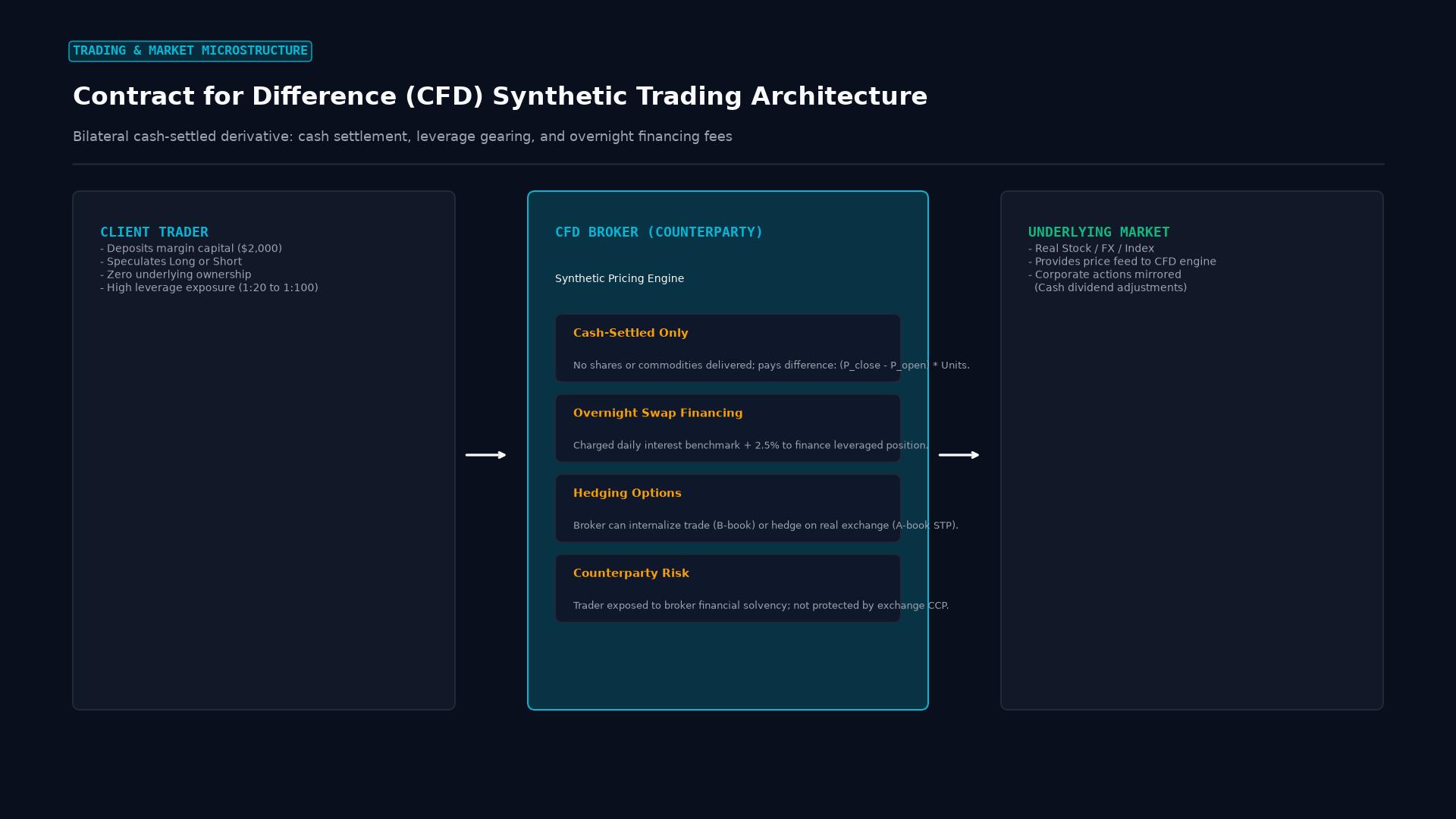 Figure: Bilateral cash-settled derivative agreement: trading net price differentials with high margin leverage and overnight financing fees without physical underlying asset ownership.
Key Takeaways
- No Asset Ownership: CFDs provide synthetic price exposure without the administrative costs, stamp duties, custody fees, or physical delivery obligations associated with holding physical securities.
- Symmetric Two-Way Trading: Shorting an asset via a CFD is just as simple and cost-effective as going long, with no need to borrow physical shares or locate securities prior to execution.
- Leverage and Margin: CFDs require only a small fractional deposit (margin) to command a substantial total notional exposure, magnifying both potential gains and potential losses.
- Financing (Swap) Costs: Holding CFD positions overnight incurs financing fees (daily rollover swaps) calculated against the full borrowed notional value, making long-term investing expensive.
- Regulatory Restrictions: Due to high retail risk, CFDs are strictly prohibited for retail investors in the United States by the CFTC/SEC, while European (ESMA), UK (FCA), and Australian (ASIC) regulators cap retail leverage between 1:2 and 1:30.
CFD Payoff Mathematics
The financial return from a CFD trade is governed by a straightforward equation based on position direction, lot size, and price movement:
Long (Buy) CFD Payoff:
$$\text{Gross P&L} = (\text{Exit Price} - \text{Entry Price}) \times \text{Number of Contracts}$$
Short (Sell) CFD Payoff:
$$\text{Gross P&L} = (\text{Entry Price} - \text{Exit Price}) \times \text{Number of Contracts}$$
Net Profit After Financing and Costs:
$$\text{Net P&L} = \text{Gross P&L} - \text{Round-Trip Commissions} - \text{Total Overnight Financing Charges}$$
Comparison: CFDs vs. Traditional Direct Asset Ownership
Understanding the operational trade-offs between synthetic CFD trading and traditional cash investing is vital for portfolio construction:
| Feature | CFD Trading | Direct Asset Ownership (Shares/Spot) |
|---|---|---|
| Physical Ownership | None; cash-settled contractual derivative | 100% legal ownership of the underlying asset |
| Short Selling | Seamless; execute sell orders instantly at prevailing market bid | Complex; requires borrowing shares, locate fees, and uptick rules |
| Leverage Available | High (e.g., 1:5 to 1:30 for retail; up to 1:500 offshore) | None (Cash accounts) or Reg T Margin (up to 1:2 in U.S.) |
| Overnight Financing | Daily interest charged on total borrowed notional exposure | None; free to hold for months or decades |
| Dividend Treatment | Cash adjustments credited (longs) or debited (shorts) | Formal dividend payments credited with voting rights |
| Stamp Duty / Taxes | Exempt from UK stamp duty ($0.5%$) due to no ownership transfer | Subject to full national stamp duty and transfer taxes |
Real-World Case Study: Hedging an Equity Portfolio Using CFDs
A private investor holds a long-term retirement portfolio containing £100,000 worth of UK FTSE 100 blue-chip equities.
The Problem:
An unexpected geopolitical crisis threatens to trigger a sharp 10% market correction over the coming month. Selling the entire portfolio would trigger substantial capital gains tax liabilities and trading fees, followed by the inconvenience of rebuying the shares later.
The CFD Hedging Strategy:
- Hedging Instrument: FTSE 100 Index CFD (trading at 8,000 points; £10 per point notional per contract).
- Exposure Required: $$\text{Contracts} = \frac{£100,000}{8,000 \times £10} = 1.25 \text{ Contracts}$$
- Execution: The investor enters a short position of 1.25 FTSE 100 CFD contracts at 8,000 points.
- Margin Required: Under FCA regulations (5% margin for major equity indices), the broker requires only £5,000 in margin collateral to maintain the hedge ($£100,000 \times 0.05$).
- The Market Drop: Over the next three weeks, the FTSE 100 drops by 800 points (10%) to 7,200.
- Physical Portfolio Value: Drops by -£10,000 (from £100,000 to £90,000).
- Short CFD Position Profit: $$(8,000 - 7,200) \times 1.25 \times £10 = +£10,000$$
- Result: The CFD profit of £10,000 completely neutralizes the £10,000 loss in the equity portfolio. The investor closes the short CFD position, collects the cash, and preserves their retirement portfolio intact without paying liquidation taxes.
Critical Risks of CFD Trading
Regulators require brokers to publish standardized risk warnings noting that between 70% and 80% of retail investor accounts lose money when trading CFDs. The primary risk drivers include:
- Excessive Leverage: Leverage acts as a double-edged sword. A 1:30 leverage ratio means a mere 3.33% adverse price movement wipes out 100% of the invested margin.
- Overnight Financing Drag: Because financing charges compound daily against the entire leveraged notional exposure, holding CFDs over multi-month horizons can quietly consume all trading profits.
- Counterparty Insolvency: Unlike exchange-traded futures cleared through centralized clearinghouses (e.g., CME Clearing), CFDs are bilateral OTC contracts. If an unregulated offshore broker files for bankruptcy, clients may lose all deposited funds.
Frequently Asked Questions
Why are CFDs banned in the United States?
Under the U.S. Commodity Exchange Act and securities regulations, over-the-counter financial products that offer retail leverage without being traded on a registered national exchange are illegal. U.S. retail residents must instead trade exchange-listed futures, options, or standard spot forex through regulated NFA/CFTC entities.
Do CFD holders receive shareholder dividends?
CFD holders do not receive formal dividend checks or shareholder voting rights. However, brokers make an equivalent dividend cash adjustment on the ex-dividend date: accounts holding long CFDs are credited with the dividend amount, while accounts holding short CFDs have the dividend amount automatically debited.
What is the difference between a CFD and an exchange-traded future?
Futures are standardized contracts traded on regulated public exchanges (like CME or ICE) with transparent central limit order books and no overnight financing interest. CFDs are customized OTC contracts provided directly by brokers with flexible lot sizes and daily overnight rollover fees.
Ready to trade forex?
Open a free demo account with a regulated broker. Practice with virtual funds before risking real money.