Contract (Lot)
A contract (lot) is the standardized unit of measurement used to quantify trade volume in the foreign exchange market, traditionally categorized into standard (100,000 units), mini (10,000 units), micro (1,000 units), and nano (100 units) lots.
What Is a Contract (Lot) in Forex?
In financial markets, a contract (commonly referred to as a lot) represents the standardized transactional unit of volume used to quantify an open position. Because currency exchange rate movements are measured in tiny fractional increments—most commonly pips ($0.0001$ of the quote currency)—trading individual single units of currency would yield negligible profits and losses. Standardizing transactions into lots allows traders and institutional desks to deploy sufficient capital to make currency movements economically meaningful.
When a trader executes an order in the foreign exchange market, the contract size specifies the exact quantity of the base currency (the first currency listed in the pair) being bought or sold.
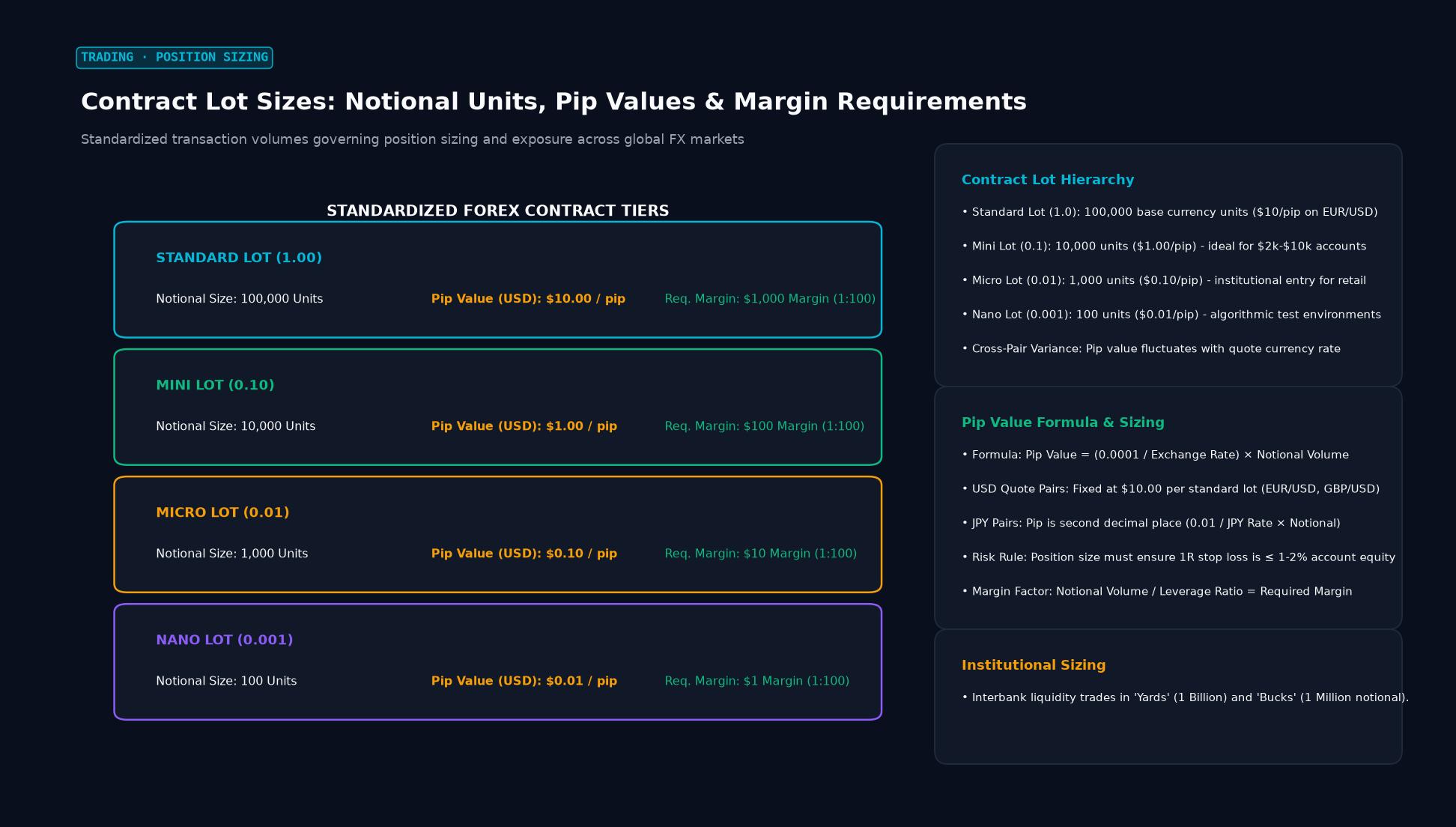 Figure: Standardized transaction volumes governing position sizing and exposure across global FX markets
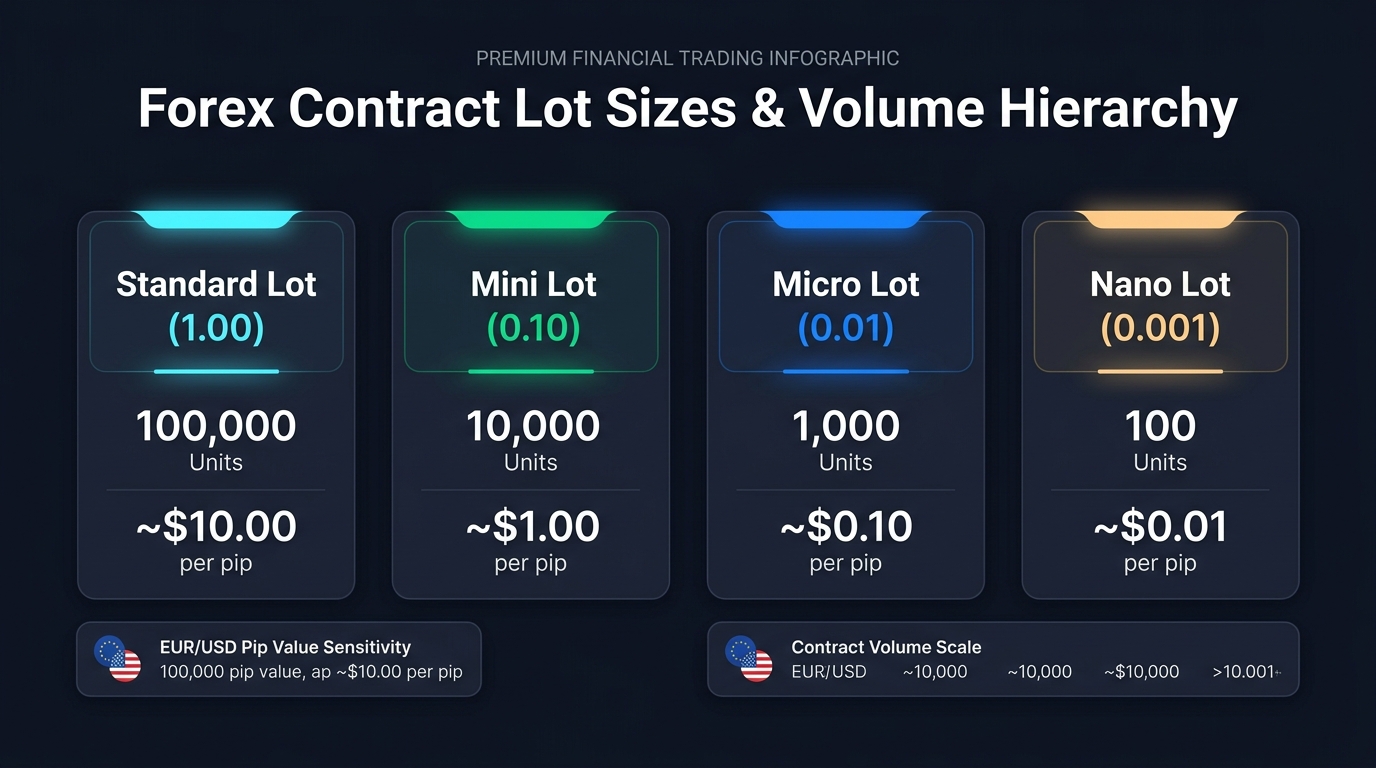
Key Takeaways
- The Standard Institutional Unit: A standard lot consists of 100,000 units of the base currency, representing the historical foundation of interbank FX trading.
- Retail Lot Subdivisions: Retail brokerages offer fractional lots—mini lots (10,000 units), micro lots (1,000 units), and nano lots (100 units)—allowing traders with small account balances to maintain strict risk management protocols.
- Pip Value Relationship: Lot size directly determines the monetary value of each pip movement: in standard EUR/USD trading, 1 standard lot equals approximately $10.00 USD per pip, whereas 1 micro lot equals $0.10 USD per pip.
- Base Currency Principle: Lot volume always designates units of the base currency. For instance, 1 standard lot of USD/CAD represents $100,000 USD, while 1 standard lot of GBP/USD represents £100,000 GBP.
The Four Standard Forex Lot Categories
The following table summarizes the specifications, notional values, and pip values for the four primary lot sizes when trading a USD-quoted pair (such as EUR/USD or GBP/USD):
| Lot Designation | Volume in Units | Volume in Lots | Notional Value (EUR/USD) | Pip Value ($0.0001 Move) | Minimum Account Size (Recommended) |
|---|---|---|---|---|---|
| Standard Lot | 100,000 units | 1.00 lot | €100,000 | ~$10.00 USD | $10,000+ |
| Mini Lot | 10,000 units | 0.10 lot | €10,000 | ~$1.00 USD | $1,000 – $5,000 |
| Micro Lot | 1,000 units | 0.01 lot | €1,000 | ~$0.10 USD | $100 – $1,000 |
| Nano Lot | 100 units | 0.001 lot | €100 | ~$0.01 USD | $10 – $100 |
Calculating Pip Value Across Currency Pairs
To manage risk accurately, a trader must calculate the exact monetary value of a one-pip change based on their selected contract size.
1. When USD is the Quote Currency (e.g., EUR/USD, GBP/USD, AUD/USD):
The pip value is fixed directly in U.S. Dollars: $$\text{Pip Value} = \text{Contract Size} \times 0.0001$$
- For 1 Standard Lot ($100,000 \times 0.0001$): $10.00 USD per pip.
- For 1 Micro Lot ($1,000 \times 0.0001$): $0.10 USD per pip.
2. When USD is the Base Currency (e.g., USD/JPY, USD/CHF, USD/CAD):
The pip value fluctuates with the current exchange rate and must be converted back to the account currency: $$\text{Pip Value in USD} = \frac{\text{Contract Size} \times \text{Pip Decimal Value}}{\text{Exchange Rate}}$$
Example (USD/JPY at 155.00 with a 0.01 pip unit): $$\text{Pip Value} = \frac{100,000 \times 0.01}{155.00} = \frac{¥1,000}{155.00} \approx $6.45 \text{ USD per pip}$$
Position Sizing Formula: Protecting Portfolio Equity
Professional traders never select their lot size arbitrarily. Position sizing is calculated backward from the trader’s predefined risk budget (e.g., risking no more than 1% of total account equity per trade) and technical stop-loss distance.
$$\text{Position Size (in Lots)} = \frac{\text{Account Equity} \times \text{Risk Percentage}}{\text{Stop-Loss Distance (in Pips)} \times \text{Pip Value per Standard Lot}}$$
Practical Application:
- Account Equity: $10,000 USD
- Risk Budget: 1% of equity ($100 USD maximum loss)
- Currency Pair: EUR/USD (Pip value = $10.00 per standard lot)
- Technical Stop-Loss: 40 pips
$$\text{Position Size} = \frac{$10,000 \times 0.01}{40 \times $10.00} = \frac{$100}{$400} = 0.25 \text{ Lots (2.5 Mini Lots or 25 Micro Lots)}$$
By trading precisely 0.25 lots, if the market moves 40 pips against the position and triggers the stop-loss, the trader loses exactly $100 (0.25 $\times$ 40 $\times$ $10 = $100), protecting 99% of their capital.
Lot Size vs. Leverage and Margin Requirements
It is critical not to confuse contract lot size with leverage. Lot size dictates the total economic exposure of the trade, whereas leverage determines how much margin collateral the broker locks up to hold that contract.
$$\text{Required Margin} = \frac{\text{Notional Value of Contract}}{\text{Leverage Ratio}}$$
| Lot Size | Notional Value | Leverage 1:30 (FCA/ESMA) | Leverage 1:100 | Leverage 1:500 (Offshore) |
|---|---|---|---|---|
| 1.00 Standard Lot | $100,000 | $3,333.33 | $1,000.00 | $200.00 |
| 0.10 Mini Lot | $10,000 | $333.33 | $100.00 | $20.00 |
| 0.01 Micro Lot | $1,000 | $33.33 | $10.00 | $2.00 |
Caution: While high leverage allows a trader to open a standard lot with only $200 in margin, the $10-per-pip risk remains unchanged. A quick 20-pip adverse price swing will trigger a margin call and wipe out the entire $200 deposit within seconds.
Frequently Asked Questions
Can I trade fractional lots like 0.05 or 1.37 lots?
Yes. Modern MetaTrader 4/5 and cTrader platforms allow volume increments down to two decimal places (0.01 steps), meaning you can enter positions such as 0.07 lots, 0.42 lots, or 3.15 lots to match your exact mathematical risk sizing.
What is the maximum lot size allowed per trade?
Maximum single-order lot limits depend on broker risk parameters and liquidity provider constraints. Most retail brokerages cap single market orders at 50 to 100 standard lots ($5M to $10M notional) to prevent excessive market impact and execution slippage.
Why do crypto and CFD commodities use different contract specifications?
In non-forex CFDs, contract specifications differ by instrument: 1 lot of Gold (XAU/USD) is typically 100 troy ounces, 1 lot of WTI Crude Oil is 1,000 barrels, and 1 lot of Bitcoin (BTC/USD) is 1 coin. Traders should always review their broker’s contract specification table before placing orders.
Ready to trade forex?
Open a free demo account with a regulated broker. Practice with virtual funds before risking real money.