Cost Pool
An intermediate grouping of individual cost items or overhead expenditures from which costs are subsequently allocated to cost objects using a standardized cost driver.
What is a Cost Pool?
A cost pool is an accounting grouping or intermediate aggregation of individual cost line items from which expenditures are systematically assigned to final cost objects, such as manufactured products, billable client projects, or operational business departments. In managerial accounting and inventory valuation under US GAAP (ASC 330) and IFRS (IAS 2), direct costs such as raw materials and production labor can be traced without ambiguity. However, indirect operating expenses (factory maintenance, machine calibration, quality assurance, supervisor salaries, and facility utilities) cannot be attributed directly to single units of output.
To solve this tracking problem, corporate controllers assemble related indirect expenditures into homogeneous cost pools. Once aggregated, the total monetary sum contained within each cost pool is allocated across finished inventory using a mathematically derived cost allocation base or an Activity-Based Costing (ABC) cost driver rate.
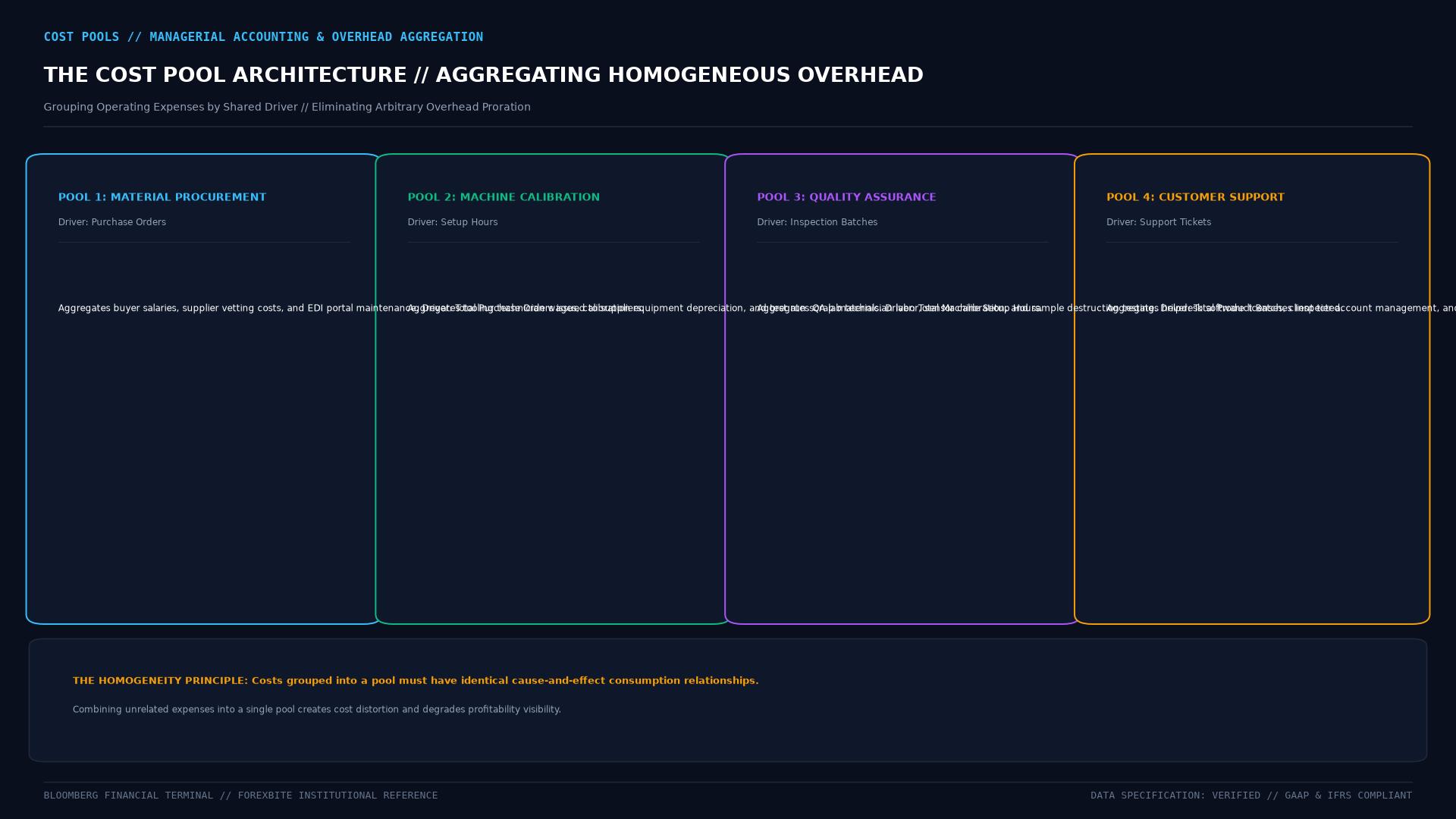 Figure: Two-stage cost allocation framework mapping indirect department expenses into homogeneous activity cost pools before driving them to end products using causal activity rates.
Traditional vs. Activity-Based Cost Pools
The structural evolution of cost pools marks the divide between traditional absorption costing and modern activity-based management:
+------------------------------------+------------------------------------+
| Traditional Cost Pools             | Activity-Based Cost Pools (ABC)    |
+------------------------------------+------------------------------------+
| Plantwide or Departmental:         | Activity-Specific:                 |
| Aggregates all indirect overhead   | Disaggregates overhead into        |
| into a single factory pool or a few| distinct, granular activity centers|
| departmental pools.                | based on business processes.       |
|                                    |                                    |
| Volume-Biased Drivers:             | Causal Drivers:                    |
| Allocates using broad metrics such | Allocates using specific causal    |
| as direct labor hours or machine   | drivers (e.g., number of setups,   |
| runtime hours.                     | material moves, purchase orders).  |
|                                    |                                    |
| Accounting Risk:                   | Accounting Benefit:                |
| Distorts margins by over-costing   | Eliminates cross-subsidization,    |
| high-volume basic items and under- | revealing true individual unit and |
| costing complex customized runs.   | customer profitability.            |
+------------------------------------+------------------------------------+
The Homogeneity Principle in Cost Pool Design
In cost accounting theory, the validity of any cost allocation depends on the homogeneity principle.
A cost pool is strictly defined as homogeneous if all individual cost items within the pool possess the identical or near-identical cause-and-effect relationship with the chosen cost allocation base.
- If machine repair costs and software license fees are dumped into the same pool and allocated based purely on machine operating hours, the pool is non-homogeneous. Software licenses vary with user counts or server instances, not spindle runtime.
- Allocating non-homogeneous pools introduces substantial accounting distortion, leading management to make flawed product discontinuation or pricing decisions.
The Four-Tier Activity Hierarchy
Pioneered by Robin Cooper and Robert Kaplan in Activity-Based Costing, industrial enterprises segment cost pools into a four-level activity hierarchy:
  Hierarchy Level         Cost Pool Example               Typical Allocation Driver
  ──────────────────────────────────────────────────────────────────────────
  Unit-Level Pools        Machine electricity, cutting    Machine hours, direct labor
                          fluid, spinning tool wear       run-time hours

  Batch-Level Pools       Machine setup, production order Purchase orders, setup hours,
                          scheduling, quality lot testing material movement counts

  Product-Sustaining      Engineering change orders, CAD  Product testing hours, bill of
                          tooling design, patent fees     materials (BOM) complexity

  Facility-Sustaining     Plant security, heating and     Direct square footage, plant
                          cooling, building insurance     depreciation base percentage
Categorizing pools into this hierarchy prevents fixed product-sustaining or facility-level overhead from being improperly variableized across individual units.
Mathematical Mechanics: Predetermined Overhead Rates (POHR)
Under standard absorption costing and standard cost accounting systems, companies do not wait until year-end to calculate actual incurred overhead. Instead, they establish a Predetermined Overhead Rate (POHR) before the fiscal year begins:
$$\text{POHR} = \frac{\text{Estimated Total Cost in Cost Pool}}{\text{Estimated Total Activity Units in Allocation Base}}$$
During the operating year, overhead is assigned to inventory as production occurs:
$$\text{Overhead Allocated} = \text{POHR} \times \text{Actual Activity Units Consumed}$$
Numerical Demonstration
A precision casting company establishes a Machine Setup Cost Pool for the upcoming fiscal year:
- Estimated annual setup labor, tooling calibration, and test materials: $600,000.
- Estimated total machine setup hours across all product lines: 3,000 hours.
- $\text{Setup POHR} = \frac{$600,000}{3,000 \text{ hours}} = $200.00 \text{ per setup hour}$.
When Production Job 410 runs, it consumes 15 setup hours to configure the molds: $$\text{Allocated Setup Overhead} = 15 \times $200 = $3,000$$
This $3,000 is debited to Work in Process (WIP) Inventory on the balance sheet alongside direct materials and direct labor.
Under-Applied vs. Over-Applied Overhead Variance Analysis
Because POHRs are calculated using forward-looking estimates, the actual overhead expenses incurred during the year rarely match the total overhead allocated to inventory:
+------------------------------------+------------------------------------+
| Under-Applied Overhead (Debit Bal) | Over-Applied Overhead (Credit Bal) |
+------------------------------------+------------------------------------+
| Condition:                         | Condition:                         |
| Actual overhead incurred exceeds   | Overhead allocated to inventory    |
| overhead allocated to products.    | exceeds actual expenses incurred.  |
|                                    |                                    |
| Economic Meaning:                  | Economic Meaning:                  |
| Production costs were under-costed | Production costs were over-costed  |
| during the interim quarters.       | during the interim quarters.       |
|                                    |                                    |
| GAAP Year-End Resolution:          | GAAP Year-End Resolution:          |
| Closed directly to Cost of Goods   | Closed directly to Cost of Goods   |
| Sold (increasing COGS expense) or  | Sold (reducing COGS expense) or    |
| prorated across inventory pools.   | prorated across inventory pools.   |
+------------------------------------+------------------------------------+
The Proration Method under GAAP/IFRS
If the variance between actual cost pool expenses and allocated overhead is material, accounting standards prohibit closing the entire variance to Cost of Goods Sold. Instead, the variance must be prorated across three accounts based on their ending balances:
- Work in Process (WIP) Inventory
- Finished Goods Inventory
- Cost of Goods Sold (COGS)
This proration ensures that inventory balances reported on the corporate balance sheet do not understate or overstate net realizable asset values.
Frequently Asked Questions
Can an enterprise have too many cost pools?
Yes. Creating excessive numbers of micro-level cost pools leads to high administrative overhead, complex enterprise resource planning (ERP) system maintenance, and employee fatigue from tracking minute operational tasks. Modern cost accounting emphasizes finding the optimal balance between cost accuracy and measurement expense, often utilizing Time-Driven Activity-Based Costing (TDABC) to simplify pool management.
How does service industry cost pooling differ from manufacturing?
In manufacturing, cost pools are absorbed into physical inventory balances on the balance sheet under strict inventory valuation rules. In service firms (such as consulting practices, law firms, and hospitals), cost pools are not capitalized into tangible inventory; instead, they are allocated directly to client engagements or patient service lines to determine billing rates and measure contract profitability.
What is the role of cost pools in corporate budgeting?
Cost pools serve as the foundational units for Activity-Based Budgeting (ABB). Rather than simply adjusting the previous year’s budget by an arbitrary percentage, managers calculate the expected demand for activities, determine the required capacity for each cost pool, and fund resources strictly based on anticipated activity volume.
Ready to trade forex?
Open a free demo account with a regulated broker. Practice with virtual funds before risking real money.