Cost Object
Any designated operational item, product, service, customer, project, contract, or organizational subunit for which monetary costs are accumulated and measured independently.
What is a Cost Object?
A cost object is any identifiable item, business activity, organizational unit, product line, customer account, or capital project for which a separate, independent measurement of monetary cost is desired. In both financial accounting (governed by GAAP and IFRS) and internal managerial accounting, the cost object serves as the focal destination where costs are accumulated, assigned, and analyzed.
Whenever corporate controllers, operational managers, or financial analysts ask the fundamental business question: “How much does X cost?”, the variable represented by “X” is the cost object. Identifying cost objects enables enterprises to set competitive retail prices, identify unprofitable operational units, evaluate vendor contracts, formulate corporate budgets, and determine whether to manufacture components internally or outsource production to offshore suppliers.
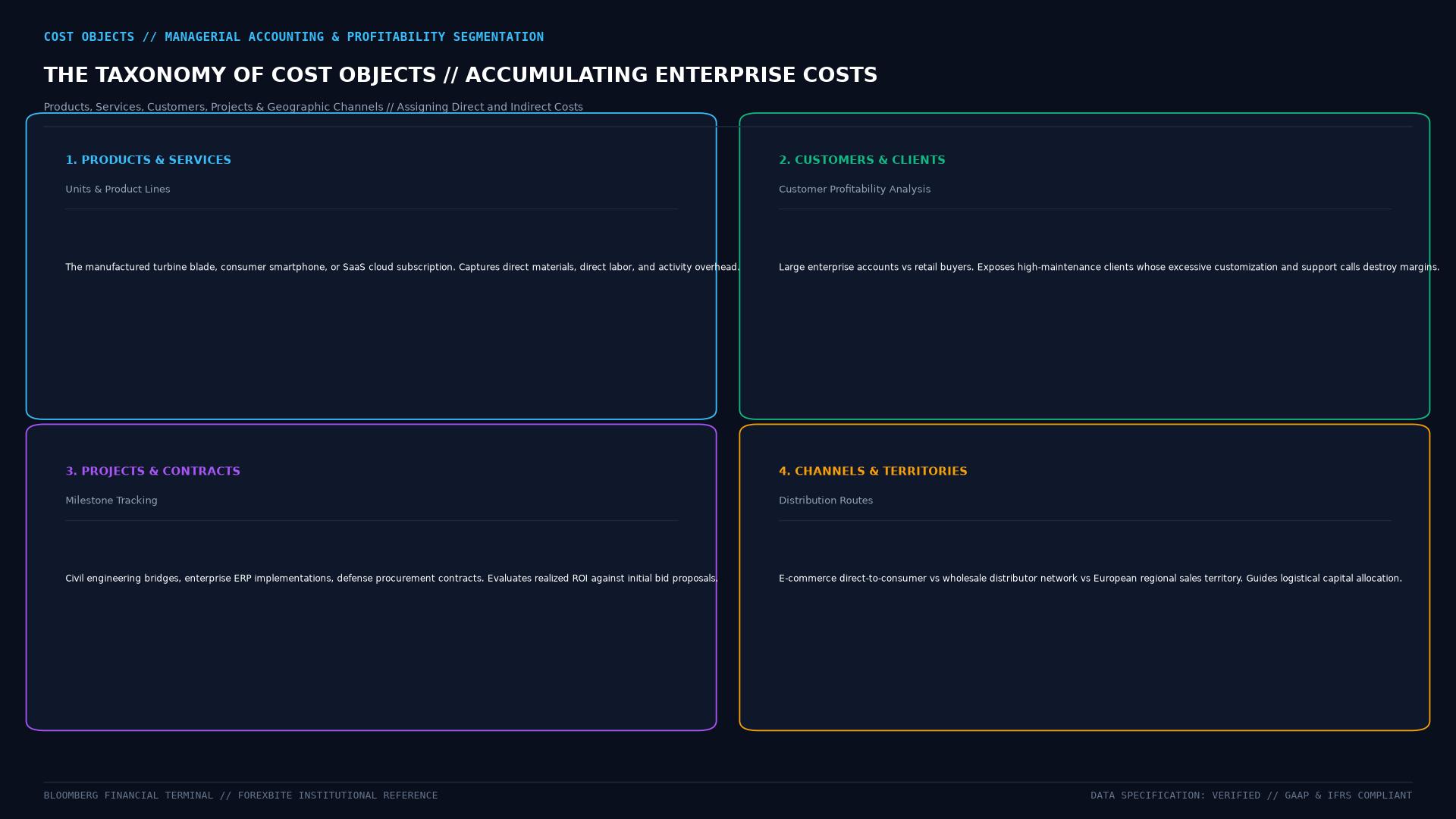 Figure: Cost Object taxonomy across Products, Services, Customers, Projects, and Channels, illustrating Direct Cost tracing, Cause-and-Effect allocation, and Arbitrary overhead allocation.
The Three Primary Categories of Cost Objects
Modern cost management frameworks categorize cost objects into three distinct operational domains:
+------------------------------------+------------------------------------+
| Cost Object Category               | Real-World Commercial Examples     |
+------------------------------------+------------------------------------+
| 1. Output Cost Objects:            | Tangible manufactured products     |
| The most common category in cost   | (automobiles, medical devices,     |
| accounting. Encompasses finished   | microchips), professional services |
| goods and commercial deliverables. | (auditing engagements, legal       |
|                                    | cases), and digital subscriptions. |
|                                    |                                    |
| 2. Operational & Segment Objects:  | Manufacturing plant departments,   |
| Functional units within the firm   | assembly lines, regional sales     |
| evaluated for operational          | branches, corporate IT helpdesks,  |
| efficiency and budget control.     | and distribution warehouse hubs.   |
|                                    |                                    |
| 3. Relationship & Strategic Objects| Specific institutional client      |
| External entities that consume     | accounts, geographic market zones  |
| internal sales, service, and       | (North American sales division),   |
| logistics resources.               | vendor supply chains, and channels.|
+------------------------------------+------------------------------------+
Cost Assignment: Direct Tracing vs. Indirect Allocation
How an expense connects to a cost object dictates the accuracy of managerial accounting reports:
1. Direct Costs (Cost Tracing)
Direct costs are expenditures that can be identified and traced directly to a specific cost object in an economically feasible manner:
- Direct Materials: The aluminum chassis installed into a specific laptop model.
- Direct Labor: The assembly technician hourly wage spent assembling an aircraft engine.
- Direct Project Expenses: The legal filing fee paid exclusively to register a trademark for a specific client.
Because direct tracing relies on physical observation, barcode scanning, and direct labor timesheets, the measurement error for direct costs is virtually zero.
2. Indirect Costs (Cost Allocation)
Indirect costs (commonly termed overhead) are expenditures that benefit multiple cost objects simultaneously and cannot be traced directly to an individual object in an economically feasible manner:
- Factory rent, property taxes, executive salaries, and facility security.
- Shared cloud server infrastructure hosting multiple software applications.
To assign indirect costs to a cost object, accountants must utilize an allocation base (such as direct machine hours) or implement Activity-Based Costing (ABC) cost object drivers that establish a causal link between the object and resource consumption:
$$\text{Total Cost of Cost Object} = \text{Direct Costs} + \sum (\text{Activity Driver Consumption} \times \text{Driver Rate})$$
Managerial Decision-Making Applications
The measurement of cost objects drives strategic corporate decisions:
1. The Make-or-Buy Decision (Outsourcing Analysis)
When an enterprise evaluates whether to manufacture a subcomponent internally or purchase it from an external supplier, the cost object is the component part.
- Controllers analyze avoidable costs tied directly to the cost object (direct materials, direct labor, and variable overhead).
- Unavoidable fixed overhead (such as corporate executive salaries or factory mortgage payments that persist regardless of the decision) is stripped out of the analysis to isolate the true marginal cost of internal production.
2. Product Line Discontinuation (Segment Reporting)
Under GAAP and IFRS segment reporting guidelines, companies evaluate entire product lines as cost objects. If Product Line C shows an operating net loss on the income statement, management must determine whether the product generates a positive contribution margin:
$$\text{Contribution Margin} = \text{Revenue} - \text{Variable Costs Directly Traced to Cost Object}$$
If Product Line C yields a positive contribution margin that helps cover corporate common fixed costs, discontinuing the product line would eliminate the revenue while leaving fixed overhead intact, reducing overall corporate net income.
  Product Line Contribution Analysis Example
  ──────────────────────────────────────────────────────────────────────────
  Line Revenue:                      $2,000,000
  Less Direct Variable Costs:       -$1,400,000 (Materials, direct labor, packaging)
  ──────────────────────────────────────────────────────────────────────────
  Contribution Margin:                 $600,000 (Positive cash generated!)
  Less Allocated Corporate Overhead:-$800,000 (Rent, CEO salary, legal retained)
  ──────────────────────────────────────────────────────────────────────────
  Reported Accounting Loss:           -$200,000 (Misleading signal to drop line!)
Dropping this product line would eliminate the $600,000 cash contribution while the $800,000 in corporate overhead remains, increasing the enterprise net loss by $600,000.
Strategic Shift: From Products to Customers as Cost Objects
Historically, businesses focused almost exclusively on physical products as cost objects. In the modern service and software economy, enterprises treat individual customers as the primary cost object.
Customer Cost Accounting reveals that two customers purchasing an identical $500,000 order can generate vastly different net profit margins:
- Customer A: Orders standard configurations online, accepts standard delivery schedules, pays invoices within 10 days, and requires zero post-sale technical support.
- Customer B: Demands custom engineering modifications, requests rush freight deliveries, disputes billing invoices, delays payment for 120 days, and consumes hundreds of hours of customer support engineering.
By treating Customer B as a distinct cost object, corporate leadership can measure the true cost-to-serve, renegotiating service level agreements (SLAs) or implementing fee surcharges to eliminate margin leakage.
Frequently Asked Questions
Can an item be both a direct cost and an indirect cost simultaneously?
Yes. The classification of an expense as direct or indirect depends entirely on the specific cost object chosen for analysis. The salary of a production department supervisor is an indirect cost with respect to individual product units produced in the department (because the supervisor oversees all products). However, that identical salary is a direct cost with respect to the department itself as the cost object.
What is a cost pool in relation to a cost object?
A cost pool is an intermediate holding account that aggregates related indirect costs before they are allocated to final cost objects. For instance, an enterprise might collect all building maintenance, heating, and property insurance costs into a “Facilities Cost Pool”, which is subsequently allocated to cost objects using square footage as the allocation driver.
How does life-cycle costing treat a cost object?
Traditional financial accounting tracks product costs solely within the calendar fiscal year of production. Life-cycle costing tracks a product cost object across its entire operational lifespan, including pre-production research and development (R&D), production tooling, distribution, marketing, and post-sale warranty support and environmental disposal costs.
Ready to trade forex?
Open a free demo account with a regulated broker. Practice with virtual funds before risking real money.