COU
The ISO 4217 code for the Unidad de Valor Real (UVR), Colombia's official inflation-indexed accounting currency unit used to stabilize long-term mortgage contracts and sovereign debt.
What is the COU (Unidad de Valor Real)?
COU is the three-letter international currency code designated under ISO 4217 for the Unidad de Valor Real (UVR), an official inflation-indexed unit of account and constant-value currency utilized in the Republic of Colombia. Unlike the standard circulating legal tender, the Colombian Peso (COP), the COU does not exist as physical coins or paper banknotes. Instead, it operates as an administrative accounting currency whose value in Colombian Pesos is calculated and published daily by the Banco de la República (Colombia central bank) based on certified changes in the national Consumer Price Index (IPC).
Established under Law 546 of December 23, 1999 (the landmark Housing Framework Law / Ley Marco de Vivienda), the UVR was designed to restore macroeconomic stability to Colombia residential mortgage market following the total collapse of the predecessor indexing system during the late 1990s financial crisis. In modern capital markets, the COU serves as the structural foundation for long-term home mortgage lending, infrastructure project financing, and the issuance of sovereign inflation-protected government bonds (TES UVR).
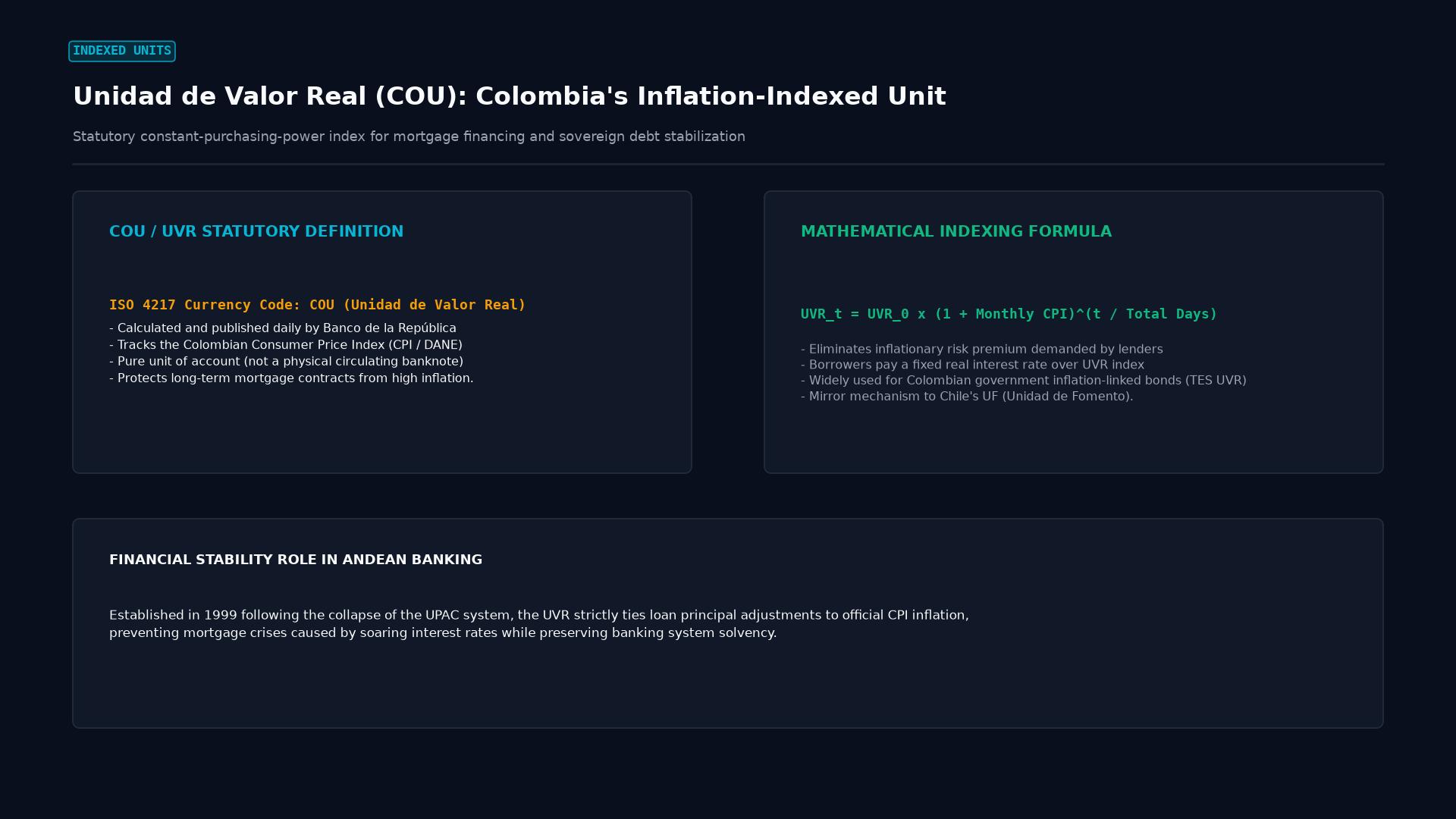 Figure: Indexed purchasing power: daily CPI-indexed UVR unit of account protecting mortgage lending and Colombian sovereign TES UVR bond debt from inflation.
Historical Origins: The Collapse of the UPAC System
To understand why Colombia created the COU / UVR, examine the failure of its predecessor, the UPAC (Unidad de Poder Adquisitivo Constante) system.
Created in 1972, the UPAC system initially tied housing loan balances to the cost of living. However, in 1993, regulatory authorities altered the mathematical formula, linking the UPAC index directly to the DTF (Depósito a Término Fijo), a short-term commercial bank fixed-deposit interest rate reflecting interbank market liquidity rather than pure consumer price inflation.
  The Anatomy of the 1998–1999 Colombian Mortgage Crisis
  ──────────────────────────────────────────────────────────────────────────
  1. Contagion from the 1998 Asian and Russian financial crises triggered
     massive capital flight from Latin American emerging markets.

  2. To defend the Colombian Peso exchange band, Banco de la República
     spiked interbank interest rates past 70% to 80%.

  3. Because UPAC was linked to the market DTF rate, mortgage debt balances
     exploded upward overnight, doubling and tripling homeowner obligations.

  4. Hundreds of thousands of middle-class families defaulted; housing
     prices collapsed by 30% to 40%, leaving borrowers in negative equity.

  5. The Colombian Constitutional Court intervened, ruling the DTF-linked UPAC
     unconstitutional and ordering the complete restructuring of the housing finance sector.
In response to this systemic banking collapse, Congress passed Law 546 of 1999, terminating the UPAC and creating the Unidad de Valor Real (UVR / COU), legally anchoring its calculation strictly to consumer inflation to prevent market interest rates from ever distorting mortgage balances again.
Mathematical Formulation of the UVR Daily Value
The Banco de la República updates and publishes the daily conversion rate of the UVR for each calendar day of the month.
The daily calculation utilizes the percentage change in the Consumer Price Index (IPC) certified by the national statistical agency (DANE) for the immediately preceding calendar month:
$$\text{UVR}t = \text{UVR}{t-1} \times (1.0 + \text{IPC}_m)^{\frac{1}{d}}$$
Where:
- $\text{UVR}_t$ is the value of the UVR on day $t$.
- $\text{UVR}_{t-1}$ is the value on the preceding day.
- $\text{IPC}_m$ is the monthly inflation rate of the preceding reference month expressed as a decimal.
- $d$ is the actual number of calendar days in the current adjustment period (typically 30 or 31 days).
If monthly inflation for March is certified at 0.60% (0.006) and the upcoming calculation month has 30 days, the daily multiplying geometric factor is:
$$\text{Daily Factor} = (1.0 + 0.006)^{\frac{1}{30}} = (1.006)^{0.03333} \approx 1.0001993$$
Each day, the peso value of one COU expands by approximately 0.01993%, ensuring a smooth, predictable daily adjustment that mirrors official cost-of-living increases without abrupt payment shocks.
Core Financial Market Applications
The COU functions as a vital instrument across two primary pillars of the Colombian financial system:
+------------------------------------+------------------------------------+
| Financial Market Pillar            | Structural Operational Role        |
+------------------------------------+------------------------------------+
| 1. Residential Mortgage Lending:   | Home loans are denominated directly|
| Protecting borrowers and banks.    | in UVR. The borrower pays a fixed  |
|                                    | real interest spread (e.g., UVR +  |
|                                    | 7.50%), preserving bank capital    |
|                                    | while keeping initial monthly      |
|                                    | payments affordable for buyers.    |
|                                    |                                    |
| 2. Sovereign TES UVR Bonds:        | The Ministry of Finance issues     |
| Inflation-protected public debt.   | sovereign debt denominated in UVR. |
|                                    | The bonds provide domestic pension |
|                                    | funds (AFPs) with guaranteed real  |
|                                    | returns matching future liabilities|
+------------------------------------+------------------------------------+
Contrast: UVR Mortgages vs. Fixed-Peso Mortgages
In Colombia, homebuyers choose between two distinct mortgage financing structures:
- Fixed-Rate Peso Mortgage: The nominal interest rate remains constant (e.g., 14.0% in COP) across the 15-year or 20-year term. However, because the bank must price in long-term inflation risk, the initial monthly payments are high, disqualifying lower-income applicants with strict Debt-to-Income (DTI) caps.
- UVR-Indexed Mortgage: The borrower commits to a low real interest rate (e.g., UVR + 6.0%). The initial monthly cash payments are substantially lower, enabling young professionals and low-income families to qualify for homeownership. The peso amount owed adjusts upward annually with general inflation.
The Chilean Parallel: COU vs. UF (Unidad de Fomento)
Colombia’s UVR was directly modeled after Chile’s famous Unidad de Fomento (UF / CLF) created in 1967:
  Metric                Colombia (COU / UVR)                          Chile (CLF / UF)
  ──────────────────────────────────────────────────────────────────────────
  Creation Year         1999 (Law 546)                                1967 (Decree 1270)
  Governing Agency      Banco de la República                         Banco Central de Chile
  Inflation Anchor      DANE Consumer Price Index (IPC)               INE Consumer Price Index (IPC)
  Scope of Usage        Primarily mortgages, social housing,          Universal: Used for rent, tuition,
                        sovereign bonds (TES), and civil suits        medical plans, and commercial leases
  Economic Effect       De-risked housing banking sector              Near-complete indexation of economy
While Chile’s economy became deeply indexed across almost all commercial contracts (university tuition, mobile phone plans, commercial leases), Colombia deliberately restricted the UVR primarily to housing finance and sovereign debt to avoid creating broad structural inflation inertia.
Frequently Asked Questions
Can an investor hold a bank account denominated directly in COU?
Yes. Colombian commercial banks offer specialized savings accounts and Certificate of Deposit (CDT) accounts denominated in UVR. The deposited principal balance is adjusted daily to reflect inflation, and the bank pays an additional fixed real annual interest percentage, guaranteeing that the depositor’s purchasing power does not erode.
What happens to a UVR mortgage during periods of deflation?
If Colombia experiences negative monthly inflation (deflation), the DANE IPC figure is negative. Under the mathematical formula, the daily compounding factor drops below 1.0, causing the peso value of the UVR to decline. Consequently, during deflationary periods, a borrower outstanding mortgage principal and monthly peso payment decrease.
Why do institutional pension funds in Colombia heavily buy TES UVR bonds?
Pension fund administrators (Administradoras de Fondos de Pensiones / AFPs) and life insurance companies manage retirement annuity liabilities that must pay inflation-adjusted monthly pensions to retirees for decades. Investing in sovereign TES UVR bonds creates an asset-liability match, guaranteeing that bond cash flows expand alongside inflation, eliminating longevity and inflation mismatch risks.
Ready to trade forex?
Open a free demo account with a regulated broker. Practice with virtual funds before risking real money.