CRC
The ISO 4217 currency code for the Costa Rican Colón, the official legal tender of the Republic of Costa Rica, regulated by the Banco Central de Costa Rica.
What is the CRC (Costa Rican Colón)?
CRC is the three-letter international currency code assigned under ISO 4217 to the Costa Rican Colón, the official legal tender and national currency of the Republic of Costa Rica. Represented domestically by the currency symbol ₡ and nominally subdivided into 100 céntimos (though inflation has phased out céntimos from circulation), the currency was created in 1896, replacing the Costa Rican Peso and named in honor of Christopher Columbus (Cristóbal Colón).
The Banco Central de Costa Rica (BCCR), established under statutory law in 1950 with headquarters in San José, functions as the sole issuing authority for banknotes and coinage while steering national monetary and exchange rate policy.
In global emerging market finance, the Costa Rican Colón occupies a distinctive profile. Unlike many regional neighbors that rely heavily on primary commodity extraction or raw agricultural exports, Costa Rica transformed its economy into a high-technology manufacturing and corporate services hub. Consequently, the foreign exchange dynamics of the USD/CRC currency pair are driven by medical device exports, multinational corporate investment flows, software engineering centers, and an expansive eco-tourism sector.
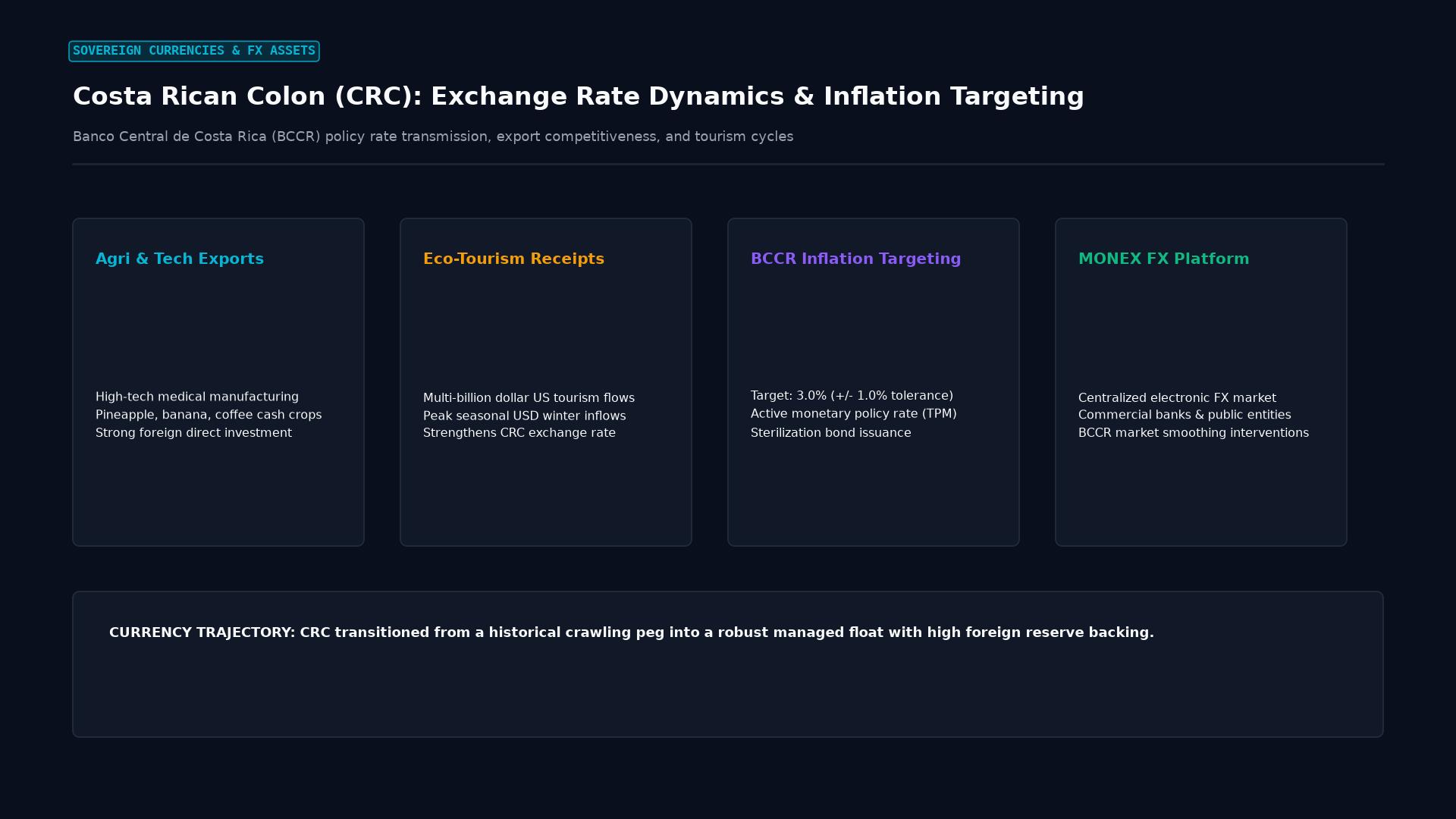 Figure: Central American macro drivers: high-tech medical device manufacturing and tourism inflows strengthening CRC within BCCR’s inflation-targeting band.
Evolution of the Exchange Rate Regime
The monetary framework governing the Costa Rican Colón has undergone three distinct policy evolutions over the past four decades:
+------------------------------------+------------------------------------+
| Historical Period                  | Exchange Rate Mechanism            |
+------------------------------------+------------------------------------+
| 1984–2006:                         | BCCR implemented predictable daily |
| The Crawling Peg (Minidevaluaciones)| mini-devaluations to match the     |
| regime.                            | inflation differential between the |
|                                    | domestic economy and the US.       |
|                                    |                                    |
| 2006–2015:                         | Established crawling floor and     |
| The Exchange Rate Band             | ceiling intervention boundaries,   |
| (Banda Cambiaria).                 | gradually widening the corridor to |
|                                    | introduce market pricing risk.     |
|                                    |                                    |
| 2015–Present:                      | The BCCR abandoned the bands,      |
| The Managed Floating Regime        | permitting supply and demand to set|
| (Flotación Administrada).          | the rate inside the MONEX market   |
|                                    | with discretionary stabilization.  |
+------------------------------------+------------------------------------+
Under the current managed float regime, the BCCR intervenes in the wholesale foreign exchange market primarily to counter erratic speculative swings or accumulate reserve assets, rather than defending an arbitrary nominal price target.
The MONEX Wholesale Foreign Exchange Market
In Costa Rica, all significant wholesale foreign exchange transactions execute on an electronic platform known as MONEX (Mercado de Monedas Extranjeras):
- Governance: Owned, operated, and supervised directly by the Banco Central de Costa Rica.
- Participants: Authorized commercial banks, mutual fund administrators, licensed currency exchange bureaus, and large multinational corporations with central bank authorization.
- Reference Rate Determination: At the close of each trading day, the BCCR calculates the official Tipo de Cambio de Referencia (Reference Exchange Rate) by computing the volume-weighted average price of all spot USD/CRC transactions executed on MONEX during the session.
Commercial retail banks use this reference rate to establish their daily retail over-the-counter buying and selling spreads for retail businesses and consumers.
Economic Engines: From Agriculture to Medical Technology
Historically, the valuation of the Colón shadowed global commodity cycles for coffee, bananas, and sugar. Over the last twenty-five years, state-sponsored industrial policy transformed the trade balance:
  Economic Pillar             Gross Export Contribution     Foreign Exchange Impact
  ──────────────────────────────────────────────────────────────────────────
  Medical Devices & Tech:     Over 35% to 40% of total      Massive structural corporate
  Free Trade Zones (FTZ)      merchandise exports           dollar inflows for local payroll

  Business Services & IT:     Over $6 billion annually      Multinational shared service
  Software, consulting, BPO   in service exports            centers converting USD to CRC

  Eco-Tourism & Travel:       Over $4 billion annually      Sustained seasonal retail dollar
  Biodiversity & hospitality  in direct tourist spending    liquidity across coastal regions

  Agricultural Goods:         Approximately 15% of exports  Traditional baseline exports
  Pineapples, coffee, bananas                               cushioning external shocks
Multinational corporations operating in Free Trade Zones (such as Intel, Medtronic, Boston Scientific, and Abbott Laboratories) import components duty-free and invoice exports in US Dollars. To pay local employee wages, social security contributions, utilities, and domestic suppliers, these companies must sell hundreds of millions of dollars on MONEX each month, creating continuous structural demand for the Costa Rican Colón.
Dual Currency Dynamics and Financial De-Dollarization
A prominent vulnerability within the Costa Rican banking architecture is financial dollarization.
Following decades of historical inflation in the late 20th century, many Costa Rican citizens and local commercial firms chose to take loans and maintain savings in US Dollars:
- The Currency Mismatch Risk: Borrowers whose income is denominated entirely in Colones (such as local retail employees or public servants) took US Dollar-denominated home mortgages to take advantage of lower nominal interest rates.
- Systemic Vulnerability: If the Colón experiences a sharp, sudden depreciation against the dollar, the debt service burden on these unhedged borrowers surges in local currency terms, threatening bank solvency with non-performing loans (NPLs).
To counteract this vulnerability, the BCCR and the banking superintendent (SUGEF) implemented macroprudential de-dollarization rules:
- Imposing higher regulatory capital requirements and higher loss reserves on commercial banks extending foreign currency credit to non-dollar earners.
- Maintaining higher reserve requirement ratios on foreign currency deposits compared to domestic Colón deposits.
- Conducting public educational campaigns discouraging unhedged retail borrowers from taking USD debt.
Frequently Asked Questions
Can tourists spend US Dollars directly in Costa Rica?
Yes. US Dollars are widely accepted in hotels, major restaurants, rental car agencies, and supermarkets across tourist areas in Costa Rica. However, change for transactions is almost universally given in Costa Rican Colones, often calculated using a retail exchange rate that includes a service margin favorable to the merchant. For local markets, bus transit, and street dining, paying in Colones avoids unfavorable retail conversions.
What is the Sinpe Móvil system in Costa Rica?
Sinpe Móvil is Costa Rica’s national, real-time electronic retail payment network developed by the BCCR. Linked directly to bank accounts and mobile phone numbers, Sinpe Móvil allows citizens and small merchants to execute instantaneous, fee-free money transfers in Colones across any commercial bank or cooperative in the country, dramatically reducing the use of physical cash.
Why did the Costa Rican Colón appreciate significantly between 2022 and 2024?
Between 2022 and 2024, the Colón experienced a historic surge against the US Dollar, becoming one of the strongest emerging market currencies in the world. This appreciation was driven by a record influx of foreign direct investment into Free Trade Zones, a rapid post-pandemic rebound in international tourism, high domestic interest rates set by the BCCR to crush post-pandemic inflation, and an aggressive fiscal reform program that attracted foreign bond portfolio investments.
Ready to trade forex?
Open a free demo account with a regulated broker. Practice with virtual funds before risking real money.