Cross Subsidy
A financial pricing practice where the profits generated from one product line, business segment, or customer demographic are intentionally or unintentionally used to cover the losses or artificial price reductions of another.
What is a Cross Subsidy?
A cross subsidy occurs when an enterprise, public utility, or government authority utilizes the surplus profits generated by one profitable product, service line, or customer demographic to absorb the losses, lower the consumer prices, or fund the operating costs of an unprofitable offering. In corporate finance, economics, and antitrust law, cross-subsidization can be executed either as an intentional corporate strategy (such as loss-leader pricing or platform monetization) or as an unintentional operational error caused by flawed cost accounting systems.
Whether mandated by public regulatory bodies to guarantee universal access to essential infrastructure (like postal delivery or rural electricity grids) or weaponized by corporate conglomerates to subsidize predatory pricing tactics against single-product competitors, cross-subsidies alter competitive market equilibrium. Understanding the mechanics of cross-subsidization is essential for equity analysts evaluating corporate margin durability, utility commissioners establishing tariff rates, and corporate controllers auditing true product profitability.
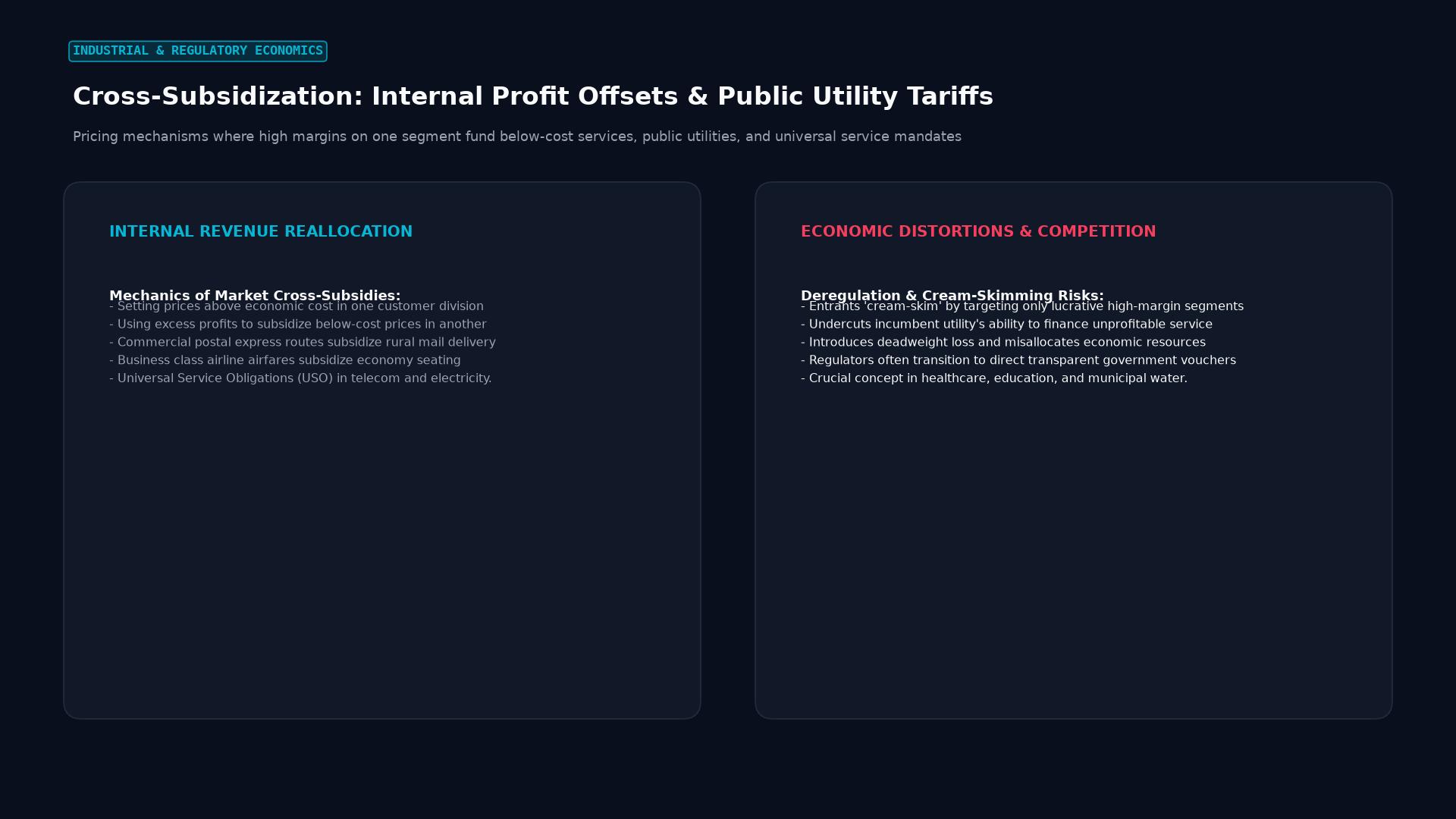 Figure: Pricing mechanisms where high margins on one segment fund below-cost services, public utilities, and universal service mandates
The Three Primary Arenas of Cross-Subsidization
Cross-subsidization manifests across distinct economic environments:
+------------------------------------+------------------------------------+
| Economic Environment               | Commercial & Structural Mechanism  |
+------------------------------------+------------------------------------+
| 1. Public Utilities & Regulated    | Regulators mandate a uniform tariff|
| Monopolies: Universal Service      | across all citizens. High-density  |
| Obligations (USO).                 | urban areas generate heavy profits |
|                                    | that subsidize high-cost, remote   |
|                                    | rural power and water connections. |
|                                    |                                    |
| 2. Corporate Strategy & Two-Sided  | Companies deliberately sell a base |
| Platforms: Freemium & Razor/Blades.| product at a loss (video game      |
|                                    | consoles, printers, search engines)|
|                                    | to capture users, cross-subsidized |
|                                    | by proprietary games, ink, or ads. |
|                                    |                                    |
| 3. Unintentional Cost Accounting:  | Traditional volume-based overhead  |
| Flawed absorption costing.         | allocation over-costs high-volume  |
|                                    | basic products, artificially cross-|
|                                    | subsidizing complex niche goods.   |
+------------------------------------+------------------------------------+
Public Utility Regulation: Universal Service Obligations and Cream-Skimming
In public economics, governments historically granted legal monopoly franchises to telecommunications, electricity, and postal providers in exchange for a statutory Universal Service Obligation (USO).
Under a USO, the utility must provide services to all geographic regions at a uniform price, regardless of underlying cost differences:
- Delivering a first-class letter across two blocks in downtown Manhattan costs the postal carrier $0.15, but generates $0.70 in postage.
- Delivering that identical letter to a remote mountain cabin in Alaska costs the carrier $12.00, but the customer still pays only $0.70.
The massive profit margins earned in high-density urban corridors cross-subsidize the operating losses of rural routes.
The Threat of “Cream-Skimming” (Cherry-Picking)
When governments deregulate an industry that relies on regulatory cross-subsidies, new private commercial entrants do not attempt to serve the entire market. Instead, they engage in cream-skimming (or cherry-picking):
- The new competitor enters solely the lucrative, high-margin urban corridors, undercutting the legacy utility by offering lower rates while ignoring rural routes.
- The legacy utility loses its profitable urban customer base, depriving it of the surplus profits required to subsidize its mandatory rural obligations.
- The cross-subsidy collapses, forcing the government to either provide direct taxpayer subsidies or permit the utility to abandon rural services.
Economic Test: The Faulhaber Stand-Alone Cost Framework
In regulatory economics and antitrust litigation, economists evaluate whether cross-subsidization is present using the formal test developed by Gerald Faulhaber (1975).
A product or service ($i$) is defined as receiving a cross-subsidy if its generated revenues ($R_i$) fail to cover its incremental cost ($IC_i$), which is the additional cost the firm incurs to produce that service on top of all its other offerings:
$$R_i < IC_i \quad \Longleftrightarrow \quad \text{Service } i \text{ is Subsidized}$$
Conversely, a customer class ($j$) is being exploited to provide a cross-subsidy if the revenues extracted from that group ($R_j$) exceed the stand-alone cost ($SAC_j$), which is the total cost a specialized firm would incur to serve only that group independently:
$$R_j > SAC_j \quad \Longleftrightarrow \quad \text{Customer Class } j \text{ is Subsidizing Others}$$
In a contestable, fair market, prices for any bundle of services must sit within the core boundary:
$$IC_S \le R_S \le SAC_S$$
If revenue falls below incremental cost, the product is predatory or economically parasitic; if revenue exceeds stand-alone cost, the seller is exercising monopoly power to extract rents.
Platform Economics and the Razor-and-Blades Strategy
In modern corporate strategy, cross-subsidization is a fundamental design principle for multi-sided platforms and ecosystem business models:
  Business Model       Subsidized Loss-Leader Product        Profitable Cross-Subsidizer
  ──────────────────────────────────────────────────────────────────────────
  Video Gaming         Gaming Hardware Consoles (PlayStation 5, Digital Software Store Royalties
                       Xbox Series X) sold at negative margins (30% cut on all game downloads)

  Printing Hardware    Consumer Inkjet Printers sold at a loss Proprietary Micro-Chipped Ink
                       for $49.00                            Cartridges priced at $65.00

  Digital Freemium     Free Ad-Free Cloud Storage Tier up to   Enterprise Corporate Storage
                       15 GB provided at zero consumer cost    Licenses and Workspace Subscriptions

  Two-Sided Media      Free Internet Search Engine or Social   Corporate Programmatic Ad Auctions
                       Media Network provided to end users     extracting ad revenue
The corporate objective is to lower the barrier to adoption for the price-sensitive side of the market (the consumer), creating network effects that increase the willingness to pay of the commercial side (advertisers, software developers, corporate buyers).
The Accounting Distortion: Hidden Internal Cross-Subsidies
In corporate manufacturing, unintentional cross-subsidies represent a silent threat to profitability. When a company uses traditional absorption costing, it spreads overhead based on direct labor or machine hours.
Consider a factory producing two industrial pumps:
- Pump Standard: Produced in batches of 10,000 units. Requires standard tooling, minimal engineering attention, and zero custom quality inspections.
- Pump Custom: Produced in specialized batches of 50 units. Requires eight hours of machine teardown, custom engineering reprogramming, and three separate stress tests.
Because Pump Standard consumes 85% of total factory machine hours, traditional accounting dumps 85% of total factory overhead onto Pump Standard. In reality, Pump Custom consumed 70% of the engineering and setup labor:
- Pump Standard is over-costed, appearing to have a tiny 5% profit margin when its true operational margin is 35%.
- Pump Custom is under-costed, appearing to yield a 40% margin when it is hemorrhaging cash on every unit sold.
The high-volume standard product cross-subsidizes the customized product. When a lean competitor enters the market producing only Pump Standard at a 20% discount, the original company cannot understand how the competitor stays solvent, eventually losing its most profitable business line. Implementing Activity-Based Costing (ABC) uncovers and eliminates these hidden cross-subsidies.
Frequently Asked Questions
Is cross-subsidization legal under antitrust laws?
Internal cross-subsidization between products is generally legal unless it crosses into predatory pricing under Section 2 of the Sherman Act or Article 102 of the Treaty on the Functioning of the European Union (TFEU). If a dominant corporate monopoly uses monopoly profits from one market to price below its average variable cost in another market with the specific intent of driving competitors out of business and subsequently raising prices, regulators can file antitrust enforcement actions.
How does cross-subsidization operate in the healthcare sector?
In commercial healthcare systems (such as in the United States), commercial private health insurance reimbursements cross-subsidize government programs (like Medicaid and Medicare) and uncompensated emergency care. Hospitals negotiate higher reimbursement rates with private commercial insurers for routine surgical procedures and diagnostic imaging to offset financial losses incurred while treating uninsured trauma patients.
What is the difference between price discrimination and cross-subsidization?
Price discrimination involves charging different prices to different customer segments for an identical good based on differences in their price elasticity of demand (such as student discounts for movie tickets), with all prices remaining above marginal cost. Cross-subsidization involves pricing one good below its incremental cost of production, requiring surplus profits from another product line to prevent overall corporate losses.
Ready to trade forex?
Open a free demo account with a regulated broker. Practice with virtual funds before risking real money.