CVE
The ISO 4217 currency code for the Cape Verdean Escudo, the official legal tender of the Republic of Cabo Verde, pegged to the Euro via a bilateral exchange accord with Portugal.
What is the CVE (Cape Verdean Escudo)?
CVE is the three-letter international currency code assigned under ISO 4217 to the Cape Verdean Escudo (escudo cabo-verdiano), the official national currency and legal tender of the Republic of Cabo Verde. Represented domestically by the cifrão symbol (a dollar sign with two vertical strokes: $\text{Esc}$ or $\text{S\kern-0.2em\rule[0.3ex]{0.1em}{1.5ex}}$) and nominally divided into 100 centavos (though coins in centavos have been retired due to historical inflation), the currency is issued and regulated by the Banco de Cabo Verde (BCV), headquartered in Praia on the island of Santiago.
In international foreign exchange and development macroeconomics, the Cape Verdean Escudo is recognized as one of the most stable currencies in West Africa. Unlike most regional neighbors whose exchange rates float or suffer severe currency devaluations, the CVE operates under an institutional fixed exchange rate regime anchored directly to the single European currency. By treaty, the Escudo is locked at the permanent parity of:
$$1.00 \text{ EUR} = 110.265 \text{ CVE}$$
This parity anchors domestic price stability, eliminates currency volatility for European tourists, and secures the purchasing power of diaspora remittances sent home by Cape Verdean emigrant communities.
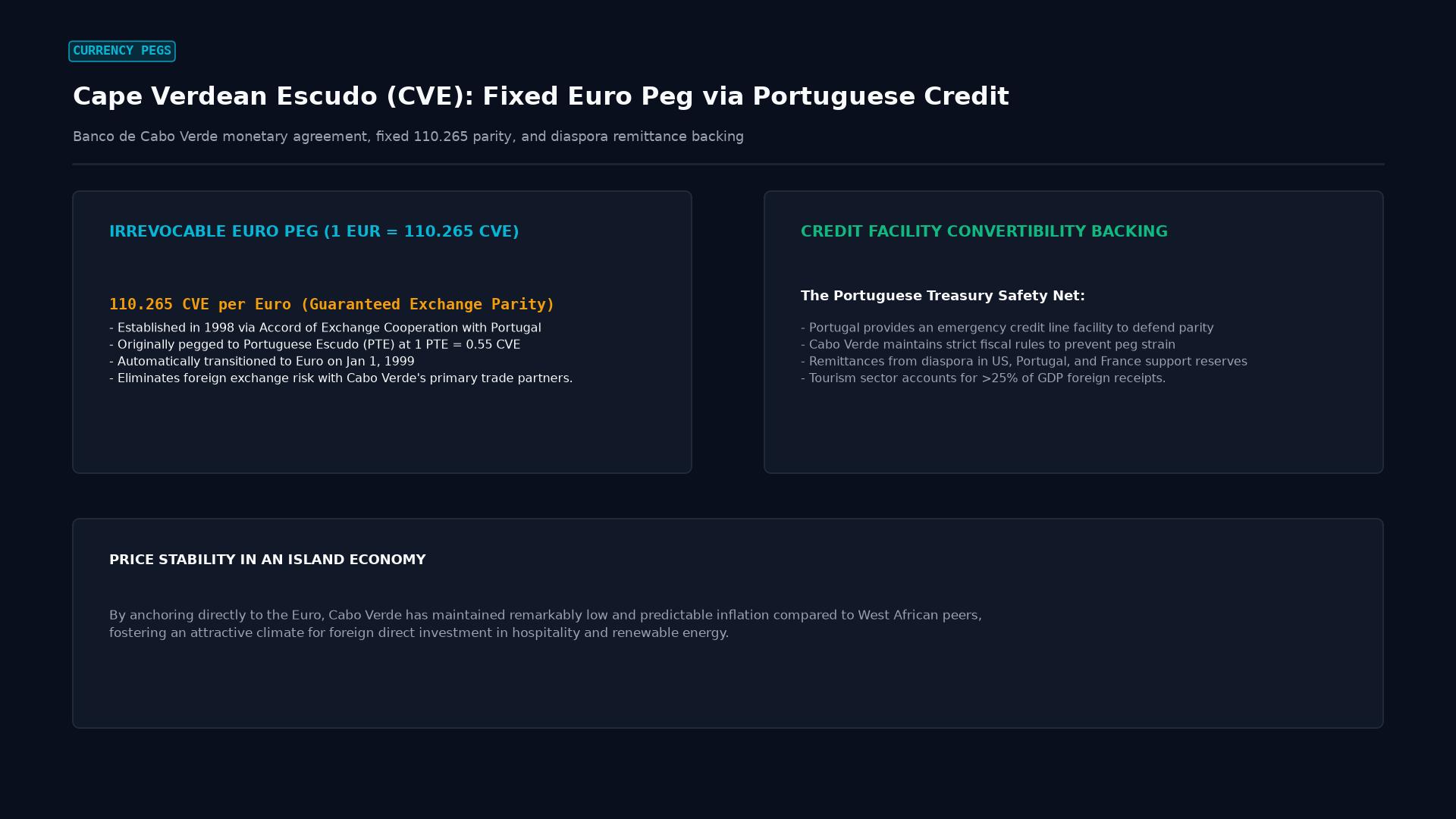 Figure: Exchange cooperation accord: 110.265 CVE fixed Euro parity defended by Portuguese Treasury credit facilities and diaspora remittance backing.
The 1998 Exchange Cooperation Accord (ACC)
The bedrock of the Cape Verdean monetary system is the Acordo de Cooperação Cambial (ACC), a bilateral treaty signed between the Republic of Cabo Verde and the Republic of Portugal on March 13, 1998.
Historical Context and Creation
Following independence from Portugal in 1975, Cabo Verde initially maintained an exchange rate pegged to a basket of trade currencies. In the 1990s, fiscal deficits and balance-of-payments shortfalls depleted foreign reserves, threatening national import capacity.
To anchor macroeconomic stability, Cabo Verde negotiated a formal currency cooperation treaty with its former colonial partner:
- In mid-1998, the Escudo was initially pegged to the Portuguese Escudo (PTE) at the rate of $1.00 \text{ PTE} = 0.55 \text{ CVE}$.
- When Portugal joined the Eurozone on January 1, 1999, adopting the Euro as its sovereign currency, the bilateral peg converted automatically to the official Euro-Escudo conversion rate ($200.482 \text{ PTE} = 1.00 \text{ EUR}$):
$$1.00 \text{ EUR} = \frac{200.482 \text{ PTE}}{1.00 \text{ EUR}} \times \frac{0.55 \text{ CVE}}{1.00 \text{ PTE}} = 110.265 \text{ CVE}$$
The Portuguese Treasury Credit Facility
Unlike unilateral currency pegs that collapse when speculative runs exhaust central bank reserves, the Cape Verdean peg is reinforced by a sovereign institutional guarantee.
Under the ACC, the Portuguese Ministry of Finance maintains a standing, revolving Credit Line Facility (Linha de Crédito de Apoio Cambial) in favor of the Banco de Cabo Verde:
- If severe external shocks (such as a global tourism collapse or a surge in international oil prices) drain BCV foreign reserves toward critical thresholds, the central bank can draw down the Portuguese Treasury credit facility to settle external import invoices.
- In exchange for this financial backstop, the ACC established a joint macroeconomic monitoring committee (Comissão do Acordo de Cooperação Cambial / COMACC), which reviews Cabo Verde fiscal discipline, public debt limits, and monetary policy twice a year in Lisbon and Praia.
+------------------------------------+------------------------------------+
| Advantages of the Euro Peg         | Structural Macroeconomic Trade-Offs|
+------------------------------------+------------------------------------+
| Eliminates foreign exchange risk   | Complete surrender of independent  |
| for European tourists and airlines.| monetary policy (BCV must shadow   |
|                                    | European Central Bank rate moves). |
|                                    |                                    |
| Keeps domestic inflation low by    | Peg overvaluation risk: When the   |
| anchoring import price baselines   | Euro rallies against the US Dollar,|
| directly to Eurozone CPI.          | Cape Verdean exports become dearer.|
|                                    |                                    |
| Fosters investor confidence in     | Requires strict exchange controls  |
| domestic commercial banks.         | on outward resident capital flows. |
+------------------------------------+------------------------------------+
Macroeconomic Drivers: Remittances and Tourism
As an arid volcanic archipelago comprising ten islands with scarce arable land and no mineral wealth, Cabo Verde has an economy structured around international service inflows:
  Economic Pillar             Share of External Receipts     Macroeconomic Function
  ──────────────────────────────────────────────────────────────────────────
  Diaspora Remittances:       Approximately 10% to 15%       Sent by over 500,000 Cape Verdeans
  Portugal, USA, France, NL   of national GDP                living abroad to support families

  Leisure Eco-Tourism:        Approximately 20% to 25%       Major European resort operators
  Sal and Boa Vista Islands   of national GDP                generating direct Euro receipts

  Foreign Aid & Concessions:  Multilateral capital flows     Finances desalination plants,
  World Bank, EU, AfDB        and grants                     harbors, and solar electricity

  Merchandise Imports:        Over 80% of domestic food,     Heavy structural trade deficit
  Food, fuel, manufactured    consumer goods, and oil        requiring continuous hard currency
Because more Cape Verdean citizens live in the diaspora than on the islands themselves, private remittance inflows provide a stable, counter-cyclical cushion that offsets the chronic merchandise trade deficit.
Exchange Controls and Domestic Banking Architecture
The Banco de Cabo Verde enforces foreign exchange regulations to ensure domestic reserves remain adequate:
- Current Account Convertibility: Cabo Verde accepted the obligations of Article VIII of the International Monetary Fund (IMF) Articles of Agreement, guaranteeing the free convertibility of currency for legitimate international trade, travel allowances, and educational expenses.
- Capital Account Controls: Capital outflows remain restricted. Cape Verdean residents cannot freely transfer large investment capital abroad or open foreign offshore bank accounts without prior authorization from the BCV.
- Dual Commercial Invoicing: On the primary resort islands of Sal and Boa Vista, international hotels, dive shops, and tour operators quote prices in Euros. By convention, businesses accept physical Euro cash from tourists, applying a rounded retail conversion of $1.00 \text{ EUR} = 110 \text{ CVE}$ or $100 \text{ CVE}$.
Cross-Rate Calculations in Foreign Exchange
Because the Escudo is locked to the Euro, cross rates against other major global currencies (such as the US Dollar, British Pound, or Swiss Franc) mirror EUR cross-pair movements on global electronic markets:
$$\text{USD/CVE Spot} = \frac{110.265}{\text{EUR/USD Spot}}$$
$$\text{GBP/CVE Spot} = \frac{110.265}{\text{EUR/GBP Spot}}$$
If the US Dollar strengthens against the Euro, causing EUR/USD to fall from 1.1000 to 1.0500, the USD/CVE rate increases automatically from 100.24 CVE to 105.01 CVE per dollar, increasing the local cost of dollar-invoiced crude oil imports.
Frequently Asked Questions
Can retail forex traders trade the CVE on MetaTrader or retail brokerages?
No. The Cape Verdean Escudo is an exotic, non-convertible currency with zero spot liquidity on retail margin trading platforms. Speculative retail trading is non-existent. International financial access is confined to commercial trade letters of credit, diaspora remittances routed through international payment processors, and physical banknote exchange for tourism.
What is the origin of the word “Cifrão” used for the Escudo symbol?
The cifrão ($\text{S\kern-0.2em\rule[0.3ex]{0.1em}{1.5ex}}$) is the traditional historical Portuguese currency symbol, featuring two vertical strokes through the “S” rather than the single stroke of the United States Dollar sign. When writing amounts in Escudos, the symbol functions as a decimal point delimiter (for instance, 25 Escudos and 50 centavos is written as $25$50$).
How does Cabo Verde maintain its reserve target?
The Banco de Cabo Verde targets minimum gross foreign exchange reserves sufficient to cover at least 3.5 to 4.0 months of prospective imports of goods and services. The central bank achieves this through conservative fiscal planning, macroprudential banking oversight, and the liquidity backstop provided by the Portuguese Treasury credit line.
Ready to trade forex?
Open a free demo account with a regulated broker. Practice with virtual funds before risking real money.