DJF
DJF is the ISO 4217 currency code for the Djiboutian Franc, the official currency of the Republic of Djibouti, pegged to the US Dollar under a currency board arrangement.
The Djiboutian Franc (ISO code: DJF) serves as the official monetary unit of the Republic of Djibouti, a strategically positioned nation on the Horn of Africa bordering the Bab el-Mandeb strait. Since 1973, the Djiboutian Franc has maintained an unwavering peg to the United States Dollar at a parity of 177.721 DJF per 1 USD. This monetary framework functions through a strict currency board arrangement administered by the Banque Centrale de Djibouti (BCD). Under this arrangement, local currency issuance is backed by full foreign currency reserves, insulating the small coastal economy from hyperinflation and speculative currency runs while constraining domestic monetary discretion.
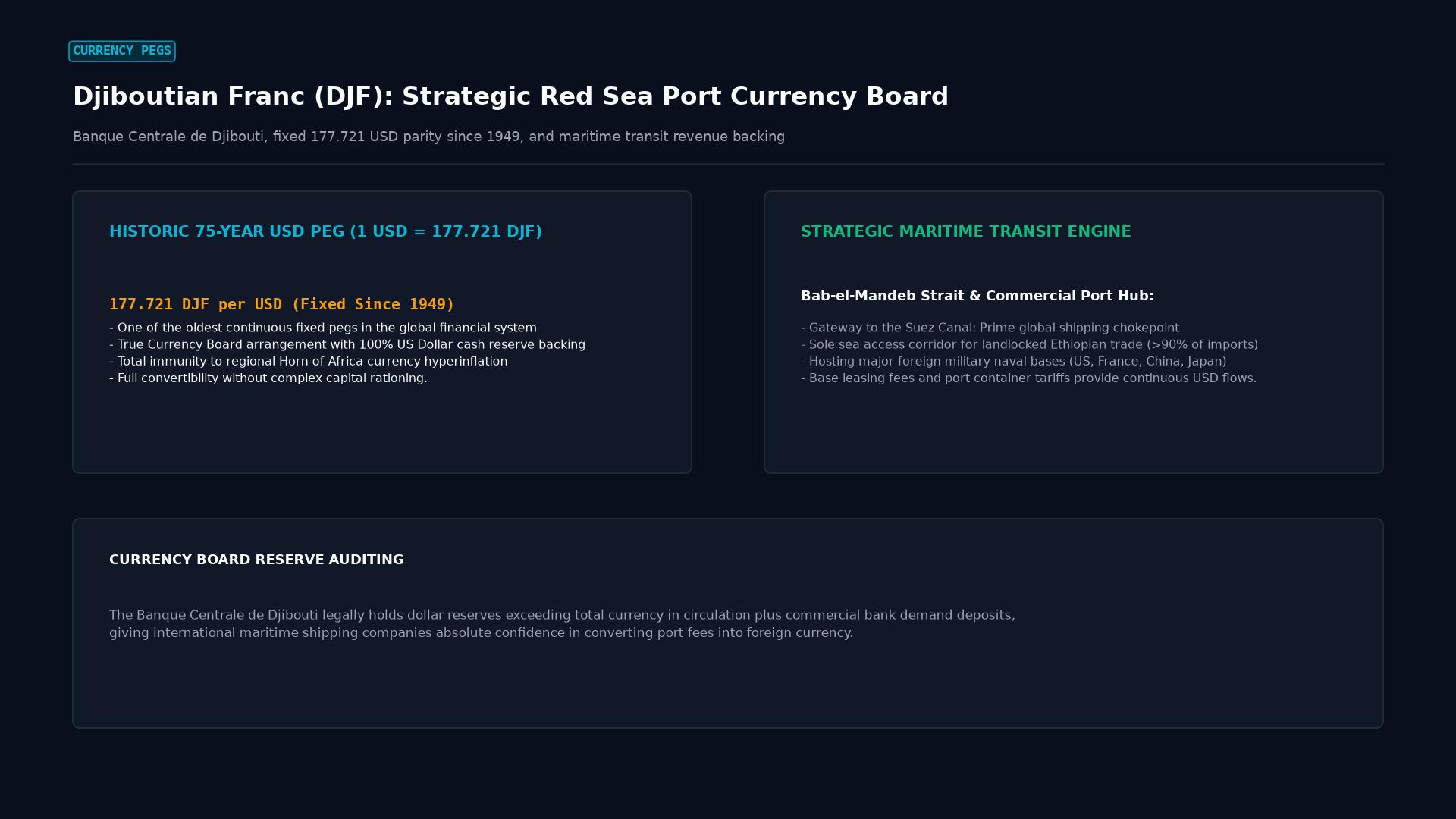 Figure: Red Sea maritime transit hub: Banque Centrale de Djibouti 75-year fixed peg of 177.721 DJF per USD backed by port tariffs and naval base lease revenues.
Origins and Historical Evolution
The monetary history of Djibouti reflects its evolving status from a colonial maritime coaling station to a sovereign trade nexus. In the nineteenth century, the region operated primarily on the silver Maria Theresa Thaler alongside Indian Rupees and French Francs. In 1908, the Bank of Indochina introduced the Bank of Indochina Franc for French Somaliland. Following monetary reforms in 1949, authorities established a specialized colonial franc pegged directly to gold and later aligned with the US Dollar rather than the French Franc, an unusual choice within the French colonial sphere designed to shield trade tariffs from Paris-driven devaluations.
Following Djibouti’s national independence in 1977, the newly formed government retained this fixed dollar relationship. In 1979, the newly created Banque Centrale de Djibouti assumed regulatory oversight and reconfirmed the parity rate of 177.721 DJF to 1 USD. Over five decades of international currency turbulence, oil shocks, regional conflicts in the Horn of Africa, and global recessions, this nominal exchange rate has remained unchanged.
The currency is subdivided into 100 centimes, although centime coins have long since disappeared from practical circulation due to decades of global purchasing power depreciation. Circulating coin denominations include 1, 2, 5, 10, 20, 50, 100, and 500 francs. Banknotes circulate in denominations of 1,000, 2,000, 5,000, and 10,000 francs.
The Currency Board Mechanism
The stability of the Djiboutian Franc rests on classic currency board rules established in the statutory statutes of the Banque Centrale de Djibouti. A currency board differs fundamentally from a conventional central bank that exercises discretionary monetary policy:
- Full Reserve Backing: National law requires the central bank to maintain foreign currency reserves, predominantly physical US dollars and US Treasury bills, equal to at least 100 percent of all local banknotes and coins in circulation. In practice, the central bank maintains an external asset coverage ratio well in excess of 105 to 110 percent to absorb valuation shocks.
- Guaranteed Convertibility: Commercial banks operating in Djibouti can present domestic currency to the central bank and receive US dollars at the official rate of 177.721 DJF per USD without quantitative restrictions for legitimate commercial transactions.
- Prohibition of Domestic Deficit Financing: The central bank cannot print money to purchase government treasury bills or finance fiscal budget shortfalls. If government expenditures exceed customs and tax receipts, the Treasury must borrow from external concessional lenders, issue bonds to local commercial banks within strict prudential limits, or curtail spending.
- Endogenous Money Supply: The domestic money supply expands when net foreign exchange enters the country through port service exports, military base leases, or foreign direct investment. Conversely, the money supply contracts when the nation experiences trade deficits, forcing local prices and wages to adjust downward.
$$\text{Coverage Ratio} = \frac{\text{Gross Foreign Exchange Reserves (USD Equiv)}}{\text{Monetary Base } (M_0 \text{ in DJF}) \times \frac{1}{177.721}} \ge 1.00$$
Strategic Economic Drivers and Foreign Exchange Inflows
Djibouti possesses few natural resources, negligible arable land, and very little domestic industrial manufacturing. Despite these physical limitations, the economy sustains stable gross foreign exchange reserves through three primary structural channels:
1. Transshipment and Ethiopian Gateway Trade
Djibouti commands the entrance to the Red Sea and the Suez Canal maritime corridor. Following the 1998 border conflict between Ethiopia and Eritrea, landlocked Ethiopia lost access to the ports of Massawa and Assab. Djibouti stepped into the vacuum, becoming the principal maritime conduit for Ethiopia’s international commerce. Today, more than 90 percent of Ethiopia’s total inbound and outbound trade flows through the Port of Djibouti and the Doraleh Multipurpose Port. Port handling fees, container storage charges, rail transit fees via the electrified Addis Ababa to Djibouti railway, and trucking services generate substantial hard currency flows into the Djiboutian banking system.
2. Foreign Military Basing Leases
Djibouti hosts an extraordinary concentration of foreign military installations due to its stable government and location adjacent to piracy corridors and Middle Eastern shipping lanes. Nations maintaining military bases include the United States (Camp Lemonnier), France, China (its first overseas naval base), Japan, and Italy. Annual lease payments, logistics support contracts, and local expenditure by foreign military personnel inject millions of US dollars and euros directly into the economy each year.
3. Telecommunications and Subsea Cable Landings
Djibouti serves as a major regional landing station for intercontinental fiber-optic submarine cables connecting Europe, the Middle East, Asia, and East Africa. State-owned Djibouti Telecom monetizes this digital infrastructure hub, generating recurring foreign currency revenues from international carriers.
| Structural Inflow Channel | Primary Currency | Economic Role in Sustaining DJF |
|---|---|---|
| Port & Container Handling Fees | USD / EUR | High-volume operational fees from Ethiopian trade and international liners |
| Basing Rights Leases | USD / EUR | Direct sovereign budgetary transfers providing non-debt dollar reserves |
| Cross-Border Rail & Logistics | USD | Tariffs collected on Ethiopian bulk grain, fertilizer, and manufacturing cargo |
| Telecom Subsea Interconnects | USD | Recurring transit bandwidth sales to East African telecommunications operators |
Trading, Banking, and FX Realities
Because Djibouti maintains a currency board with total capital mobility, there are no exchange controls on international transfers. Residents and non-residents can hold foreign currency bank accounts denominated in USD, EUR, or other major currencies.
For international forex market participants, DJF does not trade on standard G10 electronic spot matching platforms like EBS or Reuters Matching. Trading occurs almost exclusively via over-the-counter (OTC) bilateral transactions through commercial banks licensed by the Banque Centrale de Djibouti or through regional correspondent banking desks.
Exotic currency desks pricing forward contracts or swaps on DJF face structural liquidity constraints. Because the central bank does not maintain an active interbank money market discount window, domestic interest rates closely mirror US Federal Reserve monetary decisions, adjusted for a sovereign credit and commercial liquidity spread. When the Federal Reserve raises the Federal Funds Rate, borrowing costs in Djibouti rise automatically, as banks must prevent capital outflows to higher-yielding dollar deposits in New York or London.
Core Advantages and Structural Vulnerabilities
The currency board system provides profound monetary predictability, yet imposes severe real-economy trade-offs:
Key Advantages
- Anchor of Price Stability: The peg shields Djibouti from the double-digit and triple-digit inflation rates historically witnessed in neighboring regional economies such as Ethiopia and Sudan.
- Investor Confidence: Multinational port operators, sovereign defense departments, and international financial institutions operate without fear of sudden currency devaluations.
- Elimination of Dollar Shortages for Trade: Unlike surrounding African states that suffer chronic foreign exchange rationing, authorized commercial banks in Djibouti convert local currency to US dollars on demand for registered import transactions.
Key Vulnerabilities
- Loss of Monetary Independence: Djibouti cannot devalue its currency to stimulate exports or lower domestic interest rates during local economic downturns.
- Imported Inflation Risks: Because Djibouti imports virtually all food, petroleum products, and manufactured consumer goods, global price spikes in dollar-denominated commodities transmit directly into domestic consumer prices.
- Counterparty Concentration Risk: Djibouti’s external accounts are heavily dependent on economic health and political stability in Ethiopia. Any severe downturn or foreign exchange crisis in Addis Ababa immediately reduces container traffic through Doraleh, compressing port tariff collections and pressuring fiscal balances.
Frequently Asked Questions
Why has the Djiboutian Franc remained pegged to the US Dollar rather than the Euro or French Franc?
Although Djibouti was a French colony, French Somaliland pegged its currency to the US Dollar in 1949 to maintain stable port coaling tariffs for international shipping lines traversing the Red Sea. Following independence in 1977, policymakers preserved the dollar peg because global shipping tariffs, oil shipments, and maritime port fees are overwhelmingly billed in US dollars.
Can travelers and companies freely convert DJF to USD inside Djibouti?
Yes. Djibouti maintains an open capital account with no restrictions on foreign currency conversion or profit repatriation. Commercial banks and registered foreign exchange bureaus convert DJF to USD and vice versa based on the official rate, charging a small retail commission spread typically between 0.5% and 1.5%.
What is the relationship between the Djiboutian Franc and the Ethiopian Birr?
Ethiopia is landlocked and relies on Djibouti’s ports for more than 90% of its external trade. While the Ethiopian Birr (ETB) has experienced substantial devaluations and transitioning exchange controls, port tariffs in Djibouti must be settled in hard currency (predominantly USD) or converted through DJF. This dynamic insulates Djibouti from the volatility of the Ethiopian Birr while tying Djibouti’s logistics volume directly to Ethiopian economic activity.
Ready to trade forex?
Open a free demo account with a regulated broker. Practice with virtual funds before risking real money.