DKK
DKK is the ISO 4217 currency code for the Danish Krone, the official currency of the Kingdom of Denmark, pegged to the Euro within the Exchange Rate Mechanism II (ERM II).
The Danish Krone (ISO code: DKK, symbol: kr.) is the official currency of Denmark, Greenland, and the Faroe Islands. In the Faroe Islands, the local government issues Faroese króna banknotes that share identical parity and full fungibility with Danish notes. Unlike its Scandinavian peers Sweden and Norway, which operate free-floating exchange rate regimes, Denmark anchors its monetary architecture to the Eurozone. Under the European Exchange Rate Mechanism II (ERM II), Danmarks Nationalbank (the Danish central bank) maintains a fixed central parity rate of 7.46038 DKK per 1 EUR, defending one of the most durable currency pegs in global finance.
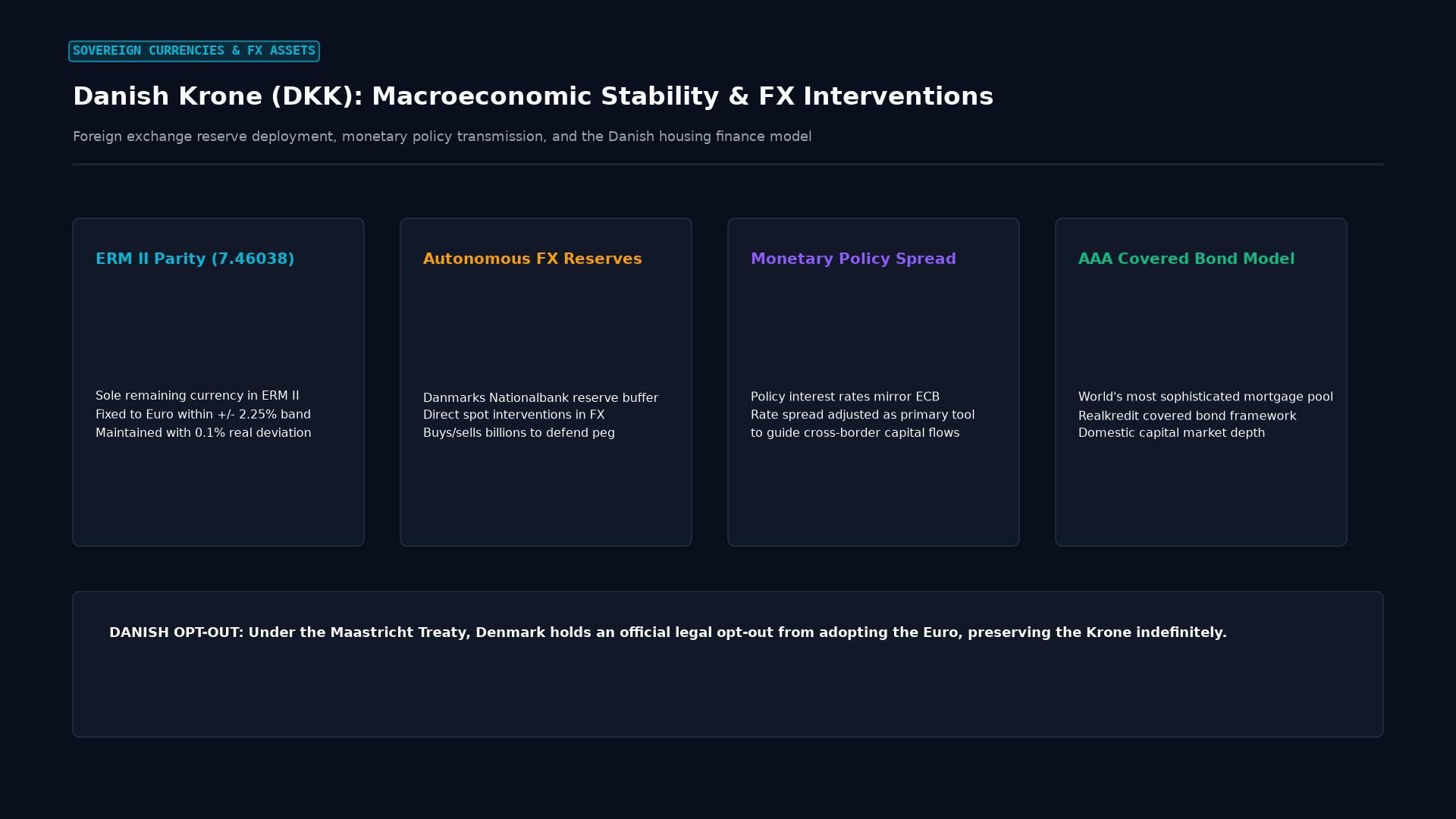 Figure: Danish monetary independence: legal Maastricht Treaty opt-out, autonomous foreign reserve deployment, and the AAA covered mortgage bond system.
Historical Background and the Maastricht Opt-Out
The Krone has served as Denmark’s monetary unit since the creation of the Scandinavian Monetary Union in 1873, which linked the Danish, Swedish, and Norwegian currencies to a common gold standard until the onset of World War I. Following the collapse of the Bretton Woods system in the early 1970s, Denmark committed to European monetary integration, participating in the European Currency Snake and joining the European Monetary System (EMS) in 1979.
In 1992, Danish voters initially rejected the European Union’s Maastricht Treaty in a historic referendum. To resolve the impasse, the Danish government negotiated four opt-outs under the Edinburgh Agreement, including an explicit exemption from joining the third stage of Economic and Monetary Union (EMU), which mandated adopting the single European currency. A second referendum in September 2000 confirmed the public’s preference to retain the Krone, with 53.2 percent voting against adopting the Euro.
Despite rejecting the Euro as physical legal tender, Danish monetary authorities chose not to adopt an independent floating exchange rate. Instead, Denmark joined ERM II on January 1, 1999, linking the Krone to the newly born Euro at the exact conversion rate previously applied to the German Deutsche Mark.
The ERM II Framework and Danmarks Nationalbank’s Mandate
Danmarks Nationalbank possesses a single, overriding objective that supersedes domestic inflation targeting or employment goals: maintaining the exchange rate stability of the Krone against the Euro.
While the standard ERM II framework permits a wide fluctuation band of $\pm 15$ percent around central parity, Denmark negotiated a formal bilateral agreement with the European Central Bank establishing a much narrower fluctuation band of $\pm 2.25$ percent (between 7.29252 and 7.62824 DKK per EUR). In daily operational practice, Danmarks Nationalbank defends an even tighter internal band, typically keeping EUR/DKK fluctuations within a fraction of one percent (often within $\pm 0.5$ percent) of the 7.46038 central rate.
$$\text{ERM II Band Bounds} = 7.46038 \times (1 \pm 0.0225) \implies [7.29252, ; 7.62824]$$
To maintain this razor-thin corridor, Danmarks Nationalbank relies on a sequenced two-tier operational mechanism:
- Direct FX Interventions: If foreign capital rushes into Denmark, driving the Krone stronger (lowering the EUR/DKK exchange rate below 7.4600), the central bank sells Krone and purchases Euros in the spot foreign exchange market. This intervention expands official foreign reserves and dampens Krone appreciation. If the Krone weakens, the central bank sells Euros and buys Krone.
- Policy Rate Adjustments: If persistent capital flows overwhelm direct market interventions, Danmarks Nationalbank adjusts its key policy rates (the certificates of deposit rate and the lending rate) independently of the European Central Bank. By widening or narrowing the interest rate differential against ECB benchmark rates, the bank alters the incentive for cross-border institutional capital to park liquidity in Copenhagen.
Pioneer of Negative Interest Rates
Denmark occupies a prominent place in modern central banking history as a pioneer of negative nominal interest rates. During the height of the European Sovereign Debt Crisis in July 2012, international investors fled peripheral Eurozone sovereign bonds, seeking sanctuary in highly rated, non-Euro sovereign safe havens such as Denmark, Switzerland, and Sweden.
Faced with massive capital inflows that threatened to shatter the ERM II peg, Danmarks Nationalbank lowered its certificate of deposit rate to -0.20 percent. Denmark became the first central bank in modern monetary history to impose negative deposit rates on commercial banks, charging institutions for depositing surplus liquidity.
The strategy was tested even more severely in January 2015, when the Swiss National Bank abruptly abandoned its 1.20 CHF per EUR floor. Speculative currency traders immediately attacked the Danish Krone, betting that Copenhagen would follow Zurich’s lead. Danmarks Nationalbank responded aggressively:
- Intervened by purchasing over 275 billion DKK worth of foreign currency in two months.
- Slashed its deposit rate in four rapid steps down to -0.75 percent.
- Convinced the Danish Ministry of Finance to temporarily halt the domestic issuance of Danish government bonds to choke off the supply of safe assets to foreign investors.
The peg held without breach, establishing Danmarks Nationalbank’s absolute credibility in international currency markets.
The Danish Covered Bond Market (Realkreditobligationer)
A structural pillar of the Danish financial system is its covered bond market, known locally as realkreditobligationer. Valued at more than 450 billion euros, the Danish mortgage bond market is the largest in Europe relative to gross domestic product, exceeding 130 percent of Danish GDP.
       THE DANISH BALANCE PRINCIPLE (MATCH FUNDING)
       ============================================

   +-------------------+                     +-------------------+
   |  DANISH HOMEBUYER |                     | DOMESTIC & GLOBAL |
   |  OR CORPORATION   |                     |   INSTITUTIONAL   |
   |                   |                     |     INVESTORS     |
   +-------------------+                     +-------------------+
             |                                         ^
             | Mortgage Loan                           | Covered Bonds
             | Payments                                | (AAA-rated)
             v                                         |
   +-------------------------------------------------------------+
   |          SPECIALIZED MORTGAGE CREDIT INSTITUTIONS           |
   |      (Nykredit / Realkredit Danmark / Nordea Kredit)        |
   |                                                             |
   |   * STRICT PASS-THROUGH: Institution holds zero interest    |
   |     rate risk; cash flows from mortgage match bond exactly. |
   +-------------------------------------------------------------+
This market operates under a statutory requirement known as the “balance principle” (Match Funding). When a Danish mortgage bank issues a loan to a homebuyer or corporation, it simultaneously issues a mortgage covered bond in the open market with identical cash flow, maturity, and interest rate characteristics. Because these covered bonds carry AAA credit ratings and high liquidity, they attract vast amounts of foreign institutional capital, creating continuous cross-currency swap flows between EUR, USD, and DKK.
Trading Dynamics and Macroeconomic Profile
The Danish economy features an AAA sovereign credit rating, low public debt (under 30 percent of GDP), and persistent current account surpluses driven by global pharmaceutical champions (Novo Nordisk), maritime shipping giants (A.P. Møller-Maersk), and renewable wind turbine manufacturers (Vestas).
For foreign exchange market participants, trading the Danish Krone presents distinct characteristics:
| Feature | Danish Krone (DKK) Dynamics |
|---|---|
| Primary FX Pair | EUR/DKK (ultra-tight bid-ask spread, minimal intraday range) |
| Secondary Pairs | USD/DKK, GBP/DKK, DKK/SEK (derived synthetic crosses via EUR) |
| Carry Trade Appeal | Negligible; central bank enforces rate parity with the ECB |
| FX Hedging Practice | Many international asset managers treat DKK as EUR proxy, leaving exposures unhedged |
| Liquidity Hours | Peak liquidity during European trading hours (07:00 to 16:00 GMT) |
Because EUR/DKK rarely fluctuates by more than 0.2 percent over months, corporate treasurers across Scandinavia frequently use EUR/DKK forwards and options for cash pooling operations, managing cross-border liquidity without incurring major structural exchange rate risk.
Frequently Asked Questions
Why does Denmark choose to keep the Krone instead of adopting the Euro?
Denmark maintains the Krone due to national sovereignty preferences expressed in the 1992 Maastricht Treaty opt-outs and affirmed by the 2000 national referendum. While the Danish public values retaining its national monetary identity, the country achieves economic stability by anchoring the Krone directly to the Euro through ERM II.
Can Danmarks Nationalbank run out of foreign reserves when defending the peg?
When the Krone strengthens, Danmarks Nationalbank faces no theoretical limit because it creates Danish Krone to buy foreign currency. When the Krone weakens, the bank uses its foreign exchange reserves to buy Krone. Under the ERM II agreement, the European Central Bank and Danmarks Nationalbank maintain mutual short-term financing facilities, providing unlimited intervention credit to defend the agreed fluctuation bands.
What is the difference between the Danish Krone and the Swedish Krona in forex trading?
While both currencies share historical origins in the Scandinavian Monetary Union, their modern currency regimes are opposites. The Danish Krone (DKK) is strictly pegged to the Euro via ERM II, displaying virtually zero volatility against EUR. The Swedish Krona (SEK) is a free-floating currency with an inflation-targeting central bank (Riksbank), exhibiting high sensitivity to global economic growth, risk sentiment, and international interest rate cycles.
Ready to trade forex?
Open a free demo account with a regulated broker. Practice with virtual funds before risking real money.