Double Barrier Option
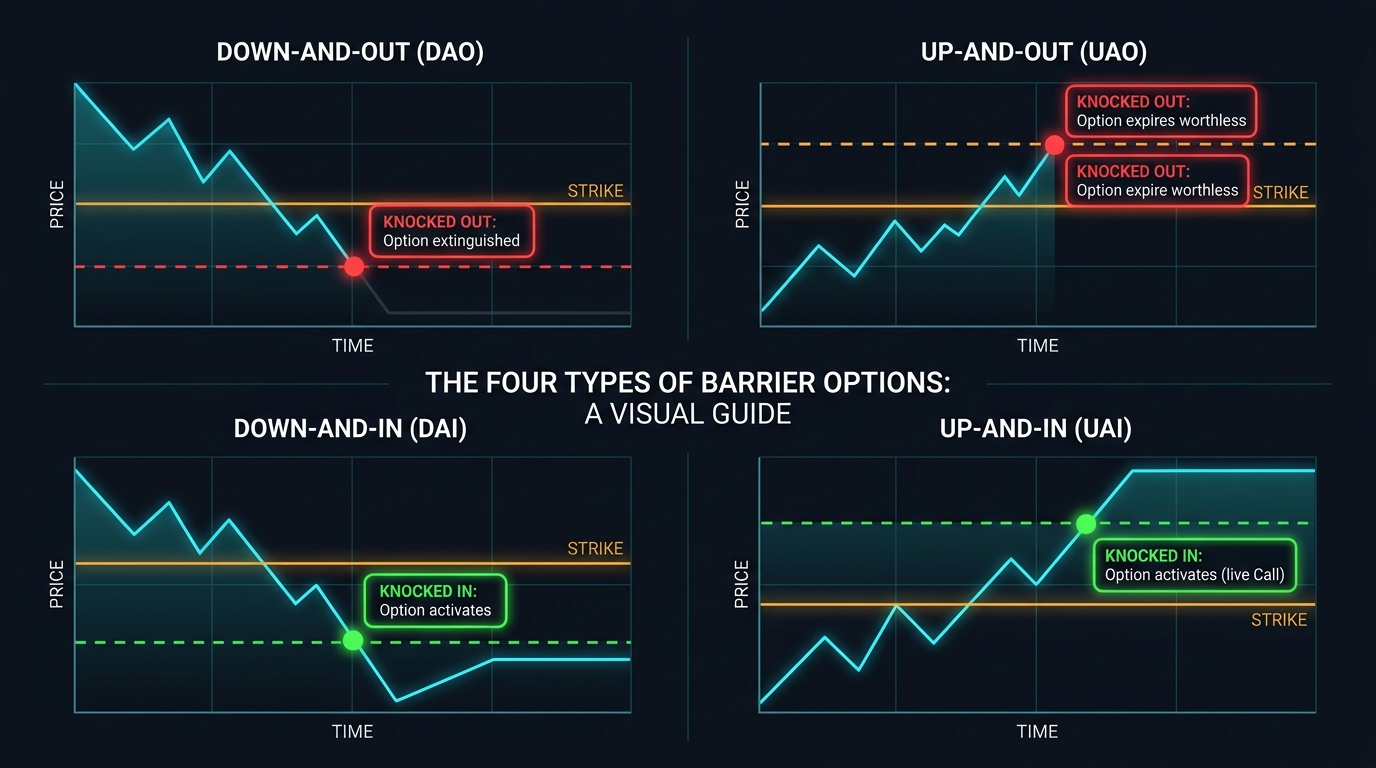
A double barrier option is an exotic derivative contract with two distinct price trigger levels—an upper and a lower barrier—that activate (knock-in) or extinguish (knock-out) the option if breached.
What Is a Double Barrier Option?
A double barrier option is a path-dependent exotic derivative contract whose validity, activation, or termination is contingent upon the price of the underlying asset respecting or breaching two distinct price boundaries: an Upper Barrier ($H_U$) positioned above the initial spot price, and a Lower Barrier ($H_L$) positioned below the initial spot price.
In conventional vanilla options, the payoff depends exclusively on the final spot price at expiration relative to the strike price ($K$), regardless of the path the asset took to get there. In contrast, a double barrier option continuously monitors the asset’s trajectory throughout its entire lifespan.
Because the buyer of a double barrier option accepts structural constraints—specifically the risk that the option may be completely extinguished if the market breaks out of its range—double barrier contracts are priced at a substantial premium discount (often 30% to 70% cheaper) compared to standard vanilla options. This makes them exceptionally popular among corporate treasuries, macro hedge funds, and institutional foreign exchange desks seeking cost-effective range hedging.
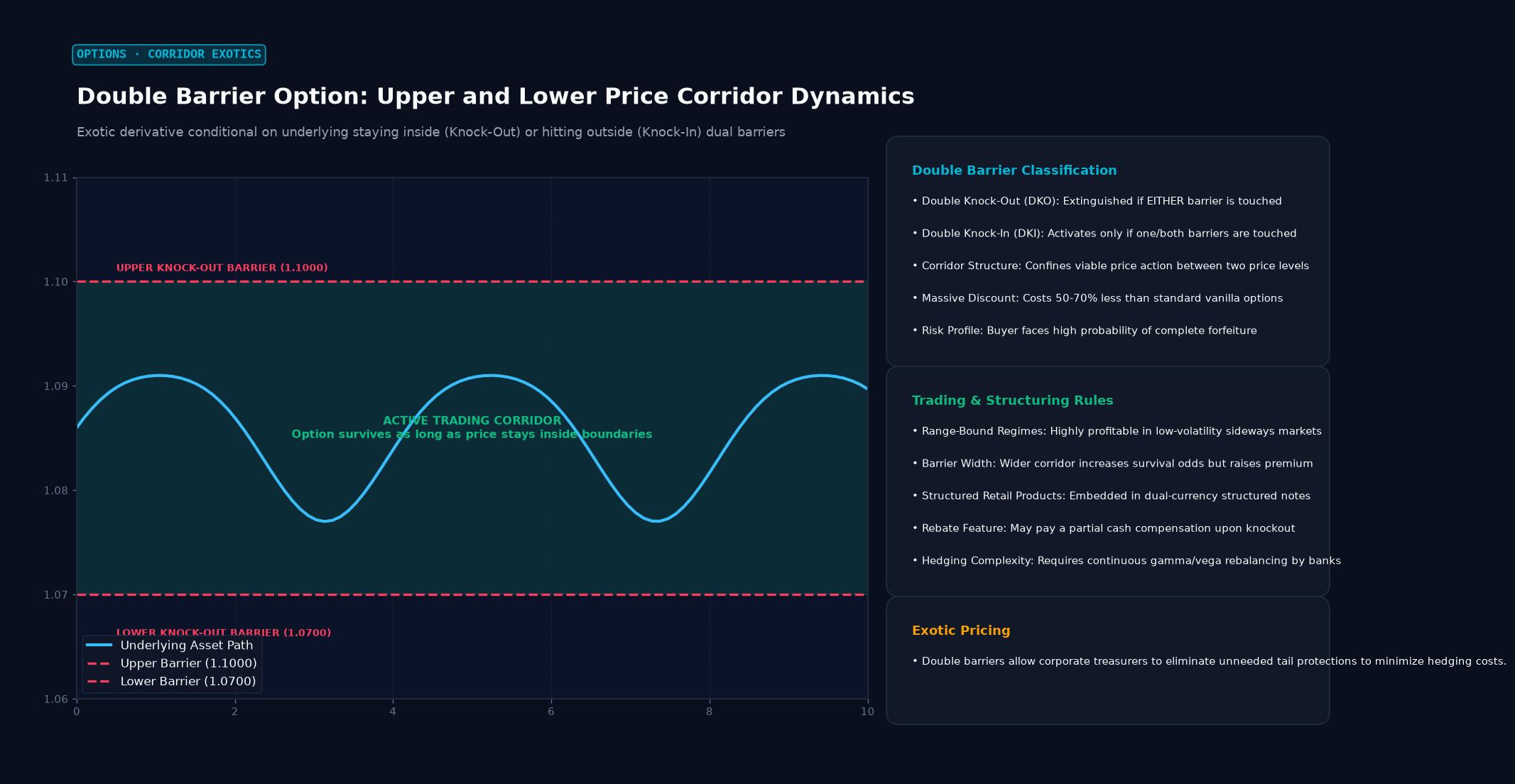 Figure: Exotic derivative conditional on underlying staying inside (Knock-Out) or hitting outside (Knock-In) dual barriers
Key Takeaways
- Twin Threshold Architecture: The contract is bound by an Upper Barrier ($H_U$) and a Lower Barrier ($H_L$), creating an active price corridor ($H_L < S_t < H_U$).
- The Two Core Types: In a Double Knock-Out (DKO), breaching either barrier terminates the contract instantly; in a Double Knock-In (DKI), the option starts dormant and activates into a live contract only if either barrier is touched.
- Massive Premium Savings: DKO options allow hedgers to secure directional upside or downside protection at a fraction of the cost of standard options, provided volatility remains contained.
- Analytical Pricing Complexity: Valuing double barrier options requires solving boundary-value partial differential equations or deploying infinite series expansions (such as the Kunitomo and Ikeda analytical framework).
The Four Primary Permutations of Double Barrier Options
Depending on corporate exposure and volatility expectations, financial institutions tailor four structural variations:
| Permutation | Acronym | Initial State at Inception | Barrier Breach Event | Ideal Market Scenario |
|---|---|---|---|---|
| Double Knock-Out | DKO | Active & Live | Breaching either $H_U$ or $H_L$ extinguishes the option | Low-volatility range; expect price to stay pinned inside corridor |
| Double Knock-In | DKI | Dormant & Inactive | Breaching either $H_U$ or $H_L$ activates the option into a vanilla contract | High-volatility breakout; expect an explosive move beyond barriers |
| KIKO Option (Knock-In / Knock-Out) | KIKO | Dormant | One barrier activates the option; the opposite barrier terminates it | Directional trend that must not exceed an outer extreme |
| Double No-Touch (DNT) | DNT | Active Binary | Pays a fixed cash payout if neither barrier is touched before expiry | Range-bound sideways markets (pure volatility selling) |
Analytical Valuation and the Kunitomo-Ikeda Model
Pricing a double barrier option under Black-Scholes assumptions is non-trivial because the probability density function must satisfy zero boundary conditions at two distinct levels simultaneously ($S = H_L$ and $S = H_U$).
In 1992, quantitative researchers Kunitomo and Ikeda derived the closed-form analytical solution using an infinite series of reflection terms:
$$V_{\text{DKO}} = \sum_{n=-\infty}^{+\infty} \left[ \text{Vanilla}_n(S, K, T) \cdot \left( \frac{H_U^n}{H_L^n} \right)^\alpha \right]$$
Intuition of Double Barrier Pricing:
The price of a Double Knock-In (DKI) option plus a Double Knock-Out (DKO) option with identical strikes and barriers equals the price of a standard Vanilla European Option:
$$V_{\text{Vanilla}} = V_{\text{DKO}} + V_{\text{DKI}}$$
Because a vanilla option can be decomposed into an option that knocks out plus an option that knocks in, this fundamental parity relationship ensures that derivatives desks cannot misprice double barrier contracts without creating instant riskless arbitrage.
The Greek Profiles: Pin Risk and “Barrier Cliffs”
Double barrier options exhibit non-linear Greeks that require intensive algorithmic delta hedging by dealer banks:
- Discontinuous Delta ($\Delta$): In a standard option, delta approaches 1.0 or 0.0 smoothly. In a Double Knock-Out option, as price approaches within a few pips of either barrier, delta drops off a literal cliff toward zero, because a 1-pip further move extinguishes the option entirely.
- Extreme Negative Gamma ($\Gamma$): Near the barriers, gamma becomes highly negative, forcing market makers to rapidly flip their spot hedge positions from long to short.
- Negative Vega ($\nu$): While vanilla options benefit from rising implied volatility ($+\nu$), DKO options have negative vega. Higher market volatility drastically increases the probability that price will swing out of the corridor and hit a barrier, reducing the DKO option’s market value.
Real-World Case Study: Corporate FX Range Hedging on EUR/USD
A German automotive manufacturer imports electronic parts from the United States, requiring a payment of $50,000,000 USD in six months.
The Hedging Dilemma:
- Current Spot Rate:
EUR/USD = 1.0850. - The corporate treasurer expects EUR/USD to fluctuate in a predictable range between
1.0500and1.1200over the next six months. - Purchasing a standard 6-month Vanilla EUR/USD Call Option with a strike at
1.0850costs €1,500,000 in upfront cash premium (a heavy corporate expense).
The Double Knock-Out Solution:
The treasurer purchases a Double Knock-Out Call Option:
- Strike ($K$):
1.0850 - Lower Barrier ($H_L$):
1.0450(400 pips below spot) - Upper Barrier ($H_U$):
1.1250(400 pips above spot) - Premium Cost: €450,000 (a massive 70% discount, saving €1,050,000 in corporate cash).
Outcome Scenarios at Month 6:
- Scenario A (Range Holds): EUR/USD oscillates between 1.0600 and 1.1150 throughout the six months, settling at
1.1050. Neither barrier was touched. The call option remains fully alive and is exercised at 1.0850, saving the company $1,000,000 USD in conversion costs while retaining the initial €1.05M premium savings. - Scenario B (Barrier Breach): In month 4, an unexpected geopolitical crisis pushes EUR/USD down to
1.0448for ten seconds. The moment the lower barrier is touched, the option is instantly extinguished. The company loses its €450,000 premium and must convert currency at prevailing spot market rates.
Frequently Asked Questions
What is a “Rebate” in a double barrier option?
To cushion the risk of contract termination, many OTC double barrier options include a contingent rebate. If a barrier is breached and the option is knocked out, the seller pays the buyer a pre-agreed cash compensation fee (the rebate) to partially offset the loss of hedging protection.
How does barrier monitoring work (continuous vs. discrete)?
In continuous monitoring (American-style barrier), the barrier can be breached at any second during market hours. In discrete monitoring (European/Bermudan barrier), the barrier is checked only at specific intervals—such as the daily 5:00 PM New York close or the 10:00 AM option cut—protecting the contract from intraday flash crashes.
Who trades double barrier options?
Double barrier options are primarily structured in the Over-the-Counter (OTC) institutional market by Tier-1 investment banks (such as Deutsche Bank, JPMorgan, and UBS) for corporate treasuries, macro hedge funds, and private wealth family offices. They are rarely available on retail trading platforms.
Ready to trade forex?
Open a free demo account with a regulated broker. Practice with virtual funds before risking real money.