EEK
EEK is the ISO 4217 currency code for the Estonian Kroon, the historic official currency of Estonia from 1928 to 1940 and 1992 to 2010, anchored to the Deutsche Mark and Euro under a currency board before Euro adoption.
The Estonian Kroon (ISO code: EEK, symbol: kr.) was the official currency of the Republic of Estonia from 1928 to 1940 and again from 1992 until January 1, 2011, when Estonia formally adopted the Euro (EUR) at a fixed conversion rate of 15.6466 EEK per 1 EUR. The reintroduction and defense of the Kroon between 1992 and 2010 represents one of the most celebrated case studies in modern monetary economics. By implementing a strict Currency Board Arrangement (CBA) backed by Eesti Pank (the Bank of Estonia), Estonia became the first post-Soviet republic to dismantle the hyperinflating ruble zone, achieve macroeconomic stabilization, and complete an unbroken transition to Eurozone membership.
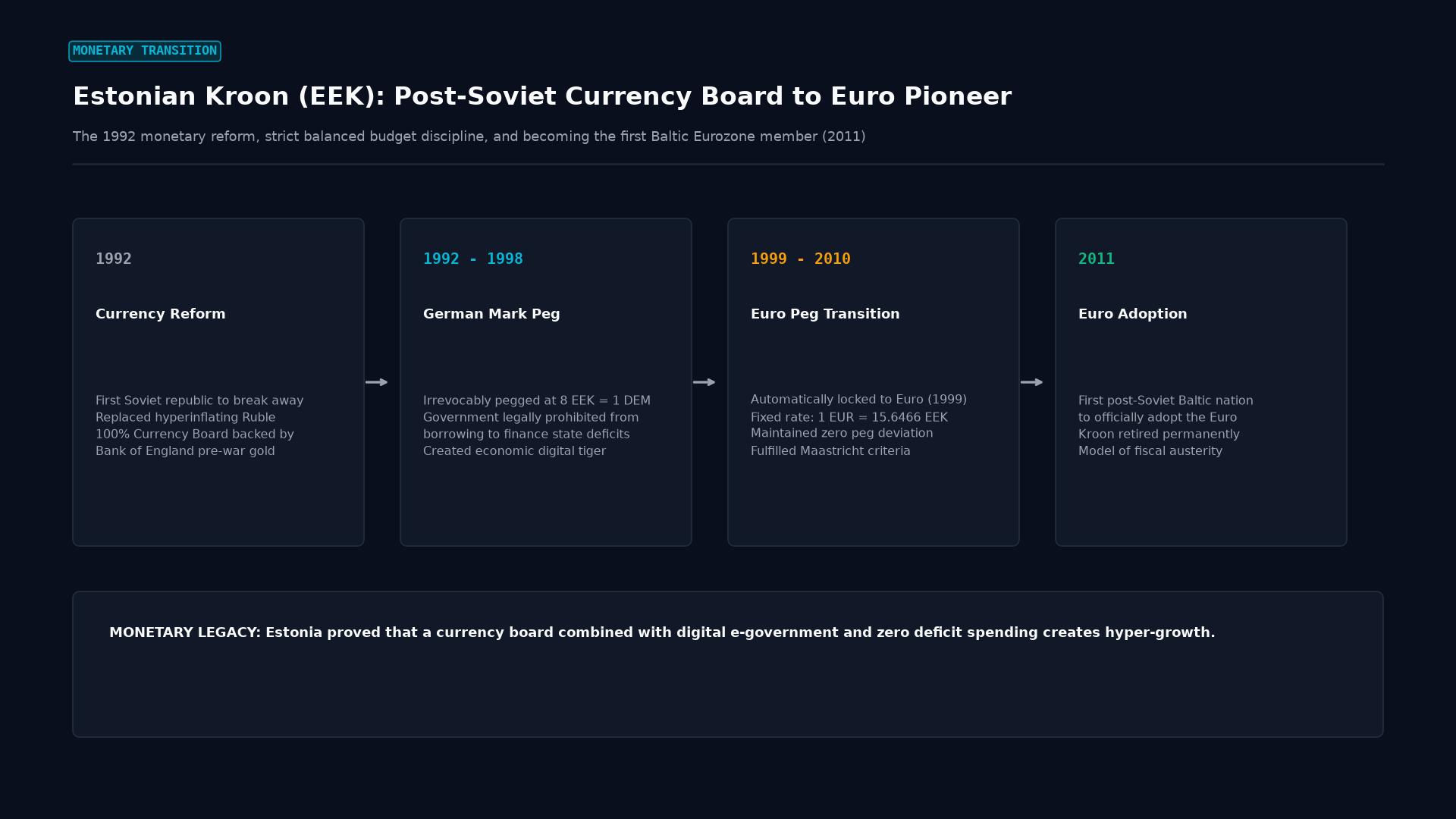 Figure: Baltic economic transition: 1992 currency board backed by pre-war gold, strict balanced budgets, German Mark peg, and 2011 Eurozone accession.
Historical Foundations and the 1992 Monetary Reform
The Kroon was first established in 1928, replacing the Estonian Mark at a rate of 100 marks per 1 kroon and linking the young Baltic republic to the gold standard. Following the Soviet occupation and annexation of Estonia in 1940, the Soviet authorities forcibly abolished the Kroon and replaced it with the Soviet Ruble at an undervalued confiscatory rate, stripping Estonian citizens of their private bank savings.
In the late 1980s, amidst the disintegration of the Soviet Union, Estonian economists developed plans for comprehensive regional economic autonomy. Following the restoration of full national independence in August 1991, Estonia faced an existential monetary threat: the collapse of the Soviet Gosbank system and hyperinflation across the ruble zone, where annual price increases exceeded 1,000 percent.
Rather than waiting for international consensus, Estonian authorities, led by central bank governor Siim Kallas and Prime Minister Mart Laar, executed a radical currency reform between June 20 and June 22, 1992:
- Residents exchanged up to 1,500 rubles per person at a rate of 10 rubles per 1 kroon, with higher balances exchanged at penal rates to discourage ruble dumping.
- Estonia established a statutory Currency Board Arrangement, legally anchoring the Kroon to the German Deutsche Mark (DEM) at an unalterable parity of 8.00 EEK per 1 DEM.
- Initial reserve backing was secured through the restitution of pre-war sovereign Estonian gold reserves held in safekeeping since 1940 by the Bank of England, the Bank for International Settlements, and the Bank of Sweden.
Estonia instantly decoupled from the monetary chaos of the Commonwealth of Independent States (CIS), creating an island of macroeconomic discipline in Eastern Europe.
Mechanics of the Estonian Currency Board Arrangement
The Estonian Currency Board functioned under four immutable statutory pillars codified in the Law on the Security of the Estonian Kroon:
1. Mandatory 100 Percent Foreign Reserve Backing
Every kroon banknote, coin, and commercial bank reserve balance held at Eesti Pank had to be backed by liquid, interest-bearing foreign exchange assets (primarily German government bunds and gold). Eesti Pank maintained an external asset coverage ratio consistently between 105 percent and 115 percent, ensuring that private holders could convert their entire local money supply into reserve currency without exhausting reserves.
2. Elimination of Discretionary Monetary Policy
Eesti Pank surrendered the traditional central banking powers of discretionary open market operations, credit rationing, and benchmark interest rate setting. The central bank could not set domestic policy interest rates; commercial lending rates were determined purely by German (and later Eurozone) benchmark rates plus a market-determined risk premium.
3. Absolute Prohibition of Fiscal Deficit Monetization
The law prohibited Eesti Pank from extending credit, loans, or overdraft facilities to the Estonian government or purchasing sovereign debt instruments on the primary or secondary market. If the state budget ran a deficit, the government was forced to cut expenditures or borrow on commercial market terms. This institutional restraint fostered a culture of fiscal conservatism, leaving Estonia with the lowest public debt-to-GDP ratio in the entire European Union (consistently under 10 percent).
$$\Delta M_0 = \Delta \text{Foreign Exchange Reserves (DEM/EUR equivalent)}$$
Under this equation, changes in the monetary base ($M_0$) were strictly determined by net foreign currency transactions entering or leaving the economy through external trade, tourism, and foreign direct investment.
The Euro Peg and the ERM II Journey
When eleven European Union nations established the Euro on January 1, 1999, the Deutsche Mark was irrevocably fixed to the new single currency at 1.95583 DEM per 1 EUR. Consequently, the Estonian Kroon automatically transitioned its anchor parity:
$$\text{EUR/EEK Parity} = 8.0000 \times 1.95583 = 15.6466 \text{ EEK}$$
Following Estonia’s formal accession to the European Union on May 1, 2004, the country entered the European Exchange Rate Mechanism II (ERM II) on June 28, 2004. While the standard ERM II framework permitted a standard fluctuation band of $\pm 15$ percent around the central parity rate, Eesti Pank maintained its currency board unilaterally, operating with a zero-percent fluctuation band.
During the global financial crisis of 2008-2009, Baltic real estate bubbles burst, and Estonia’s GDP contracted by over 14 percent in 2009. Speculative voices urged Estonia to abandon the peg and devalue the Kroon to regain export competitiveness. Estonian authorities adamantly refused, arguing that devaluation would destroy household balance sheets (which held foreign-currency mortgages) and shatter two decades of hard-won institutional credibility.
Instead, Estonia executed an “internal devaluation” across the economy:
- Slashing public sector wages and government operational budgets.
- Freezing pensions and restructuring civil service headcount.
- Allowing private sector wages and domestic prices to adjust downward.
The internal adjustment succeeded. Current account deficits flipped into surpluses, foreign investor confidence returned, and Estonia met all Maastricht convergence criteria during one of the deepest global recessions in history.
Transition to the Euro
On July 13, 2010, the Council of the European Union gave final approval for Estonia to join the Eurozone. On January 1, 2011, the Euro became legal tender in Estonia, replacing the Kroon after a two-week dual circulation period.
Commercial banks converted all bank balances, mortgages, consumer loans, and securities denominated in EEK into EUR free of commission at the unalterable historical conversion rate of 15.6466 EEK per EUR. Eesti Pank continues to exchange legacy Kroon banknotes and coins into Euros indefinitely at its head office in Tallinn with no fee.
| Metric | Estonian Kroon (EEK) Era (1992-2010) | Euro (EUR) Era (Post-2011) |
|---|---|---|
| Monetary Anchor | Deutsche Mark (1992-1998) / Euro (1999-2010) | Full European Central Bank Governing Council Member |
| Exchange Rate | Fixed at 8.00 DEM / 15.6466 EUR | Free-floating global reserve currency |
| Central Bank Role | Strict Currency Board; zero discretionary rate setting | National Central Bank participating in Eurosystem decisions |
| Public Debt / GDP | Kept below 10% through balanced budget mandate | Remains lowest in EU (approx. 10-19% of GDP) |
| Commercial Currency | Retail cash used domestically; trade settled in DEM/EUR | Standard cross-border payment integration via SEPA / TARGET |
Frequently Asked Questions
Why did Estonia choose a currency board instead of an independent floating currency in 1992?
Following five decades of Soviet occupation, Estonia lacked independent central banking traditions, foreign exchange trading infrastructure, and international institutional credibility. Adopting a strict currency board anchored to the German Deutsche Mark instantly imported the monetary credibility of the Bundesbank, suppressed hyperinflation within months, and assured foreign investors that their capital would not be eroded by politically motivated currency printing.
How was Estonia able to join the Eurozone during the European Sovereign Debt Crisis?
While southern European nations were experiencing severe fiscal crises in 2010-2011, Estonia fulfilled every Maastricht criterion: public debt below 10% of GDP, a balanced state budget, low long-term bond yields, and exchange rate stability maintained without devaluation for 18 years under the currency board.
Are old Estonian Kroon banknotes still redeemable?
Yes. Unlike central banks that impose strict sunset clauses on discontinued currencies, Eesti Pank guarantees the exchange of Estonian Kroon banknotes and coins into Euros indefinitely at the official parity rate of 15.6466 EEK per 1 EUR, without time limits or transaction fees.
Ready to trade forex?
Open a free demo account with a regulated broker. Practice with virtual funds before risking real money.