Quantitative Easing (QE)
Quantitative easing is an unconventional monetary policy tool where a central bank purchases large quantities of financial assets — primarily government bonds — to inject money directly into the financial system. It is deployed when conventional rate cuts have been exhausted (rates at or near zero) and the economy still needs stimulus. QE typically weakens a currency by expanding money supply.
When Normal Monetary Policy Runs Out of Room
A central bank’s primary tool is the interest rate. But rates can only go so low — in most cases, zero sets a practical floor. When a severe recession or financial crisis hits and rates are already at zero, the central bank has a problem: its main weapon is spent.
Quantitative easing was designed to solve that problem. Instead of lowering the cost of money (rate cuts), QE increases the supply of money directly — by creating new central bank reserves and using them to purchase assets from financial institutions. The hope is that those institutions, now holding reserves instead of bonds, will deploy the capital into loans, investments, and economic activity.
Whether QE achieves its intended economic stimulation remains genuinely debated among economists. Its effect on asset prices — and currencies — is less controversial.
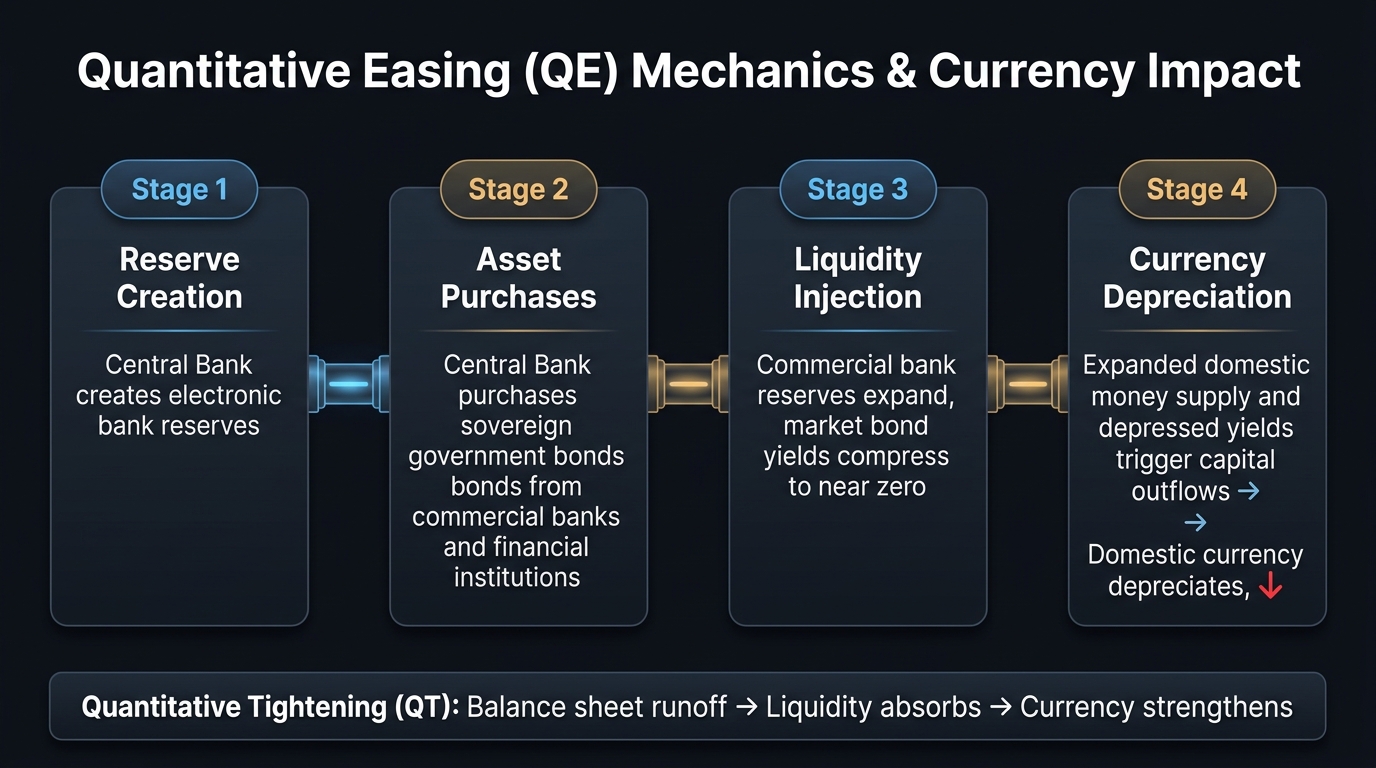
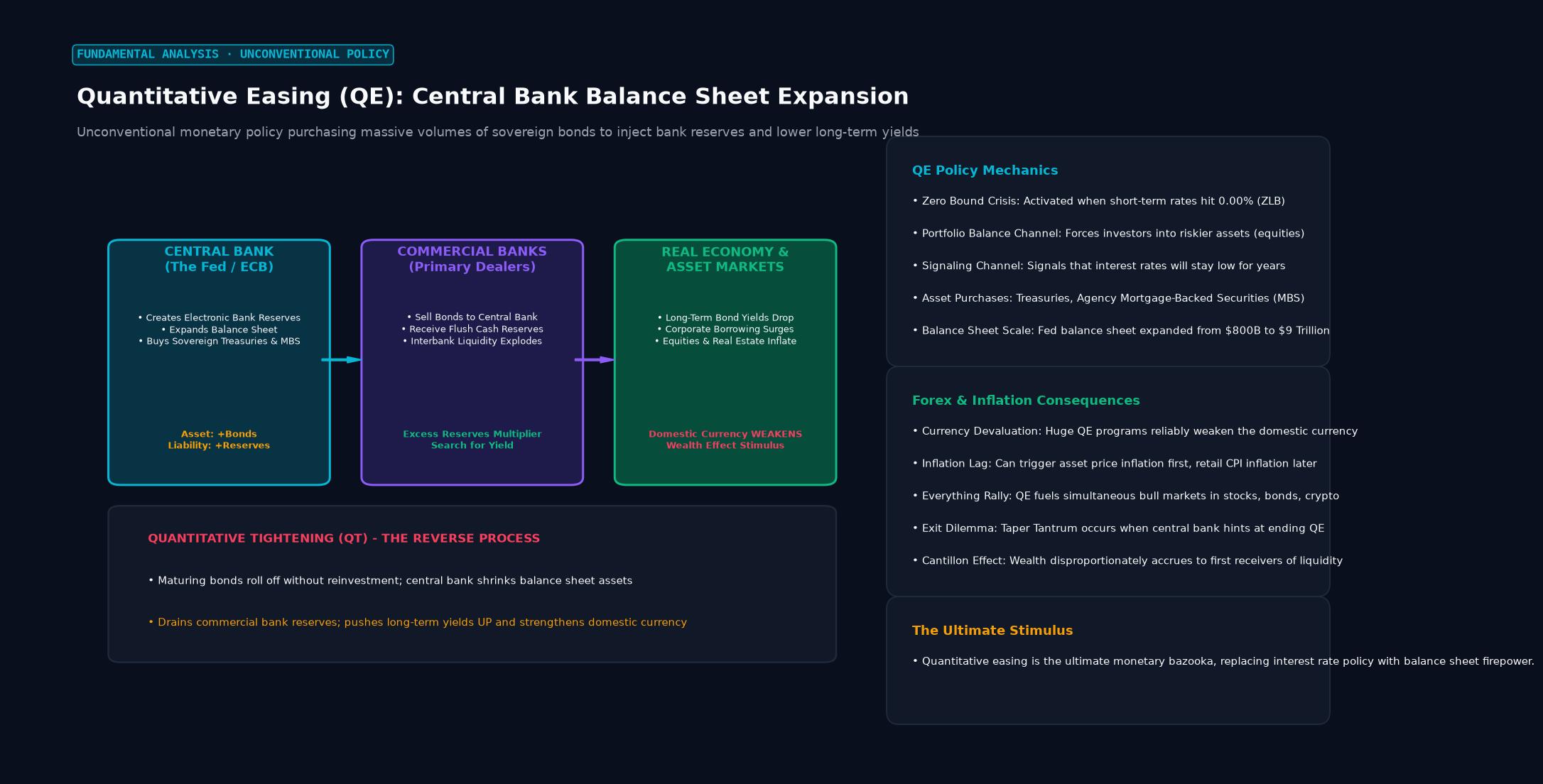 Figure: Unconventional monetary policy purchasing massive volumes of sovereign bonds to inject bank reserves and lower long-term yields
How QE Actually Works, Step by Step
- The central bank announces a QE program — for example, the Federal Reserve’s QE3 in 2012: $85 billion per month in Treasury and mortgage-backed security purchases.
- The Fed purchases these bonds from commercial banks, crediting those banks’ reserve accounts at the Fed with newly created money.
- Commercial banks now hold more reserves. The bond sellers (often pension funds, insurance companies) receive cash for their bonds and typically redeploy it into other assets — stocks, corporate bonds, real estate.
- Asset prices rise across the board as this newly created money seeks return. Interest rates on longer-dated bonds fall because the Fed’s buying creates demand.
- Cheaper long-term borrowing theoretically encourages business investment and consumer spending.
The currency effect: QE expands the money supply. More dollars (or euros, or yen) in circulation means each unit is worth slightly less relative to foreign currencies. Major QE programs have historically been associated with currency weakness.
QE in Practice: Three Key Episodes
US QE1, QE2, QE3 (2008-2014): The Federal Reserve conducted three rounds of quantitative easing following the 2008 financial crisis. At its peak, the Fed’s balance sheet expanded from roughly $900 billion in 2008 to $4.5 trillion by 2015. The dollar weakened during active QE periods but recovered as expectations of tapering grew.
BOJ QE (ongoing from 2001, expanded dramatically in 2013): The Bank of Japan pioneered large-scale asset purchases. Under Governor Kuroda’s Abenomics program launched in 2013, the BOJ committed to purchasing ¥80 trillion annually — equivalent to roughly 15% of Japan’s GDP per year. USD/JPY rallied from 78 to 125 as yen supply surged. Japan’s experience showed that even sustained massive QE couldn’t consistently hit inflation targets — one reason QE’s effectiveness remains debated.
ECB QE (2015-2022): The ECB launched its Public Sector Purchase Programme in January 2015, eventually buying €20 billion per month. EUR/USD fell from 1.2000 to below 1.0500 during the most aggressive phases.
The QE Trade in Forex
When a central bank announces QE, the standard trade is to sell that currency:
- Fed announces QE → sell USD
- ECB expands QE → sell EUR
- BOJ increases purchases → sell JPY
The trade works because QE explicitly increases money supply and often coincides with zero rates — a combination that makes the currency less attractive for yield-seeking capital. However, the market reaction depends heavily on whether the QE was expected or surprising, and how it compares in scale to other central banks’ actions.
In 2020, the Fed’s emergency QE response to COVID was so massive and so synchronized with other central banks that the dollar initially strengthened (safe-haven demand) before weakening substantially through 2021 as risk appetite recovered and the dollar’s yield advantage evaporated.
Tapering and QT: The Exit from QE
QE is not permanent. Eventually, when the economy recovers and inflation returns, central banks begin reducing asset purchases — a process called tapering. The first hint that tapering is coming can be as market-moving as the original QE announcement.
Ben Bernanke learned this in May 2013: a single comment suggesting the Fed might start tapering — made offhandedly in Congressional testimony — triggered the “Taper Tantrum,” a violent selloff in bonds and emerging market currencies worldwide.
After tapering ends, the next step is quantitative tightening (QT): actively selling assets or allowing them to mature without reinvestment, shrinking the balance sheet. QT is contractionary — it reduces money supply and is generally currency-positive.
Key Takeaways
- QE is used when interest rates are at zero and the economy needs additional stimulus
- The central bank creates new money to purchase government bonds, expanding money supply
- QE typically weakens the currency of the country conducting it
- The Fed, ECB, and BOJ have all conducted substantial QE programs post-2008
- Tapering (reducing QE) and QT (reversing QE) tend to strengthen a currency
FAQ
Does QE cause inflation? In theory, expanding money supply should eventually cause inflation. In practice, post-2008 QE in the US, EU, and Japan produced surprisingly little inflation for over a decade — suggesting the money created stayed in the financial system rather than circulating in the real economy. The post-COVID inflation surge of 2021-2022 reignited debate about QE’s long-term inflationary consequences.
What’s the difference between QE and printing money? They’re similar in effect but different in mechanism. “Printing money” (monetizing government debt) directly finances government spending. QE purchases assets from private sector financial institutions. In both cases, new money enters the financial system, but the transmission path differs.
Ready to trade forex?
Open a free demo account with a regulated broker. Practice with virtual funds before risking real money.