Factor Income
The economic flows of compensation received by the owners of factors of production (wages to labor, rents to land, interest to capital, and profits to enterprise) in exchange for productive services rendered in the generation of gross domestic product.
Factor Income
Factor income refers to the aggregate financial compensation earned by individuals, households, and corporate entities in return for supplying the services of factors of production to the economic system. Every dollar of gross domestic product (GDP) produced in an economy corresponds to an identical dollar of income distributed to the primary economic inputs: wages and salaries paid to labor, rental income paid to landowners, interest yields paid to capital providers, and entrepreneurial profit paid to business owners.
In macroeconomic analysis, sovereign debt underwriting, and central bank policy forecasting, factor income forms the foundation of the income approach to national accounting. Tracking how national income is divided between labor compensation and corporate capital returns (the functional distribution of income) provides critical signals regarding consumer demand sustainability, corporate profit margin cycles, wage-push inflation dynamics, and equilibrium foreign exchange values.
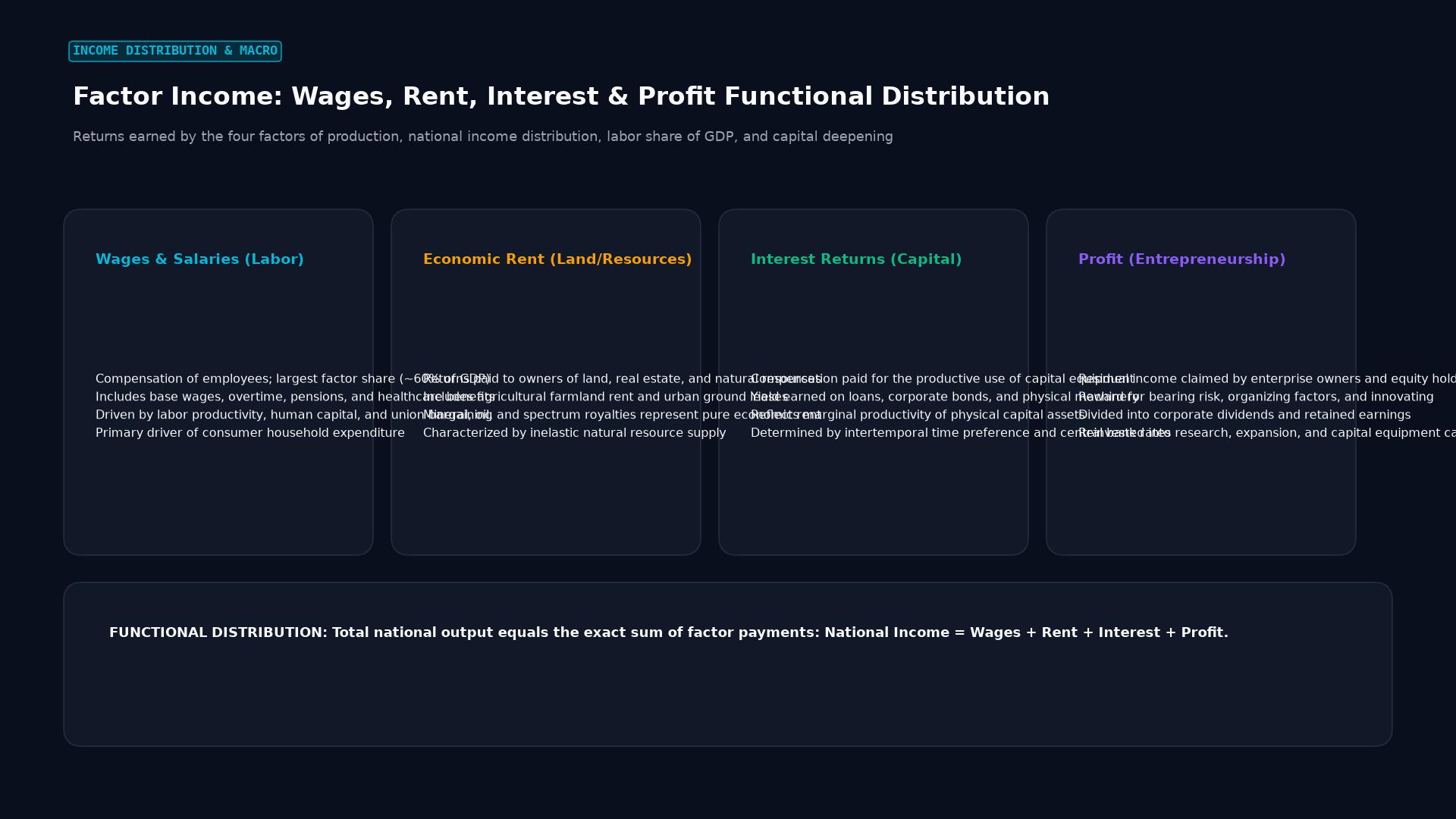 Figure: Returns earned by the four factors of production, national income distribution, labor share of GDP, and capital deepening
The Four Primary Streams of Factor Income
National economic accounting classifies factor incomes into four discrete categories based on the economic nature of the resource provided:
+--------------------------------------------------------------------------+
|                  The Four Canonical Factor Income Streams                |
+--------------------------------------------------------------------------+
|  Resource Factor | Income Mechanism        | Economic Character          |
+------------------+-------------------------+-----------------------------+
|  1. Labor        | Wages, Salaries, and    | Contractual compensation    |
|                  | Employer Benefits       | for physical or mental time |
|  2. Capital      | Net Interest and        | Return on deferred          |
|                  | Debt Yields             | consumption & physical plant|
|  3. Land         | Ground Rent, Mineral    | Compensation for geographic |
|                  | Royalties, Right-of-Way | surface area & raw resources|
|  4. Enterprise   | Corporate Profit,       | Residual reward for bearing |
|                  | Dividends, Equity Yield | commercial & economic risk  |
+--------------------------------------------------------------------------+
1. Labor Compensation ($w \times L$)
Compensation of employees constitutes the largest single component of national factor income in modern industrial economies. This includes gross hourly wages, executive salaries, overtime bonuses, and mandatory employer-paid contributions toward healthcare insurance, social security, and retirement pensions.
2. Capital Income ($r \times K$)
Capital earns income in the form of contractual interest payments, equipment lease revenues, and financing charges. Capital providers sacrifice present consumption liquidity to fund capital equipment, industrial facilities, and technological infrastructure, receiving interest yields as compensation.
3. Rental Income ($q \times T$)
Landlords and owners of natural resources receive rental payments for granting commercial access to physical real estate, farmland, mineral extraction rights, and telecommunication spectrum bands. Land possesses relatively inelastic supply, meaning rental prices fluctuate dynamically based on regional economic productivity.
4. Entrepreneurial Profit ($\Pi$, The Residual Claimant)
Unlike labor and debt capital, which receive contractually guaranteed payments, enterprise is the residual claimant of the economic process:
$$\Pi = \text{Total Revenue} - (\text{Wages} + \text{Interest} + \text{Rent} + \text{Depreciation})$$
If revenues exceed input costs, business owners extract entrepreneurial profit (distributed as corporate dividends or reinvested as retained earnings). If revenues fall short, profits turn negative, forcing equity owners to absorb losses.
The Functional Distribution of Income: Labor vs. Capital Share
Economists evaluate the functional distribution of income to analyze how aggregate economic output is divided between workers and owners of capital:
+--------------------------------------------------------------------------+
|                  Formulation of Functional Factor Shares                 |
+--------------------------------------------------------------------------+
|                                                                          |
|  Aggregate National Output: Y = Labor Share (s_L) + Capital Share (s_K)  |
|                                                                          |
|  Labor Share of Income:     s_L = (w * L) / Y                            |
|                                                                          |
|  Capital Share of Income:   s_K = (r * K + Π) / Y                        |
|                                                                          |
|  Where:                                                                  |
|  - s_L + s_K ≈ 1.0 (in standard closed-economy macroeconomic models)     |
|                                                                          |
+--------------------------------------------------------------------------+
Secular Decline of the Labor Share in Advanced Economies
Labor Share (%)
72%|
| * * * (1960s - 1970s: Stable Bowley's Law Regime ~68%)
68%| \
| \
64%| \ * * * (1980s - 1990s: Globalization Onset)
| \ / \
60%| * * \ * * * (2010s - 2020s: Tech Sclerosis)
| \ / \
56%+-------------------------*-----------*-------*--------------------->
1970 1990 2010 2025 TimeThe Breakdown of Bowley’s Law
For decades throughout the twentieth century, economists observed Bowley’s Law, an empirical generalization asserting that the division of national income between labor and capital remained remarkably constant at roughly 65% to 70% for labor and 30% to 35% for capital.
However, since approximately 2000, the labor share across OECD economies has suffered a secular decline, falling toward 58% to 62%:
- Capital-Labor Substitution ($\sigma > 1$): Rapid technological deflation in the cost of computing power, robotics, and industrial software incentivized corporations to replace manual and clerical labor with automated capital systems.
- Global Value Chain Offshoring: The integration of hundreds of millions of low-cost workers in China, India, and Southeast Asia into global trade expanded effective global labor supply, depressing the bargaining power of workers in advanced economies.
- The Rise of “Superstar” Firms: In sectors dominated by technology platforms and intellectual property monopolies, firms achieve high profit margins with lean labor forces (e.g., software giants generating billions in revenue with modest headcounts). This concentration shifts corporate value added directly into capital profits.
Factor Income vs. Transfer Income
In macroeconomic analysis, factor income must be distinguished from transfer income:
+--------------------------------------------------------------------------+
|                  Factor Income vs. Transfer Income Comparison            |
+--------------------------------------------------------------------------+
|  Analytical Dimension | Factor Income           | Transfer Income        |
+-----------------------+-------------------------+------------------------+
|  Economic Origin      | Direct provision of     | Government tax-and-    |
|                       | productive inputs       | spend redistribution   |
|  GDP Inclusion        | Counted directly in GDP | Excluded from GDP to   |
|                       | under income approach   | prevent double-counting|
|  Primary Examples     | Wages, commercial rent, | Social security checks,|
|                       | interest, gross profit  | unemployment benefits  |
|  Household Impact     | Primary earner wealth   | Consumption floor and  |
|                       | generation              | welfare safety net     |
+-----------------------+-------------------------+------------------------+
Transfer payments (such as state unemployment benefits, stimulus checks, or veteran pensions) do not reflect current production of new goods or services. They merely transfer purchasing power from taxpayers to benefit recipients.
While transfer payments are excluded from GDP calculations, they are included in Personal Disposable Income (PDI), which dictates retail consumer expenditure.
Cross-Border Factor Flows: GDP vs. GNI and the Irish Case Study
When analyzing global capital markets, economists distinguish between domestic geographic production and sovereign citizen factor earnings:
$$GNI = GDP + NFIA$$
Where:
- $GNI$ represents Gross National Income, measuring the total factor income earned by domestic residents and corporations, regardless of where production physically takes place.
- $GDP$ measures the value of production taking place strictly within national geographic borders.
- $NFIA$ represents Net Factor Income from Abroad (factor income earned by domestic residents abroad minus factor income earned by foreign investors within the domestic economy).
+--------------------------------------------------------------------------+
|                  The Irish Leprechaun Economics Anomaly                   |
+--------------------------------------------------------------------------+
|  Irish Headline GDP (2015)     | Surged by an astonishing +26.3% YoY     |
|  Underlying Physical Reality   | Factory output and jobs remained stable |
|  Factor Income Mechanism       | US multinational tech and pharma giants |
|                                | relocated intellectual property balance |
|                                | sheets to Dublin for tax efficiency     |
|  Distortion Result             | Massive corporate profits flowed through|
|                                | Ireland, but exited as repatriated      |
|                                | factor income (dividends) to US owners  |
|  Institutional Solution        | Central Bank of Ireland introduced      |
|                                | Modified GNI (GNI*) to strip out        |
|                                | distorted multinational factor flows    |
+--------------------------------------------------------------------------+
Macroeconomic and Central Bank Policy Implications
Central banks monitor the composition of factor income to formulate monetary policy:
[ Tight Labor Market: Unemployment Drops Below Natural Rate (u < u*) ]
                               │
                               ▼
[ Workers Demand Elevated Wages: Labor Factor Income (w * L) Surges ]
                               │
                               ▼
[ Corporations Face Rising Unit Labor Costs (ULC) ]
                               │
       ┌───────────────────────┴───────────────────────┐
       ▼                                               ▼
[ Absorb Cost: Margins Compress ]            [ Pass On Cost: Raise Retail Prices ]
  - Corporate Profits (Π) Fall                 - Core Services Inflation Accelerates
  - Equity Valuations Downgraded               - Central Bank Hikes Policy Rates
                                               - Sovereign Currency Appreciates
When wage factor income accelerates significantly above labor productivity gains, corporations must either raise retail consumer prices (sparking a wage-price spiral) or absorb margin contractions.
Central bankers closely track the Employment Cost Index (ECI) and unit labor costs. A persistent expansion in labor factor income signals embedded service-sector inflation, compelling monetary authorities to sustain restrictive interest rate policies, which bolsters sovereign currency exchange rates.
Frequently Asked Questions
Why is profit considered a factor income rather than a simple markup?
In economic theory, profit is the factor income that compensates entrepreneurship and risk-taking. Unlike salaried employees or bondholders who have contractual claims to compensation, entrepreneurs risk bankruptcy, deploy equity capital, and organize production under conditions of commercial uncertainty. Economic profit is the market mechanism that rewards successful resource allocation.
How does factor income relate to personal income?
Factor income measures payments made to factors of production during the creation of GDP. Personal income adjusts factor income to reflect what households actually receive: it adds governmental transfer payments (pensions, child allowances) and subtracts undistributed corporate profits, corporate income taxes, and payroll social security taxes.
What causes a country to have negative Net Factor Income from Abroad (NFIA)?
A country has negative NFIA when foreign investors own more productive assets within its borders than domestic citizens own abroad. In this situation, the outflow of dividends, loan interest, and corporate profits sent to foreign investors exceeds the inflow of overseas earnings returned to domestic residents, causing Gross National Income (GNI) to be smaller than Gross Domestic Product (GDP).
Ready to trade forex?
Open a free demo account with a regulated broker. Practice with virtual funds before risking real money.