Factor Endowment
The relative aggregate supply of land, labor, capital, and natural resources possessed by a sovereign nation that dictates its comparative advantage, trade specialization, and long-term equilibrium exchange rate dynamics within the Heckscher-Ohlin framework.
Factor Endowment
A country’s factor endowment represents the structural inventory of productive economic inputs it possesses and can deploy in commercial enterprise. Classical and modern macroeconomic theory partitions these resources into four primary pillars: land (arable geography, mineral reserves, hydrocarbon deposits), labor (workforce size, demographic age profile), capital (machinery, transportation logistics, communication grids), and human capital / entrepreneurship (technological patents, engineering skills, institutional governance).
In international economics and global macro trading, factor endowments provide the foundational architecture for predicting trade flows, current account balances, and long-term sovereign currency trajectories. Through the lens of the Heckscher-Ohlin model of international trade, a nation’s relative factor scarcity or abundance determines its comparative advantage. Nations export commodities and manufactures that intensively utilize their abundant factors while importing goods that require factors they lack.
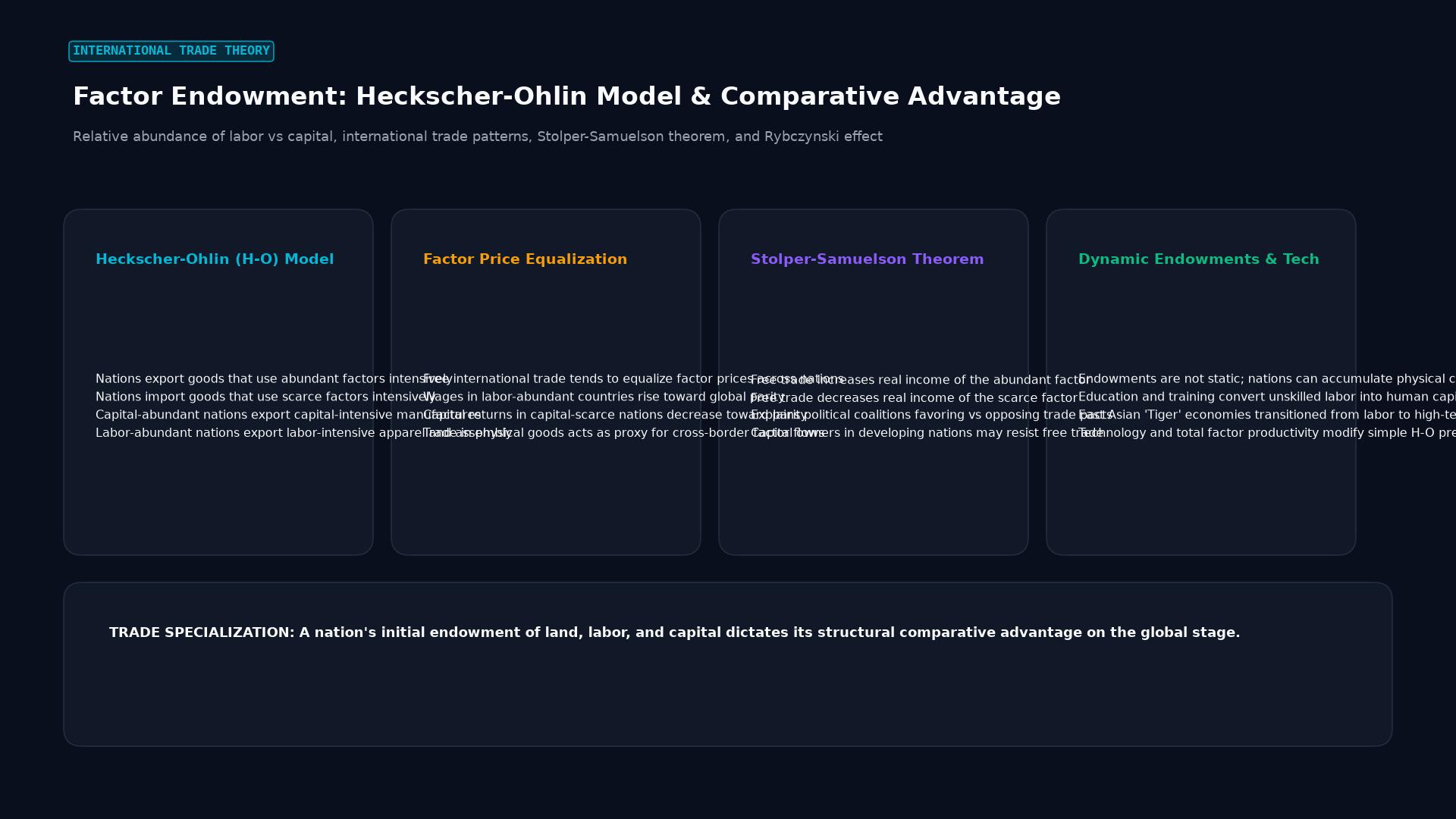 Figure: Relative abundance of labor vs capital, international trade patterns, Stolper-Samuelson theorem, and Rybczynski effect
Theoretical Foundations: The Heckscher-Ohlin-Samuelson Framework
Formulated by Swedish economists Eli Heckscher and Bertil Ohlin, and subsequently formalized mathematically by Paul Samuelson, the Heckscher-Ohlin (H-O) model established modern trade theory by replacing David Ricardo’s labor-only comparative advantage with multi-factor general equilibrium analysis.
The standard benchmark model considers two countries, two final consumption goods, and two homogenous factors of production (Capital $K$ and Labor $L$), operating under identical consumer preferences and constant returns to scale:
+--------------------------------------------------------------------------+
|                  Mathematical Condition for Factor Abundance             |
+--------------------------------------------------------------------------+
|                                                                          |
|  Country A is capital-abundant relative to Country B if and only if:     |
|                                                                          |
|                           (K_A / L_A) > (K_B / L_B)                      |
|                                                                          |
|  Alternatively, evaluated via factor price ratios under autarky:         |
|                                                                          |
|                             (r_A / w_A) < (r_B / w_B)                    |
|                                                                          |
|  Where:                                                                  |
|  - K and L represent total capital stock and aggregate labor force.      |
|  - r represents the rental price of physical capital.                    |
|  - w represents the prevailing nominal wage rate of labor.               |
|                                                                          |
+--------------------------------------------------------------------------+
The Four Core Theorems of Factor Endowment Economics
The Heckscher-Ohlin-Samuelson framework derives four interrelated mathematical theorems that govern international trade and factor pricing:
+--------------------------------------------------------------------------+
|                  The Four Foundational HOS Trade Theorems                |
+--------------------------------------------------------------------------+
|  Theorem                | Economic Mechanism & Predictive Rule           |
+-------------------------+------------------------------------------------+
|  1. Heckscher-Ohlin     | A country will export goods that intensively   |
|     Theorem             | use its abundant factor and import goods that  |
|                         | intensively use its scarce factor.             |
|  2. Stolper-Samuelson   | Free trade increases the real return of the    |
|     Theorem             | abundant factor and reduces the real return of |
|                         | the scarce factor within each nation.          |
|  3. Rybczynski          | At constant prices, an expansion in a factor's |
|     Theorem             | endowment increases the output of the good that|
|                         | uses it intensively more than proportionally.  |
|  4. Factor Price        | Free trade in goods equalizes absolute factor  |
|     Equalization (FPE)  | prices (wages and capital returns) across all  |
|                         | trading nations, even without factor mobility. |
+--------------------------------------------------------------------------+
1. The Stolper-Samuelson Distributional Shock
The Stolper-Samuelson theorem explains why international trade generates intense domestic political friction. When a capital-rich economy opens its borders to free trade with a labor-rich developing nation:
- Demand for domestic capital rises, driving up real interest rates and capital returns.
- Domestic low-skilled workers face direct wage competition, depressing their real purchasing power.
- Trade expands aggregate national wealth, but it concentrates gains in the hands of the abundant factor owners while penalizing the scarce factor.
2. The Factor Price Equalization Theorem
Samuelson demonstrated that when nations trade goods freely without tariff barriers or transport friction, indirect factor trade occurs. When the United States imports textiles from Bangladesh, it is indirectly importing cheap Bangladeshi labor.
Under strict theoretical assumptions, this indirect exchange causes the real wages ($w$) and capital rental rates ($r$) in both nations to converge toward parity, even if zero physical workers or machinery cross international borders.
The Leontief Paradox and Its Resolution
In 1953, Nobel laureate Wassily Leontief conducted the first comprehensive empirical test of the Heckscher-Ohlin theorem using input-output tables of the United States economy.
Because the United States possessed the world’s largest capital stock in the post-World War II era, the H-O model predicted that US exports would be overwhelmingly capital-intensive, while US imports would be labor-intensive. Leontief’s empirical findings shocked the economics profession:
+--------------------------------------------------------------------------+
|                  The Leontief Paradox Empirical Findings (1947 Data)     |
+--------------------------------------------------------------------------+
|  Economic Metric                     | US Exports       | US Imports     |
+--------------------------------------+------------------+----------------+
|  Capital Requirements ($ per $1M)    | $2,550,780       | $3,091,339     |
|  Labor Requirements (Person-Years)   | 182.31           | 170.00         |
|  Capital-per-Worker Ratio (K/L)      | $13,991 / Worker | $18,184 / Work |
|  Empirical Result                    | Labor-Intensive  | Capital-Intens |
+--------------------------------------------------------------------------+
Leontief discovered that US competitive exports were approximately 30% more labor-intensive than the goods the US imported from abroad. This apparent contradiction became known as the Leontief Paradox.
The Human Capital Resolution
Economists reconciled the paradox by refining the definition of labor. American workers in 1947 possessed vastly superior education, engineering training, and managerial expertise compared to overseas labor pools.
When economists partitioned labor into unskilled manual labor and skilled human capital, the paradox disappeared. The United States was not an exporter of raw physical labor; it was the world’s dominant exporter of embedded knowledge, research, and high-tier human capital.
Dynamic Evolution: How Nations Reshape Their Endowments
Factor endowments are not static geological destinies. Sovereign governments actively re-engineer their national factor profiles over multi-decade horizons:
[ Phase 1: Agrarian / Low-Skilled Labor Endowment (1960s) ]
  - Export: Raw Agricultural Commodities & Textiles
  - Capital Stock: Deficient; Dependent on Foreign Aid
                           │
                           ▼
[ Phase 2: Industrial Capital Accumulation (1980s) ]
  - Reinvest Corporate Savings into Heavy Machinery, Ports & Power Grids
  - Export: Steel, Shipbuilding, Consumer Electronics Assembly
                           │
                           ▼
[ Phase 3: Advanced Human Capital & Technological Endowment (2020s) ]
  - Universal Higher Education, Massive R&D Expenditure, Patent Portfolios
  - Export: Semiconductors, Biotechnology, AI Systems, Aerospace Components
The East Asian Economic Transformation
In the 1960s, South Korea, Taiwan, and Singapore possessed factor endowments characterized by high rural population density and virtually zero industrial capital. By pursuing aggressive capital accumulation, subsidized corporate savings, and state-backed educational investments, these nations transformed their capital-to-labor ratios ($K/L$).
Within forty years, South Korea evolved from exporting raw tungsten and plywood into the world’s premier exporter of advanced semiconductor memory and display panels.
China’s Structural Turning Point
Between 1990 and 2010, China functioned as the world’s manufacturing center by leveraging an abundant endowment of rural migrant labor, keeping manufacturing wages below $1.00 per hour.
However, demographic shifts resulting from the one-child policy, coupled with massive capital deepening, caused China to cross the Lewis Turning Point around 2015. Coastal factory wages surged toward $6.00 to $8.00 per hour. As its labor endowment grew scarce, China relocated low-end textile and assembly manufacturing to Vietnam, Indonesia, and Bangladesh, while deploying capital into advanced electric vehicles, green energy infrastructure, and industrial automation.
Forex Market and Macroeconomic Implications
Factor endowment dynamics exert profound structural influence on foreign exchange markets:
+--------------------------------------------------------------------------+
|                  Macro FX Transmission of Factor Endowments              |
+--------------------------------------------------------------------------+
|  Economic Phenomenon | Mechanism Transmitting to Sovereign Currency      |
+----------------------+---------------------------------------------------+
|  Terms-of-Trade      | Surging global demand for a nation's abundant     |
|  Windfalls           | factor exports expands export revenues, driving   |
|                      | structural current account surpluses and FX bids. |
|  Balassa-Samuelson   | Rapid productivity growth in capital-intensive    |
|  Effect              | tradables bids up domestic non-tradable wages,    |
|                      | causing real exchange rate appreciation.         |
|  Dutch Disease       | Abundant natural resource discovery triggers massive|
|  Syndrome            | capital inflows, overvaluing the nominal currency |
|                      | and destroying non-commodity manufacturing.       |
+--------------------------------------------------------------------------+
1. Dutch Disease in Commodity-Endowed Currencies
When a nation discovers massive natural resource endowments (such as the Netherlands with North Sea natural gas in the 1960s, or Australia with iron ore in the 2000s), surging commodity exports generate massive foreign currency inflows. As international buyers purchase the local currency to settle mineral contracts, the sovereign exchange rate appreciates sharply.
This currency appreciation makes domestic agricultural and manufacturing exports uncompetitive internationally, hollowing out the nation’s non-commodity industrial base.
2. The Balassa-Samuelson Productivity Transmission
As developing nations accumulate physical and human capital, their labor productivity in tradable manufacturing sectors rises rapidly toward developed-market benchmarks. To prevent domestic factory workers from defecting, non-tradable service industries (hairdressers, local construction, healthcare) must match those rising industrial wages, even though service productivity gains are modest.
This dynamic pushes up domestic service price levels, causing the nation’s real exchange rate (adjusted for relative purchasing power parity) to appreciate steadily over time.
Frequently Asked Questions
What is the difference between absolute advantage and factor endowment?
Absolute advantage describes a country’s ability to produce a specific good using fewer physical inputs (hours of labor or raw material) than another country. Factor endowment describes the underlying national inventory of resources (capital, labor, land). Factor endowment explains why comparative and absolute advantages emerge in particular industrial sectors.
How does the Leontief Paradox challenge trade theory?
The paradox challenged the classical Heckscher-Ohlin assumption that labor is a uniform, homogenous input. Wassily Leontief showed that the capital-rich United States was exporting labor-intensive products. This was resolved when economists recognized that high-skill human capital (engineering, research, design) represents a distinct, high-value factor of production rather than raw manual labor.
Can a nation overcome poor natural resource endowments?
Yes. Numerous premier global economies (such as Japan, Switzerland, Singapore, and South Korea) possess virtually zero domestic oil, natural gas, or mineral reserves. These economies compensated for geographic scarcity by accumulating massive physical capital stocks, cultivating world-class human capital, and constructing sophisticated legal, financial, and logistical infrastructure.
Ready to trade forex?
Open a free demo account with a regulated broker. Practice with virtual funds before risking real money.