Factors of Production
Factors of production are the primary economic inputs — land, labor, capital, and entrepreneurship — that are combined by producers to generate goods and services within an economy, each commanding its own distinct category of factor income: rent, wages, interest, and profit.
What Are the Factors of Production?
In classical and neoclassical macroeconomic theory, the factors of production are the fundamental economic inputs that businesses combine to transform raw inputs into finished goods and services. Traditional economic taxonomy classifies four primary factors:
- Land: All natural resources extracted from the physical environment — including arable farmland, mineral ore deposits, petroleum and gas reserves, freshwater resources, and geographic location. Compensation: Rent.
- Labor: The physical and cognitive human effort expended in the production process. Compensation: Wages and Salaries.
- Capital: Human-created productive assets — factories, machinery, software, transportation infrastructure, and financial capital — used to facilitate and scale production. Compensation: Interest and Dividends.
- Entrepreneurship: The organizational capacity, risk tolerance, and innovative vision that combines the other three factors into a viable business enterprise. Compensation: Profit (the residual after all other factors are paid).
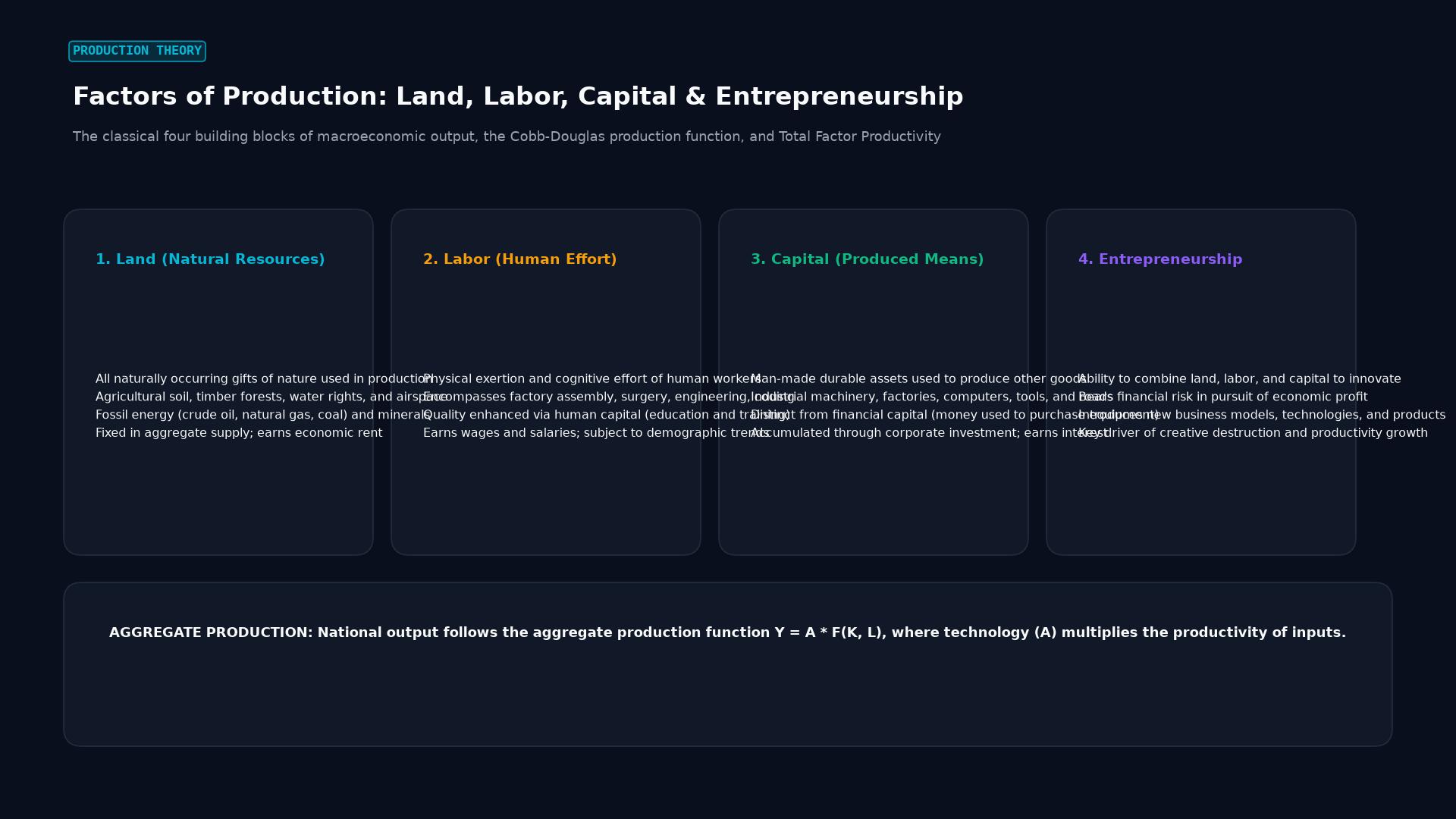 Figure: The classical four building blocks of macroeconomic output, the Cobb-Douglas production function, and Total Factor Productivity
Technical Mechanics: The Aggregate Production Function
At the macroeconomic level, the relationship between factor inputs and national output is formalized through the Aggregate Production Function (APF). The canonical Cobb-Douglas specification is:
$$Y = A \cdot K^{\alpha} \cdot L^{1 - \alpha}$$
Where:
- $Y$: Real GDP (total national output).
- $A$: Total Factor Productivity (TFP) — a measure of technological efficiency.
- $K$: Aggregate capital stock deployed in production.
- $L$: Total hours of labor input in the economy.
- $\alpha$: Capital’s output elasticity (empirically estimated at approximately 0.30 to 0.35 for advanced economies).
- $(1-\alpha)$: Labor’s output elasticity (approximately 0.65 to 0.70).
Capital-Labor Ratio & Growth Accounting
The Solow Residual decomposes economic growth into factor input growth and Total Factor Productivity (TFP) improvements:
$$\frac{\Delta Y}{Y} = \alpha \cdot \frac{\Delta K}{K} + (1 - \alpha) \cdot \frac{\Delta L}{L} + \frac{\Delta A}{A}$$
Modern Additions: Knowledge & Data as the 5th Factor
Contemporary economists have proposed a fifth factor of production to accommodate the digital economy:
| Factor | Classic Classification | Modern Digital Economy |
|---|---|---|
| Land | Physical geography, mineral resources | Spectrum rights, data centers, satellite orbits |
| Labor | Manual and cognitive human effort | AI-augmented knowledge work |
| Capital | Factories, machinery, equipment | Cloud computing, software platforms |
| Entrepreneurship | Risk-bearing business organization | Platform ecosystems, network effects |
| Knowledge / Data | Not recognized in classical models | Patent portfolios, training datasets, algorithms |
Real-World Case Study: China’s Factor Rebalancing (1978–Present)
The most dramatic large-scale reallocation of factors of production in modern economic history was executed by China during its reform era.
Anatomy of a Factor Transformation:
1. Pre-Reform (1978): China's factors of production were almost entirely mobilized through central government planning. Land was collectivized; labor was assigned by the state; capital was controlled by state-owned banks.
2. The Reform Mechanism: Deng Xiaoping's "Open Door" policy created Special Economic Zones (Shenzhen, Shanghai) where market-based factor prices — wages, rents, and interest rates — were allowed to emerge through supply and demand.
3. The Factor Arbitrage: Multinational corporations relocated production to China to access labor at $0.30/hour vs. $15/hour in the US — exploiting a massive factor price differential.
4. The Transformation: China's factor composition shifted from predominantly agricultural land and unskilled labor (1978) to advanced capital investment and human capital (2024), lifting 800 million people out of poverty — the largest factor-driven economic expansion in recorded history.
Frequently Asked Questions (FAQ)
Why is entrepreneurship considered a separate factor of production rather than just a type of labor?
Labor refers to the mechanical or cognitive execution of tasks that can be performed by workers under management direction. Entrepreneurship is fundamentally distinct because it involves the assumption of financial risk — committing personal capital with no guaranteed return — and the creative organization of the other three factors into a viable production system. An employee receives a guaranteed wage; an entrepreneur receives a residual profit only if the enterprise creates more value than the total cost of all factor inputs.
What is the difference between “factor cost” and “market price” in national income accounting?
GDP at factor cost measures national output at the income prices received by factors of production — wages, rent, interest, and profit — excluding all indirect taxes (such as value-added tax) and including any government production subsidies. GDP at market price is what consumers actually pay, which includes indirect taxes but excludes subsidies. The relationship is: $\text{GDP at Market Price} = \text{GDP at Factor Cost} + \text{Indirect Taxes} - \text{Subsidies}$.
How does automation threaten the labor factor of production?
Automation and artificial intelligence directly substitute capital (robots, algorithms) for labor in the production function. As the capital-labor ratio ($K/L$) rises, the marginal product of labor increases for highly skilled workers who complement technology — but collapses for routine-task workers who are directly replaced. Mainstream economic research projects that AI-driven automation could displace 40% to 60% of existing job categories over the next twenty years, requiring massive retraining investment in the labor factor.
Ready to trade forex?
Open a free demo account with a regulated broker. Practice with virtual funds before risking real money.