Factor Market
A market where the services of factors of production (labor, capital, land, and raw materials) are bought and sold, operating through derived demand mechanics where prices equal marginal revenue products in competitive equilibrium.
Factor Market
A factor market (also termed an input or resource market) is an economic arena where businesses and commercial enterprises purchase or rent the productive services of factors of production: labor, physical and financial capital, raw commercial land, and technological resources. Factor markets stand in direct structural contrast to final goods and services markets (product markets). In the circular flow of macroeconomic activity, the institutional roles of market participants are inverted: households and resource owners act as sellers, supplying their labor and capital, while commercial business firms act as buyers, purchasing the necessary inputs to execute manufacturing and service operations.
In financial market analysis, central banking economics, and currency valuation, factor markets serve as the upstream originators of cost pressures. The prices established within factor markets (prevailing hourly wages, industrial borrowing rates, commercial lease rents, and bulk commodity prices) dictate the cost curve of the entire economy. Frictions or structural imbalances in factor markets transmit directly into consumer price inflation, corporate earnings compressions, central bank monetary policy shifts, and sovereign foreign exchange fluctuations.
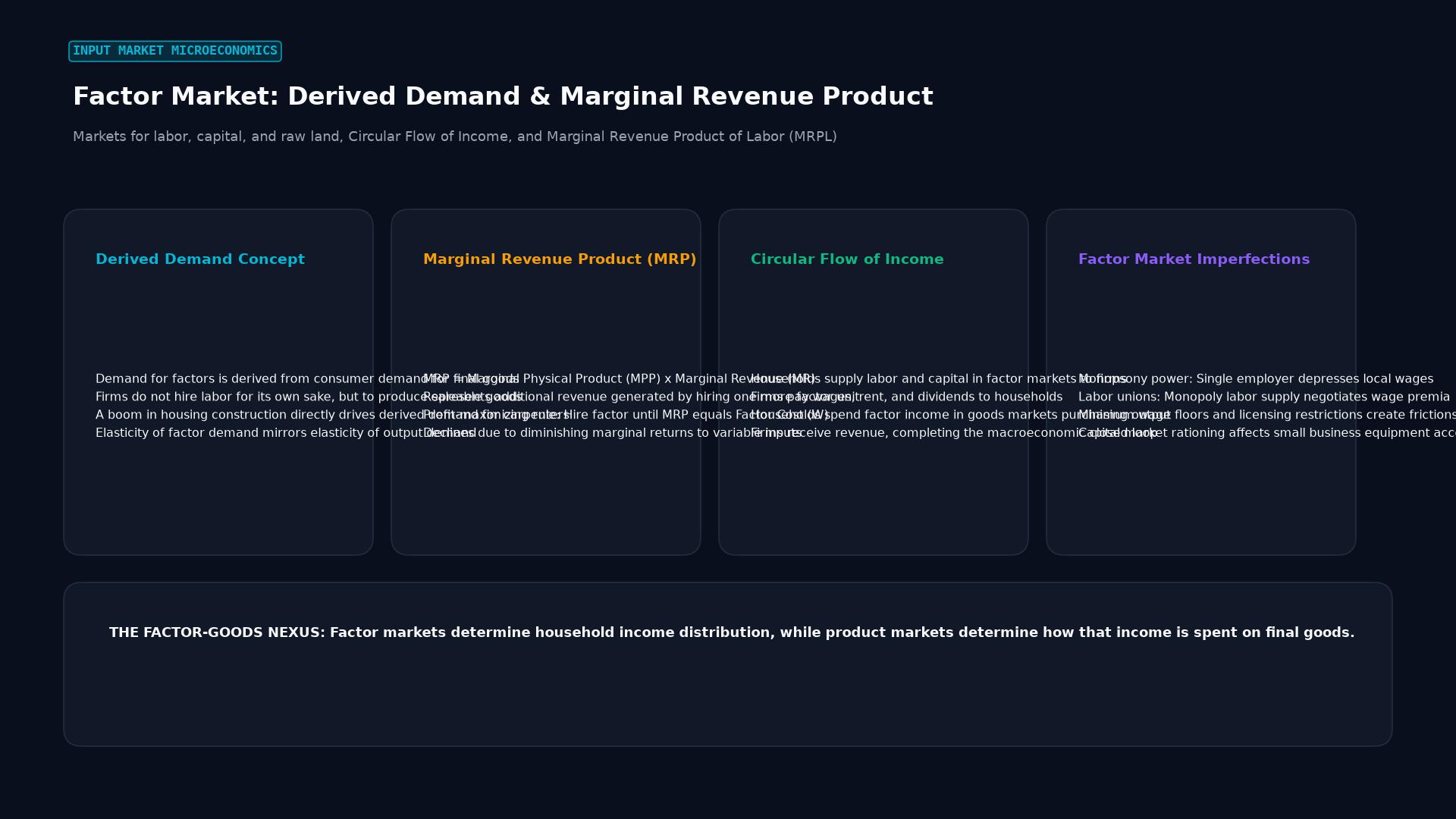 Figure: Markets for labor, capital, and raw land, Circular Flow of Income, and Marginal Revenue Product of Labor (MRPL)
The Derived Demand Architecture
The foundational economic principle governing factor markets is the concept of derived demand. Unlike consumer goods, which are purchased for their direct utility or satisfaction, businesses do not demand labor, machinery, or warehouse space for intrinsic enjoyment.
A firm’s demand for productive inputs is derived entirely from the downstream consumer demand for the final goods and services those inputs create:
[ Downstream Consumer Demand: Global Surge in Electric Vehicles (EVs) ]
                                 │
                                 ▼
   [ Derived Demand Shock Transmitted Directly into Upstream Factor Markets ]
                                 │
    ┌────────────────────────────┼────────────────────────────┐
    ▼                            ▼                            ▼
[ Labor Factor Market ]  [ Capital Factor Market ]   [ Resource Factor Market ]
Surging demand for       Massive capital allocation   Lithium, Nickel, Copper,
Battery Chemists &       into Gigafactory robotics    Cobalt spot prices spike
Automation Engineers     and battery cell plants      on global commodities desks
Alfred Marshall’s Four Rules of Derived Demand
In his 1890 Principles of Economics, Alfred Marshall formalized the conditions that dictate whether the price elasticity of demand for a factor of production will be high (sensitive) or low (inelastic):
+--------------------------------------------------------------------------+
|                  Marshall's Four Laws of Derived Factor Demand           |
+--------------------------------------------------------------------------+
|  Marshallian Rule     | Economic Reality & Operational Implication       |
+-----------------------+--------------------------------------------------+
|  1. Essentiality of   | Factor demand is more inelastic when the factor  |
|     the Factor        | is technologically essential and lacks close,    |
|                       | viable substitutes in the production process.   |
|  2. Downstream Good   | Inelastic consumer demand for the final product   |
|     Price Elasticity  | translates into highly inelastic factor demand.  |
|  3. Factor Share of   | "The Importance of Being Unimportant": when an   |
|     Total Production  | input represents a tiny fraction of total cost,  |
|     Cost (The Share)  | buyers readily absorb price increases.           |
|  4. Supply Elasticity | Inelastic supply of complementary inputs makes   |
|     of Other Inputs   | demand for the primary factor more inelastic.    |
+--------------------------------------------------------------------------+
Marginal Productivity Theory and Mathematical Equilibrium
In competitive factor markets, firms determine the profit-maximizing quantity of an input to employ by comparing the input’s marginal revenue contribution against its marginal cost:
+--------------------------------------------------------------------------+
|                  Marginal Productivity Mathematical Foundations          |
+--------------------------------------------------------------------------+
|                                                                          |
|  1. Marginal Product of Labor (MP_L):                                    |
|     MP_L = ∂Q / ∂L (Additional physical output produced by one extra unit|
|            of labor, holding capital and technology constant).           |
|                                                                          |
|  2. Marginal Revenue Product of Labor (MRP_L):                           |
|     MRP_L = MP_L * MR (Additional dollar revenue generated by hiring     |
|             one extra unit of labor).                                    |
|                                                                          |
|     Under perfect competition in output markets (where MR = P):          |
|     MRP_L = MP_L * P_output                                              |
|                                                                          |
|  3. Marginal Factor Cost (MFC_L):                                        |
|     MFC_L = ∂TC / ∂L (Additional total expense incurred by the firm      |
|             to acquire one additional unit of labor).                    |
|                                                                          |
+--------------------------------------------------------------------------+
Competitive Factor Market Equilibrium (Labor Hiring)
Wage / MRP ($)
^
| MFC_L = w (Horizontal Competitive Labor Supply Curve)
w* +---------------------------*----------------------------->
| / \
| / \
| / \
| / \ MRP_L = Demand for Labor (MP_L * P)
| / \
0 +---------------------------------*----------------------->
L* Labor QuantityThe Profit-Maximizing Hiring Rule
A rational, profit-maximizing firm will continue hiring labor up to the exact point where the marginal revenue product equals the marginal factor cost:
$$\text{MRP}_L = \text{MFC}_L = w$$
- If $\text{MRP}_L > w$: The revenue generated by an additional worker exceeds the wage paid; the firm expands hiring to capture surplus profit.
- If $\text{MRP}_L < w$: The last worker costs more in wages than they generate in commercial output; the firm contracts headcount to eliminate losses.
Imperfect Competition: Monopsony and Factor Exploitation
While classical textbook models presume perfectly competitive factor markets, real-world markets frequently exhibit monopsony (a market structure with a single dominant buyer or a small oligopsony of employers):
+--------------------------------------------------------------------------+
|                  Competitive vs. Monopsonistic Factor Markets            |
+--------------------------------------------------------------------------+
|  Market Dimension     | Competitive Factor Market | Monopsony Factor Market |
+-----------------------+---------------------------+-------------------------+
|  Number of Buyers     | Thousands of small firms  | Single dominant employer|
|                       | competing for workers     | in an isolated region   |
|  Wage-Setting Power   | Zero; price-taker at w*   | High; wage-maker        |
|  Factor Supply Curve  | Perfectly elastic (flat)  | Upward-sloping          |
|  MFC vs. Wage (w)     | MFC = w                   | MFC > w                 |
|  Hiring Outcome       | Efficient: w = MRP_L      | Exploitative: w < MRP_L |
+--------------------------------------------------------------------------+
Monopsony Wage Determination and Deadweight Loss
Wage / MRP ($)
^
| / Marginal Factor Cost (MFC_L)
| /
| / / Average Factor Cost (Supply)
| * Monopsony / /
| / Intersection /
w_c+------------------+----------------* (Competitive Equilibrium)
| / / \
| / / \
w_m+---------------* Monopsony Wage / \ Demand for Labor (MRP_L)
+--------------------------------------------------------->
L_m L_c Labor QuantityThe Mechanics of Monopsonistic Wage Suppression
Because a monopsonist faces the entire market upward-sloping labor supply curve, hiring an additional worker requires raising the wage for all existing employees. Consequently, the Marginal Factor Cost curve ($\text{MFC}_L$) lies steeply above the average wage supply curve:
- The monopsonist equates $\text{MRP}_L = \text{MFC}_L$, hiring only $L_m$ workers.
- The firm pays the wage indicated by the supply curve at that employment level ($w_m$).
- The resulting wage $w_m$ is significantly lower than the competitive wage $w_c$, and employment $L_m$ falls short of the competitive benchmark $L_c$.
- The difference between worker productivity ($\text{MRP}_L$) and the actual wage paid ($w_m$) represents monopsonistic rent extraction, transferring factor income from labor to equity owners.
The Capital Factor Market and Central Bank Transmission
The factor market for capital determines the rental rate of equipment and the benchmark cost of financial credit (the interest rate). In macroeconomics, this market connects aggregate domestic savings (supply of loanable funds) with corporate capital investment demand:
[ Central Bank Policy Decision: Hikes Policy Benchmark by 250 bps ]
                                │
                                ▼
[ Capital Factor Market Repricing: Interbank Lending Rates Adjust ]
                                │
                                ▼
[ Corporate Cost of Capital (WACC) Escalates: Marginal Factor Cost of K Jumps ]
                                │
                                ▼
[ Investment Cutoff: Projects with Expected Return < New Cost of Capital Halted ]
                                │
                                ▼
[ Capital Deepening Stalls: Aggregate Demand Cools & Inflation Recedes ]
When central banks manipulate short-term policy interest rates, they are directly intervening in the capital factor market. By elevating the marginal factor cost of capital, monetary authorities make it uneconomic for corporations to borrow, cooling capital expenditures (CapEx) and restoring macroeconomic price stability.
Case Study: The 2021–2023 Post-Pandemic Factor Market Shock
Between 2021 and 2023, global capital markets experienced an unprecedented, simultaneous supply shock across all major factor markets:
+--------------------------------------------------------------------------+
|                  The Multi-Factor Supply Squeeze (2021-2023)             |
+--------------------------------------------------------------------------+
|  Factor Market | Empirical Disruption Observed                           |
+----------------+---------------------------------------------------------+
|  Labor Market  | Early retirements, shifting worker preferences, and     |
|                | border closures created massive labor scarcity. US job  |
|                | vacancies hit 12 million; Beveridge Curve shifted out.   |
|  Capital       | Ultra-loose quantitative easing ignited asset bubbles,   |
|  Market        | followed by the fastest monetary tightening in 40 years.|
|  Commodity /   | Supply chain logistics bottlenecks and geopolitical     |
|  Land Market   | sanctions spiked spot prices across crude oil, natural  |
|                | gas, industrial fertilizers, and semiconductor wafers.   |
+--------------------------------------------------------------------------+
The Forex Transmission Mechanism
This factor market tightness drove US wage growth above 6.0% and headline CPI to 9.1% in mid-2022. The Federal Reserve responded with 525 basis points of rapid rate hikes.
Because the US factor market exhibited higher wage flexibility and capital return adjustments than the European or Japanese factor markets, global capital flooded into the US dollar. The US Dollar Index (DXY) rallied to a two-decade high of 114.70, forcing EUR/USD below parity and USD/JPY above 150.00. This macro episode demonstrated that sovereign exchange rates are fundamentally determined by the relative pricing and flexibility of national factor markets.
Frequently Asked Questions
What is the primary difference between a product market and a factor market?
In a product market, households act as buyers who purchase final consumer goods and services, while commercial businesses act as sellers. In a factor market, the roles are inverted: households and resource owners act as sellers who supply labor, land, and financial savings, while businesses act as buyers who purchase or rent these inputs to conduct production.
Why is factor demand called derived demand?
Factor demand is called derived demand because businesses do not purchase factors of production for direct personal enjoyment. A commercial construction firm does not purchase bulldozers or hire crane operators for leisure; its demand for those inputs is derived entirely from the downstream market demand for residential apartment complexes or commercial office towers.
What is Marginal Revenue Product (MRP)?
Marginal Revenue Product (MRP) is the additional monetary revenue a business generates by employing one additional unit of a variable factor of production (such as hiring one more worker or leasing one more machine). In competitive markets, it is calculated as the physical marginal product of the input multiplied by the market price of the output ($MRP = MP \times P$).
Ready to trade forex?
Open a free demo account with a regulated broker. Practice with virtual funds before risking real money.