Factory Gate Price
Factory gate price, or ex-works price, is the wholesale valuation of manufactured goods directly at the production plant exit point, capturing domestic manufacturing costs and operating profit margins while excluding transport, freight, insurance, and retail taxes.
What Is Factory Gate Price?
In industrial economics, trade logistics, and national statistical measurement, the factory gate price (frequently synonymous with the international trade term Ex Works (EXW)) is the price charged by a manufacturing facility for finished products before any shipping, logistical distribution, customs handling, or retail markups are added.
Because it isolates pure manufacturing expenses—raw materials, industrial energy, factory floor wages, equipment amortization, and manufacturer profit margins—the factory gate price serves as the foundational data source for national Producer Price Indices (PPI). Central banks and macroeconomic analysts track factory gate pricing as the primary leading indicator for future inflationary pressures before they propagate through the distribution pipeline to end consumers.
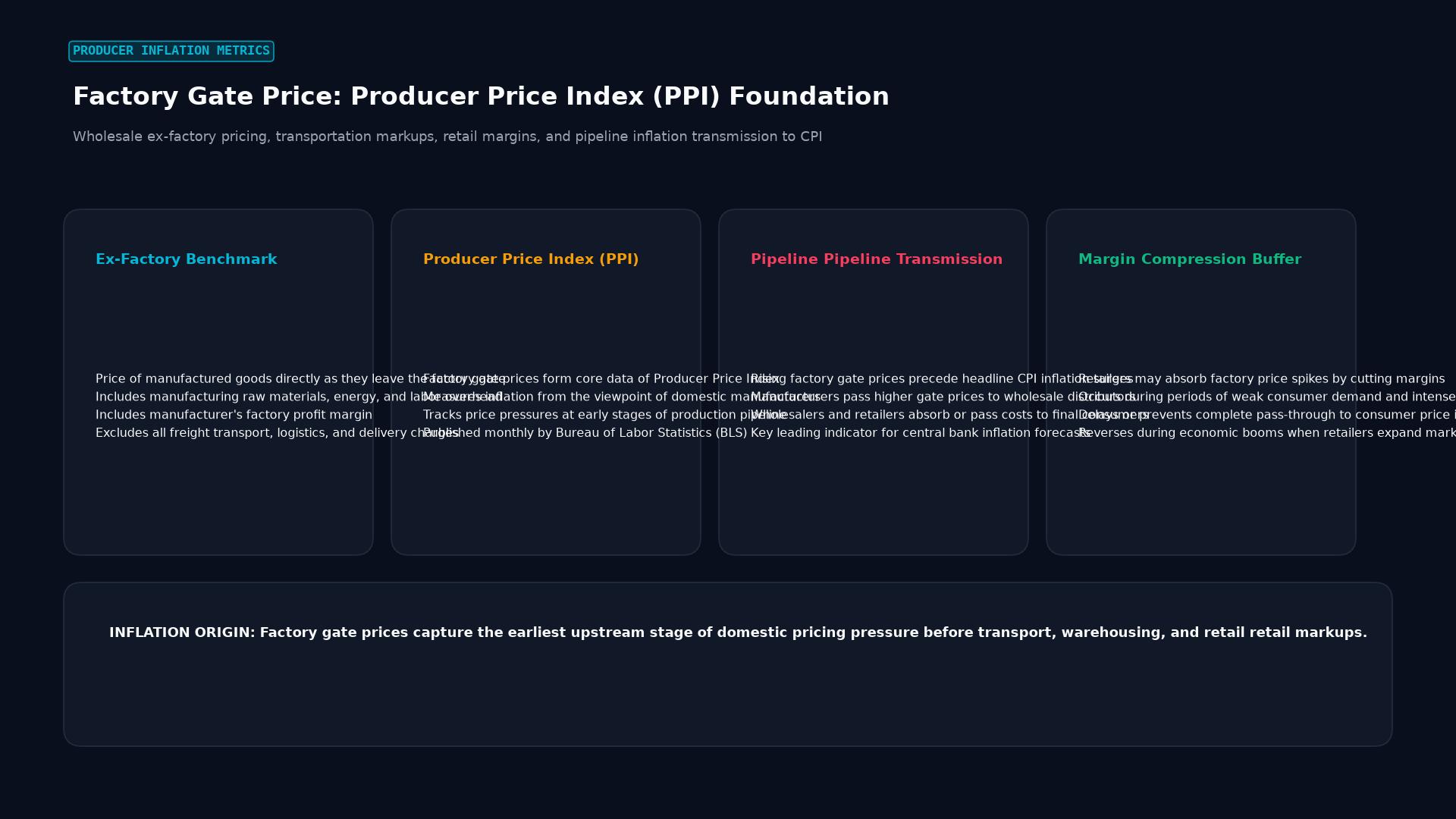 Figure: Wholesale ex-factory pricing, transportation markups, retail margins, and pipeline inflation transmission to CPI
Technical Mechanics & Economic Transmission
The movement of factory gate prices serves as the earliest empirical stage of the cost-push inflation pipeline. Statistical agencies model the relationship between factory gate prices and downstream retail consumer prices through dynamic distributed lag models:
1. Cost Breakdown Identity
The factory gate price per unit of output ($P_{FG}$) is decomposed as:
$$P_{FG} = \frac{\sum_{i} P_i \cdot X_i + W \cdot L + E + D}{Q} \times (1 + m)$$
Where:
- $\sum P_i X_i$ represents raw material and intermediate component costs.
- $W \cdot L$ represents direct manufacturing labor compensation.
- $E$ is industrial energy and utility overhead.
- $D$ is capital equipment depreciation.
- $Q$ is total physical units produced.
- $m$ is the manufacturer’s target net operating profit margin.
2. Lead-Lag Transmission to Consumer Price Index (CPI)
Econometric analysis indicates that changes in factory gate prices lead changes in core goods Consumer Price Index (CPI) by two to six months, depending on supply chain complexity and inventory turnover rates:
$$\Delta \text{CPI}{t} = \alpha + \sum{k=1}^K \beta_k \Delta P_{FG, t-k} + \gamma \Delta \text{Logistics}_t + \varepsilon_t$$
When manufacturers experience elevated energy or raw material costs, they either absorb the shock by compressing margins ($m$), or pass the cost downstream into factory gate prices, forcing wholesalers and retailers to raise final shelf prices.
Comparative Matrix: Pricing Stages Across Supply Chains
| Price Concept | Point of Measurement | Includes Freight & Shipping? | Includes Retail Sales Tax? | Primary Economic Indicator |
|---|---|---|---|---|
| Factory Gate Price (EXW) | Manufacturing facility loading dock | No (borne by buyer or freight forwarder) | No | Producer Price Index (PPI) - Output |
| Free on Board (FOB) Price | Port of export ship terminal | Yes (domestic inland transit to port) | No | Export Price Index (XPI) |
| Wholesale / Distributor Price | Regional fulfillment warehouse | Yes (inbound transport + warehousing) | No | Wholesale Price Index (WPI) |
| Retail Consumer Price | Final retail checkout / e-commerce cart | Yes (full logistics, shelf, and delivery) | Yes (VAT, GST, sales tax) | Consumer Price Index (CPI) |
Real-World Case Study: China’s Factory Gate Deflation & Global Spillover
As the “world’s factory,” China’s Factory Gate Price Index (officially reported as China PPI) exerts a profound gravitational pull on global goods pricing and international central bank monetary policy:
- The 2023–2024 Industrial Capacity Surge: Facing real estate headwinds and domestic demand rebalancing, Chinese industrial firms expanded high-end manufacturing across electric vehicles, lithium batteries, and solar photovoltaics.
- Deflationary Factory Gate Pressures: Fierce domestic competition, combined with plunging battery raw material costs, triggered an extended contraction in China’s factory gate prices (PPI contracted year-over-year for over 18 consecutive months).
- Cross-Border Transmission: As Chinese manufacturers lowered export dollar prices to clear domestic inventory, imported goods prices in the United States, Europe, and Southeast Asia plummeted.
- Global Inflation Impact: Disinflation in factory gate prices acted as a major tailwind for the Federal Reserve and European Central Bank, accelerating the return of headline inflation toward their 2% mandates and influencing global foreign exchange (USD, EUR, CNH) cross-rates.
Frequently Asked Questions (FAQ)
What is the difference between factory gate price and Ex Works (EXW)?
In commercial practice, Ex Works (EXW) is the formal Incoterm defined by the International Chamber of Commerce (ICC) designating that the seller fulfills obligations by making goods available at their factory floor. Factory gate price is the economic and statistical price quote corresponding directly to an EXW commercial transaction.
Why do factory gate prices exhibit greater volatility than consumer prices?
Factory gate prices are exposed directly to raw commodity price volatility (crude oil, natural gas, steel, base metals, semiconductors). Retail prices, by contrast, incorporate sticky costs—such as commercial real estate rent, advertising, retail labor, and distribution contracts—which act as structural buffers that smooth out headline consumer price swings.
How does currency appreciation impact domestic factory gate prices?
A strengthening domestic currency lowers the cost of imported raw materials, fuels, and foreign intermediate components for domestic manufacturers. This cost relief puts downward pressure on domestic factory gate prices. Conversely, if a country’s currency depreciates sharply, factory gate prices surge as imported production inputs become significantly more expensive in local currency terms.
Ready to trade forex?
Open a free demo account with a regulated broker. Practice with virtual funds before risking real money.