Facultative Reinsurance
Facultative reinsurance is a specialized reinsurance arrangement wherein a primary ceding insurer negotiates coverage for a single, high-value, or atypical policy on an individual basis, with the reinsurer retaining full underwriting discretion to accept, reject, or re-price the specific risk.
What Is Facultative Reinsurance?
In commercial insurance, risk underwriting, and institutional capital management, facultative reinsurance is a transactional risk-transfer agreement covering an individual, designated insurance policy. Under a facultative contract, the primary insurer (known as the ceding company) transfers a portion or the entirety of an exceptional liability—such as an offshore oil rig, a commercial satellite launch, a massive infrastructure bridge, or a skyscraper—to a secondary balance sheet (the reinsurer).
The term facultative derives from the reinsurer’s complete “faculty” or optional right: unlike programmatic treaty reinsurance, where the reinsurer is legally obligated to absorb all policies meeting predefined criteria, in facultative reinsurance the reinsurer independently assesses, underwrites, and chooses whether to accept or decline each individual risk submitted.
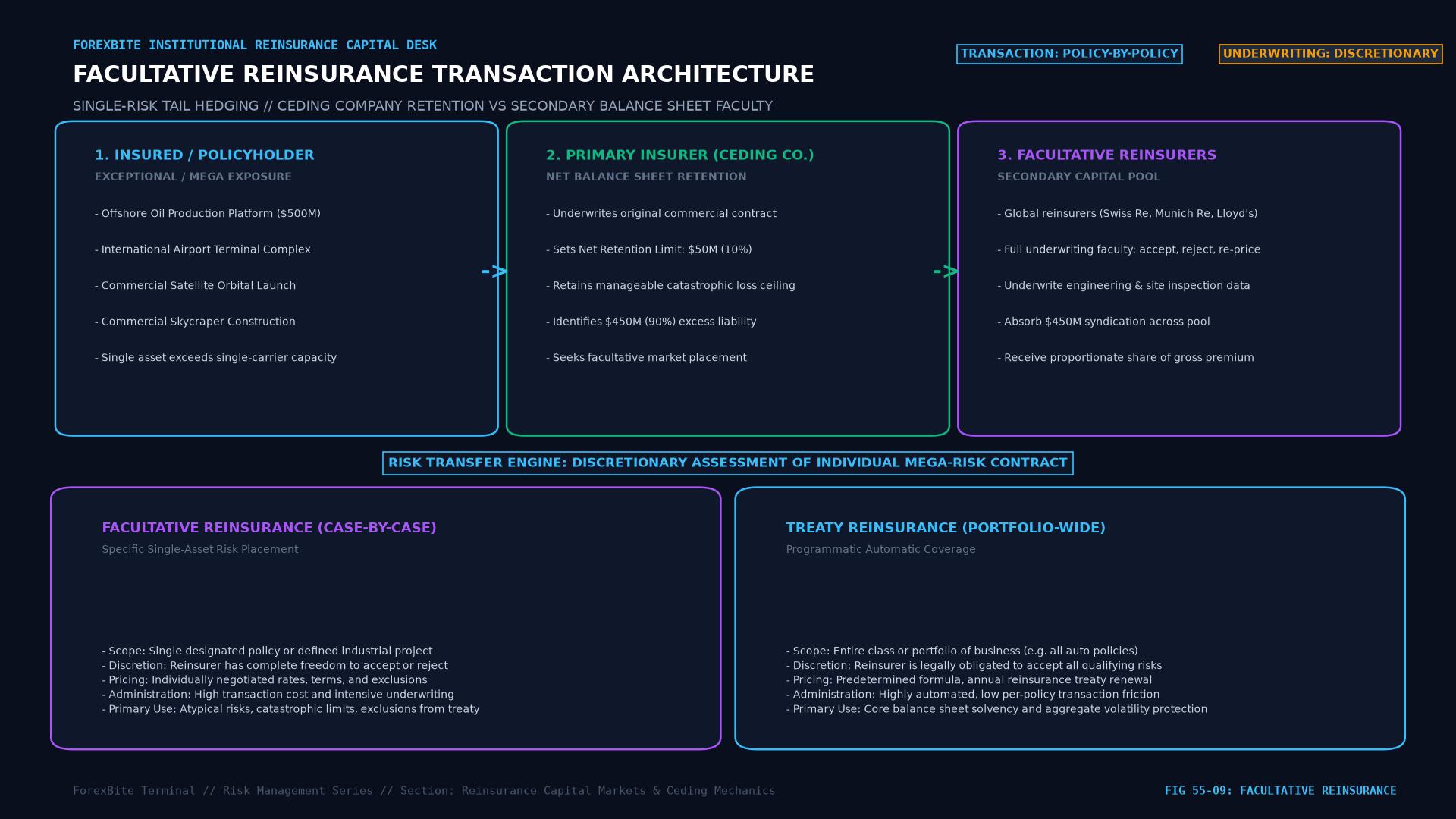 Figure: The facultative reinsurance workflow showing individual risk cession from primary insurer retention to discretionary reinsurer underwriting faculty.
Technical Structures: Proportional vs. Non-Proportional
Facultative reinsurance contracts are structured under two primary mathematical arrangements:
1. Facultative Proportional (Quota Share / Surplus)
The primary insurer and reinsurer agree to split all premiums and losses on a predetermined percentage basis.
$$\text{Reinsurer Payout} = \text{Total Claim} \times \left( \frac{\text{Ceded Capacity}}{\text{Total Policy Limit}} \right)$$
For example, if an insurer issues a $100 million policy on an industrial chemical refinery, retains $20 million (20%), and cedes $80 million (80%) facultatively:
- The reinsurer receives 80% of the gross premium (less ceding commission).
- In the event of a $50 million explosion loss, the reinsurer pays $40 million (80%), and the ceding insurer pays $10 million (20%).
2. Facultative Non-Proportional (Excess of Loss - XOL)
The reinsurer only responds if an individual claim exceeds the ceding company’s defined retention limit (attachment point):
$$\text{Reinsurance Payout} = \min \left( \text{Reinsurance Limit}, \max \left( 0, \text{Loss} - \text{Attachment Point} \right) \right)$$
If an insurer retains $10 million and purchases $40 million in excess of $10 million facultative coverage:
- A loss of $8 million is paid 100% by the primary insurer.
- A loss of $35 million requires the insurer to pay $10 million, with the facultative reinsurer paying the remaining $25 million.
Comparative Matrix: Reinsurance Mechanisms
| Structural Characteristic | Facultative Reinsurance | Treaty Reinsurance | Facultative-Obligatory | Retrocession |
|---|---|---|---|---|
| Underwriting Focus | Individual specific policy | Entire portfolio / book of business | Hybrid: Ceding company chooses, reinsurer bound | Reinsurance of a reinsurer |
| Reinsurer’s Discretion | Complete right to accept or decline | Obligated to accept all eligible policies | Obligated to accept policies meeting rules | Varies (Treaty or Facultative) |
| Administrative Cost | High (bespoke actuarial review per risk) | Low (programmatic automated cessions) | Moderate | High (syndicated capital layers) |
| Typical Application | High-severity, complex, or atypical risks | Standardized homeowner, auto, life lines | Spillover capacity above treaty limits | Global catastrophe risk spreading |
Real-World Case Study: The Panama Canal Third Set of Locks Expansion
When the Panama Canal Authority undertook its historic $5.25 billion expansion project—constructing third sets of locks to accommodate New Panamax container vessels—the colossal construction risks, geological complexities, and potential third-party liabilities far exceeded the underwriting retention limits of any single domestic or regional insurer.
- Treaty Limitations: The local consortium of primary insurers found that their existing annual property/casualty reinsurance treaties contained strict sub-limits excluding single megaprojects exceeding $150 million.
- Facultative Syndication: The primary underwriters engaged global reinsurance brokers in London, Zurich, and Bermuda to assemble a multi-layered facultative reinsurance syndicate (including Swiss Re, Munich Re, and Lloyd’s of London syndicates).
- Layered Absorption: Each facultative reinsurer independently evaluated the geotechnical engineering models, soil mechanics, and seismic risks, agreeing to take custom tranches (e.g., $200 million excess of $300 million).
- Result: The facultative placement effectively dispersed multi-billion-dollar systemic catastrophic risk across global balance sheets without destabilizing the primary local insurance market.
Frequently Asked Questions (FAQ)
When does an insurer choose facultative reinsurance over a standard treaty?
Insurers turn to facultative reinsurance when:
- The policy limits exceed the monetary ceiling of their standard reinsurance treaty.
- The underlying risk is atypical or hazardous (e.g., handling hazardous petrochemicals, space travel, high-profile celebrity disability).
- The risk is specifically excluded under standard treaty terms.
- The insurer wishes to protect its existing treaty loss-ratio record from being contaminated by a volatile single event.
What is a ceding commission in facultative reinsurance?
A ceding commission is a fee paid by the reinsurer back to the primary ceding insurer. It reimburses the primary insurer for upfront policy acquisition costs, administrative overhead, brokerage fees, and local state regulatory taxes incurred during the original policy underwriting.
What is the main drawback of facultative reinsurance for the primary insurer?
The principal disadvantages are administrative expense and placement uncertainty. Because every policy requires individualized actuarial analysis and negotiation, underwriting takes considerable time. Furthermore, if reinsurers decline the facultative submission or demand prohibitive pricing, the primary insurer may be unable to bind the commercial contract for the client.
Ready to trade forex?
Open a free demo account with a regulated broker. Practice with virtual funds before risking real money.