Earned Premium
In insurance accounting and actuarial science, earned premium is the pro-rata portion of an insurance policy's collected premium that corresponds to the expired portion of the policy term during which the insurer provided coverage and bore risk.
What Is Earned Premium?
In insurance accounting, risk management, and actuarial science, earned premium represents the precise fraction of an insurance policy’s total premium that applies to the time period that has already elapsed, during which the insurance carrier provided active policy coverage and absorbed financial risk.
Under standard accrual accounting principles (including US GAAP, statutory insurance accounting, and IFRS 17), insurance companies cannot treat customer premiums as immediate revenue upon receipt. When a policyholder pays an annual $1,200 auto insurance premium upfront on January 1, the insurer has not yet “earned” that money. Instead, the cash is classified on the balance sheet as an Unearned Premium Reserve (UPR)—a formal corporate liability representing the unperformed obligation to provide coverage.
With each day that passes without policy cancellation, a pro-rata slice of that liability transfers from the balance sheet onto the income statement as earned premium.
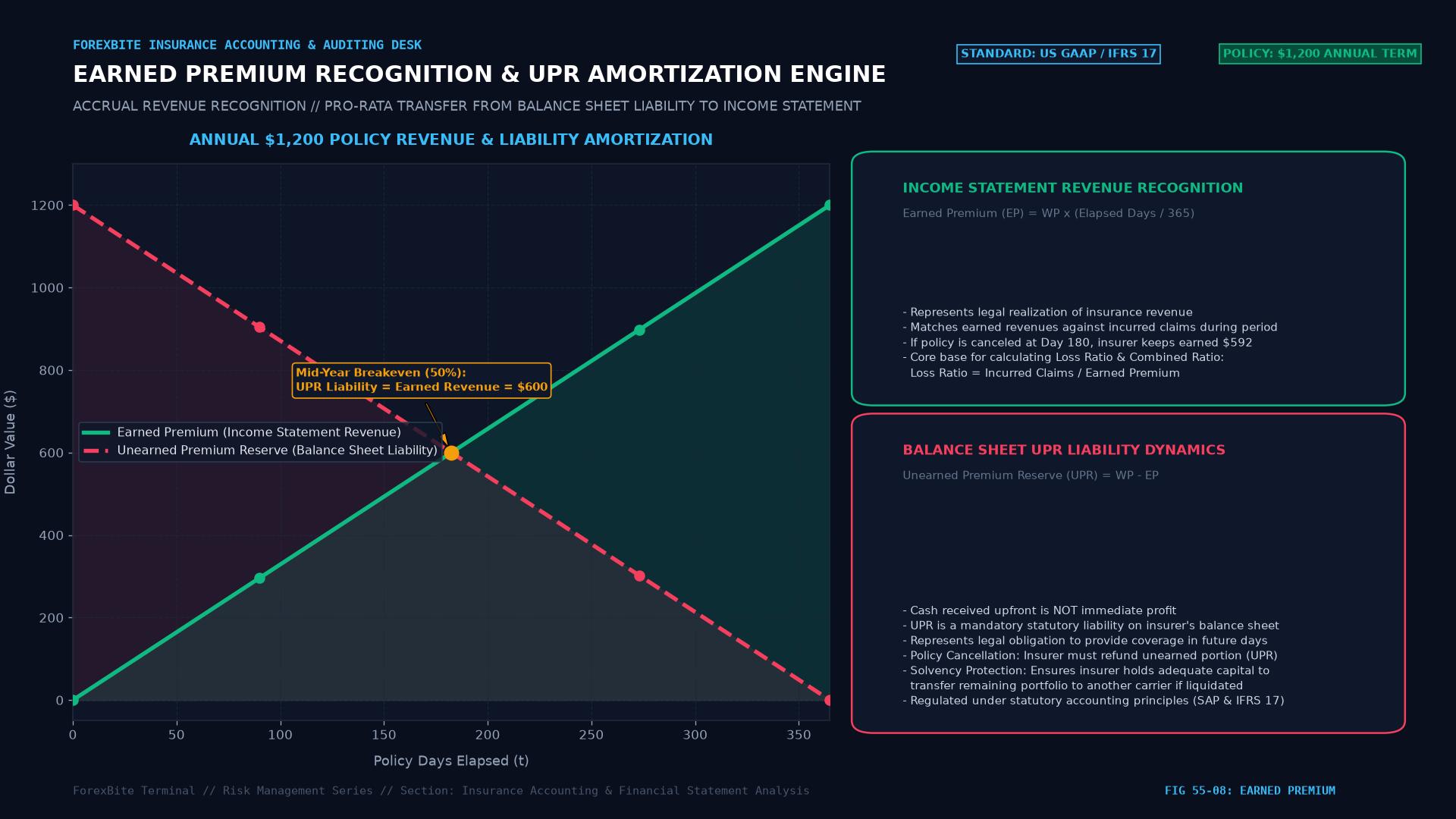 Figure: Recognition trajectory of earned premium on the income statement alongside the amortization of the unearned premium reserve (UPR) liability over a 365-day policy term.
Technical Mechanics & Actuarial Performance Metrics
Actuaries calculate earned premium using daily pro-rata or monthly split conventions:
Pro-Rata Earned Premium Formula
$$\text{Earned Premium } (EP_t) = \text{Written Premium } (WP) \times \left( \frac{t - t_0}{T_{\text{term}}} \right)$$
$$\text{Unearned Premium Reserve } (UPR_t) = WP - EP_t$$
Where:
- $WP$: Total gross written premium charged for the policy contract.
- $t - t_0$: Number of calendar days elapsed since policy inception.
- $T_{\text{term}}$: Total duration of the policy contract (e.g., 365 days).
Actuarial Underwriting Ratios
Earned premium serves as the critical denominator for evaluating an insurance carrier’s core underwriting profitability:
- Loss Ratio: Measures the percentage of earned premiums consumed by policyholder claims: $$\text{Loss Ratio} = \left( \frac{\text{Incurred Losses} + \text{Loss Adjustment Expenses (LAE)}}{\text{Earned Premium}} \right) \times 100$$
- Expense Ratio: Measures operational overhead against written premiums: $$\text{Expense Ratio} = \left( \frac{\text{Underwriting Expenses}}{\text{Written Premium}} \right) \times 100$$
- Combined Ratio: The benchmark indicator of underwriting health:
$$\text{Combined Ratio} = \text{Loss Ratio} + \text{Expense Ratio}$$
- Combined Ratio $< 100%$: The insurer is generating pure underwriting profit before investment income.
- Combined Ratio $> 100%$: The insurer is losing money on its insurance policies and relying on investment portfolio returns to remain solvent.
Comparative Matrix: Insurance Revenue Classifications
| Premium Metric | Accounting Recognition | Balance Sheet Classification | Impact of Early Cancellation |
|---|---|---|---|
| Written Premium | Total gross contract value billed | Cash Asset (Offset by UPR) | Cancelled portion reduces future volume |
| Earned Premium | Revenue earned over elapsed time | Income Statement Revenue | Retained 100% by the insurance company |
| Unearned Premium | Future unexpired coverage period | Current Balance Sheet Liability | Must be refunded to policyholder |
| Net Earned Premium | Earned premium minus reinsurance | Net Operating Revenue | Adjusted for ceded reinsurance recovery |
Real-World Case Study: The Florida Property Insurance Crisis (2022)
The existential risk of an exploding Loss Ratio relative to earned premiums was demonstrated during the 2022 Florida Property Insurance Crisis, punctuated by Hurricane Ian.
Anatomy of an Underwriting Collapse:
1. The Baseline: Regional Florida property and casualty (P&C) insurers had accumulated roughly $4 billion in annual earned premiums.
2. The Shock (September 2022): Category 4 Hurricane Ian struck southwest Florida, generating an estimated $60 billion in insured property losses.
3. The Ratio Inversion: For several regional carriers (such as Southern Fidelity, Weston Insurance, and FedNat), incurred property loss claims exceeded 300% to 500% of their annual earned premiums.
4. Insolvency Cascades: Because claims vastly exceeded earned premium reserves and exhausted reinsurance towers, six major Florida property insurance carriers collapsed into state receivership and liquidation within twelve months.
Frequently Asked Questions (FAQ)
What happens to unearned premium if an insured cancels their policy early?
If a policyholder cancels an annual policy after six months, the insurance company is legally required to return the unearned premium. Under standard pro-rata cancellation, the insurer refunds exactly 50% of the gross premium. Under short-rate cancellation (where the policyholder cancels early without cause), the insurer retains an administrative penalty (typically 10% of the unearned portion) and refunds the remainder. The insurer always keeps 100% of the earned premium corresponding to the months coverage was active.
Why is unearned premium treated as a liability on an insurance company’s balance sheet?
Unearned premium is classified as a liability under GAAP and statutory accounting because it represents money collected for a service that has not yet been delivered. The insurer owes a contractual obligation: if the policyholder cancels tomorrow or if a catastrophic house fire occurs during the remaining term, the insurer must either refund the cash or disburse millions in claim settlements. It only becomes pure earned equity as time expires.
How does the concept of “earned premium” apply to options trading?
In financial derivatives, an option seller (writer) collects an upfront cash option premium. This premium is not truly “earned” until the option contract expires or is bought back. As time passes, the option loses extrinsic value through time decay (Theta $\Theta$). Derivatives traders refer to this steady, daily erosion of option value into the writer’s pocket as “earning the option premium.”
Ready to trade forex?
Open a free demo account with a regulated broker. Practice with virtual funds before risking real money.