HRK
HRK is the ISO 4217 currency code for the Croatian Kuna, the historic official currency of Croatia from 1994 until its replacement by the Euro on January 1, 2023, at a fixed conversion rate of 7.53450 HRK per 1 EUR.
The Croatian Kuna (ISO code: HRK, symbol: kn) was the official legal tender of the Republic of Croatia from May 30, 1994, until January 1, 2023, when Croatia officially became the twentieth member state of the Eurozone, adopting the Euro (EUR) at an unalterable statutory conversion rate of 7.53450 HRK per 1 EUR. Administered during its operational life by the Croatian National Bank (Hrvatska narodna banka, or HNB), the kuna functioned under a tightly managed floating regime anchored to the German Deutsche Mark and subsequently the Euro. The monetary history of the kuna represents a textbook transition from post-conflict stabilization and deep financial euroization to full European monetary integration.
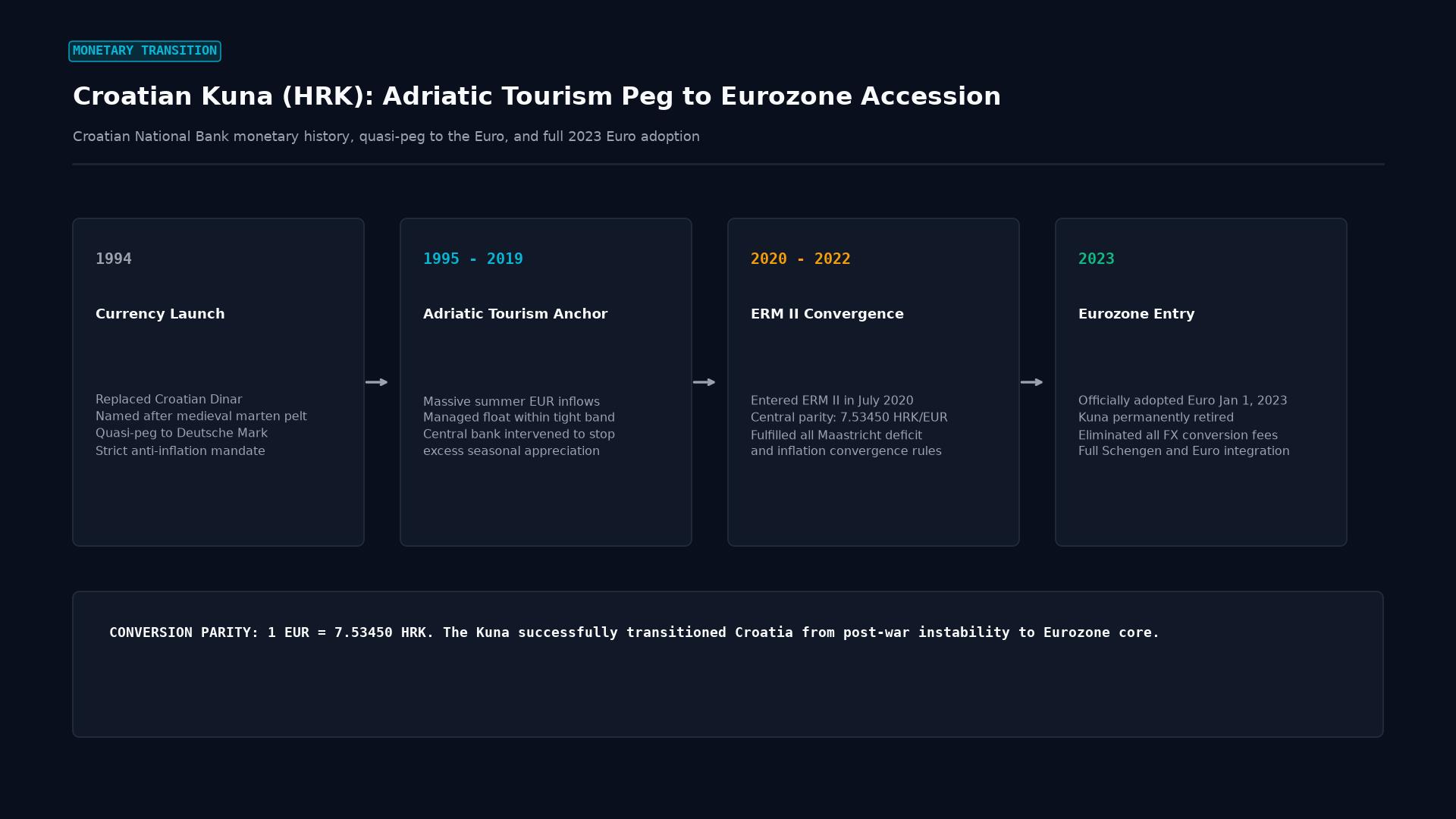 Figure: Croatian National Bank monetary history, quasi-peg to the Euro, and full 2023 Euro adoption
Historical Lineage: From Medieval Pelts to Modern Currency
The term kuna translates to “marten” in Croatian, referencing the historic medieval use of marten pelts as standardized units of trade, taxation, and accounting across the northern Croatian regions of Slavonia and the Adriatic coast during the Middle Ages. The marten was minted on medieval Croatian silver coins (banovac) as early as the thirteenth century.
Following the declaration of independence from Yugoslavia in 1991 during the Croatian War of Independence, Croatia faced hyperinflation driven by the disintegration of the Yugoslav central banking system. As an emergency transitional measure on December 23, 1991, the Ministry of Finance issued the Croatian Dinar (HRD) at 1:1 parity with the Yugoslav dinar. The Croatian Dinar was printed rapidly on temporary coupon paper and lacked coins, serving solely to insulate the domestic economy while the central bank prepared comprehensive structural reforms.
Under the 1993 Anti-Inflationary Stabilization Program crafted by economist Nikica Valentić and HNB Governor Pero Jurković, Croatia executed a sweeping monetary reset. On May 30, 1994 (Croatia’s Statehood Day), the government abolished the transitional dinar and introduced the modern Croatian Kuna at a conversion rate of 1,000 Croatian Dinars per 1 Kuna.
The currency was subdivided into 100 lipa (meaning “linden tree” in Croatian). Banknotes were printed in denominations of 5, 10, 20, 50, 100, 200, 500, and 1,000 kuna, featuring prominent historical Croatian figures and architectural landmarks.
The Managed Float and De Facto Euroization
Throughout its 28-year existence, the Croatian Kuna was operated by the Croatian National Bank under a policy of “quasi-pegged” managed floating. While never bound by an official fixed exchange rate peg until entering ERM II, the HNB intervened consistently in foreign exchange markets to maintain the kuna within a narrow band against the German Deutsche Mark (1994-1998) and subsequently the Euro (1999-2022), typically between 7.30 and 7.60 HRK per EUR.
This deliberate stabilization was necessitated by the deep “euroization” of the Croatian financial system:
- Balance Sheet Mismatches: Long before the introduction of the Euro, Croatian citizens and corporations held deep memories of Yugoslav hyperinflation and distrusted fiat paper money. Consequently, over 70 percent of all savings deposits in Croatian commercial banks were denominated in euros or deutsche marks.
- Foreign-Currency Indexed Mortgages: Over 65 percent of all corporate and household loans (including residential mortgages and vehicle financing) were contractually indexed to the Euro (valutna klauzula).
$$\text{Domestic Debt Burden} = \text{Loan Principal (EUR)} \times \text{Spot EUR/HRK Exchange Rate}$$
If the HNB had permitted the kuna to depreciate by 15 or 20 percent against the Euro to boost export competitiveness, the local-currency repayment burden on Croatian homeowners and enterprises would have exploded overnight, triggering catastrophic systemic defaults across the banking sector. Preserving the exchange rate stability of EUR/HRK was therefore identical to preserving systemic banking solvency.
Tourism Seasonality and Central Bank Interventions
The foreign exchange market for the Croatian Kuna exhibited severe, predictable seasonal liquidity cycles driven by the Adriatic tourism industry.
Croatia’s tourism sector, centered along the Dalmatian coast, Istria, and Dubrovnik, generates over 11 billion to 13 billion euros annually, accounting for nearly 20 percent of national GDP:
- Summer Appreciation Pressure (Q2-Q3): During the summer tourist influx, millions of European travelers converted billions of euros into kuna to pay for accommodations, dining, and marinas. The massive excess supply of euros pushed the EUR/HRK rate toward the 7.35 level. To prevent excessive kuna appreciation that would harm industrial exporters, the HNB conducted heavy foreign exchange purchases, buying billions of euros in the spot market and accumulating record sovereign foreign reserves.
- Winter Depreciation Pressure (Q4-Q1): During the off-season, energy import bills (natural gas and oil) and corporate year-end balance sheet settlements increased commercial demand for euros, pushing EUR/HRK toward 7.60. The HNB sold foreign currency back into the interbank market to smooth the depreciation.
| Metric | Croatian Kuna (HRK) Era | Euro (EUR) Era (Post-Jan 2023) |
|---|---|---|
| Legal Status | Sovereign national currency (1994-2022) | Historical collectible; replaced by Euro |
| Exchange Rate Mechanism | HNB Managed Float / ERM II Corridor | Free-floating global reserve currency |
| Fixed Conversion Rate | 7.53450 HRK = 1.00 EUR | Permanent irrevocably fixed conversion rate |
| Sovereign Debt Currency | Heavy issuance in EUR-indexed instruments | Direct issuance in European sovereign debt market |
| Cross-Border Frictions | Retail foreign exchange spread commissions | Zero currency conversion fees across Eurozone |
The Road to the Euro and January 2023 Accession
Following Croatia’s accession to the European Union on July 1, 2013, the government committed to adopting the single European currency under the terms of the EU accession treaty.
The formal convergence roadmap unfolded systematically:
- ERM II Accession (July 10, 2020): Croatia entered the European Exchange Rate Mechanism II alongside Bulgaria, establishing a central parity rate of 7.53450 HRK per 1 EUR with a standard fluctuation band of $\pm 15$ percent. The HNB maintained the kuna within an internal corridor of less than 1 percent around central parity without stress.
- Maastricht Criteria Fulfillment: Despite the economic shocks of the pandemic and Zagreb earthquakes, Croatia kept its public debt-to-GDP ratio on a decisive downward trajectory, brought fiscal deficits below 3 percent of GDP, and satisfied inflation and long-term interest rate criteria.
- Council Approval (July 12, 2022): The Council of the European Union adopted the final legal acts approving Croatia’s euro adoption and confirming the conversion rate at 7.53450 HRK.
- Dual Pricing and Dual Circulation: To protect consumers against unjustified merchant price gouging, the government mandated mandatory dual display of prices in both HRK and EUR across all retail shops and service invoices from September 5, 2022, through December 31, 2023.
On January 1, 2023, the Euro became legal tender in Croatia. Physical cash circulation operated under a two-week dual circulation window, after which the Kuna was formally retired. The Croatian National Bank continues to exchange legacy Kuna coins through the end of 2025 and Kuna banknotes indefinitely at its headquarters in Zagreb with zero fee.
Frequently Asked Questions
Can old Croatian Kuna banknotes still be converted into Euros?
Yes. The Croatian National Bank (Hrvatska narodna banka) in Zagreb exchanges legacy Croatian Kuna banknotes indefinitely with no time expiration. Kuna coins can be exchanged at the HNB through December 31, 2025. Standard commercial banks in Croatia ceased free retail over-the-counter conversions at the end of 2023.
Why did Croatia choose to adopt the Euro instead of retaining the Kuna like Poland or the Czech Republic?
Unlike Poland or Czechia, which maintained low levels of household foreign-currency debt and large domestic consumer markets, Croatia’s economy was already 70%+ de facto euroized for decades. Adopting the Euro eliminated foreign exchange conversion costs for Croatia’s massive European tourism industry, dismantled currency risk on corporate and mortgage balance sheets, and secured permanent access to European Central Bank liquidity facilities.
What happened to commercial ATM networks during the January 2023 transition?
The transition required a synchronized nationwide software reconfiguration of all 4,000 automated teller machines (ATMs) across Croatia. In December 2022, banks phased out kuna cash dispensing, loading machines with freshly minted Croatian-designed euro banknotes. By January 1, 2023, the entire ATM infrastructure began dispensing euro banknotes exclusively.
Ready to trade forex?
Open a free demo account with a regulated broker. Practice with virtual funds before risking real money.