HUF
HUF is the ISO 4217 currency code for the Hungarian Forint, the official currency of Hungary, regulated under a floating exchange rate regime by the Magyar Nemzeti Bank.
The Hungarian Forint (ISO code: HUF, symbol: Ft) is the official currency of Hungary, a Central European member state of the European Union. Regulated by the nation’s central bank, the Magyar Nemzeti Bank (MNB) in Budapest, the forint operates under a free-floating exchange rate regime. Highly sensitive to European energy commodity prices, geopolitical dynamics, European Union fiscal funding negotiations, and global risk appetite, the forint functions as a high-beta regional emerging market currency deeply integrated into the Central European automotive manufacturing supply chain.
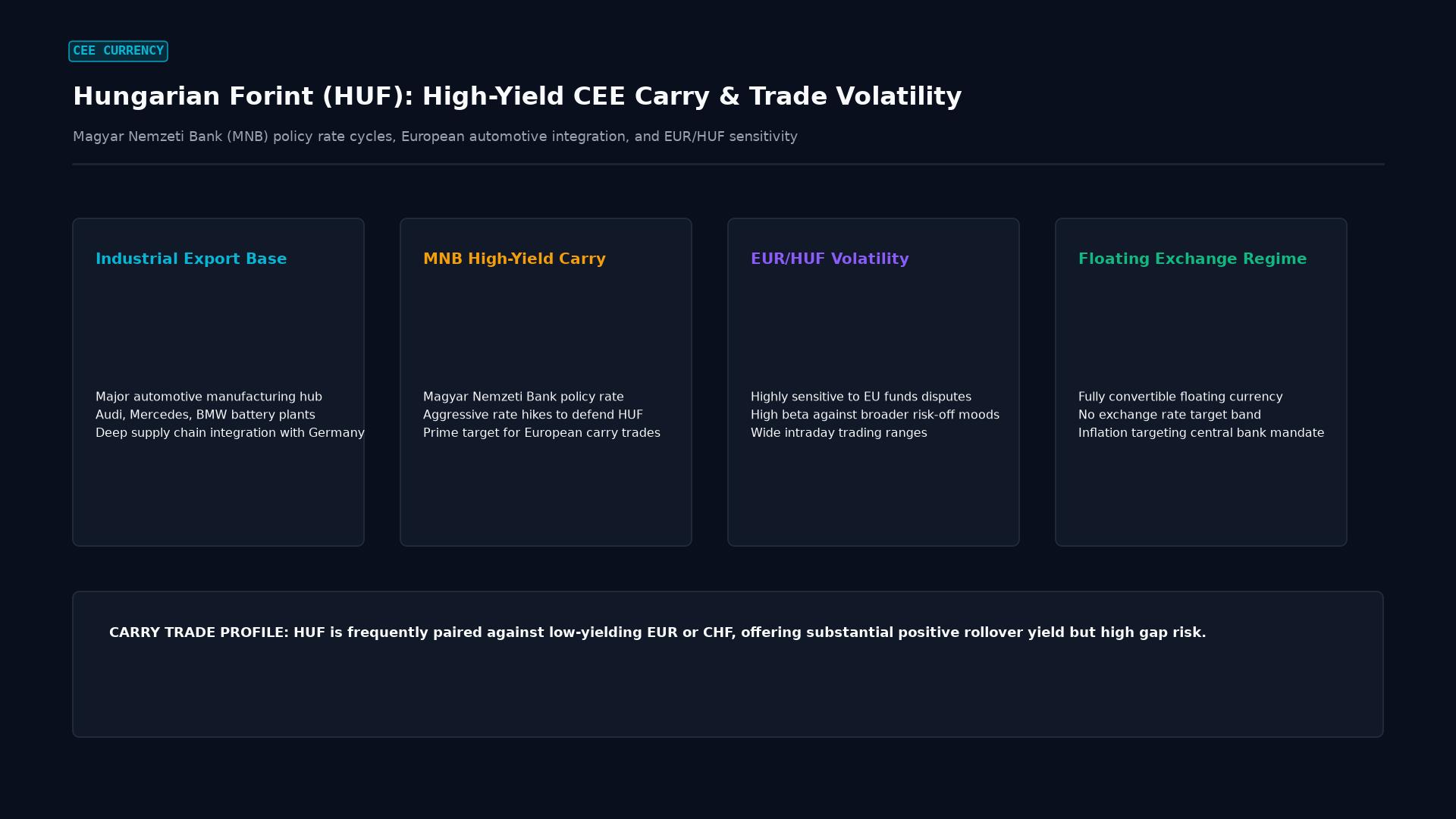 Figure: Magyar Nemzeti Bank (MNB) policy rate cycles, European automotive integration, and EUR/HUF sensitivity
Historical Inception and Stopping World Record Hyperinflation
The forint boasts historical origins dating to the fourteenth century, when King Charles Robert introduced gold florins minted in Kremnica, named after the golden fiorino d’oro of Florence.
The modern Hungarian Forint, however, was introduced on August 1, 1946, under extraordinary economic circumstances: ending the most catastrophic hyperinflation in recorded world history. Following World War II, the preceding Hungarian currency, the Pengő, experienced absolute destruction:
- The daily inflation rate exceeded 200 percent, with prices doubling every 15 hours.
- The government printed banknotes up to 100 quintillion ($10^{20}$) pengő.
- At the final monetary stabilization on August 1, 1946, the conversion rate was set at 1 Forint to 400 octillion ($4 \times 10^{29}$) pengő, completely wiping out the legacy currency and restoring physical gold-backed accounting stability under the newly formed post-war central bank administration.
Throughout the socialist era (1948-1989), the forint was an unconvertible national currency strictly regulated by the state monopoly on foreign exchange. Following the democratic transition in 1989-1990, Hungary dismantled price controls, opened its capital account, and initiated market-oriented reforms.
The currency was subdivided into 100 fillér, although fillér coins were phased out of circulation in 1999 due to post-transition inflation. Circulating banknotes are issued in denominations of 500, 1,000, 2,000, 5,000, 10,000, and 20,000 forints, adorned with prominent Hungarian statesmen and monarchs, including King Saint Stephen, Ferenc Rákóczi II, and Count István Széchenyi.
Monetary Framework and the Elimination of Fluctuation Bands
Between 1995 and 2001, the Magyar Nemzeti Bank operated a crawling peg regime against a basket of the German Mark and US Dollar, transitioning later to a Euro peg with a narrow $\pm 2.25$ percent fluctuation band.
In May 2001, seeking greater monetary flexibility to accommodate massive foreign direct investment inflows and prepare for European Union accession, the MNB widened the forint’s fluctuation band against the Euro to $\pm 15$ percent around a central parity of 282.36 HUF per EUR.
On February 25, 2008, the MNB and the Ministry of Finance formally abolished the $\pm 15$ percent currency band, adopting a fully free-floating exchange rate regime. Since that date, the MNB has operated an explicit inflation-targeting framework, setting a headline medium-term consumer price inflation target of $3.0% \pm 1.0%$.
$$\text{MNB Policy Objective} = \text{HICP Inflation} \in [2.0%, ; 4.0%]$$
Under the floating framework, the central bank does not maintain an official target for EUR/HUF or USD/HUF. However, because Hungary is a small, open economy where import price changes rapidly feed into domestic consumer prices, the MNB pays acute attention to exchange rate stability as a primary transmission channel of monetary policy.
The 2022 Energy Shock and Emergency Monetary Measures
The vulnerability of the Hungarian Forint to external commodity shocks was dramatically illustrated in 2022 following the outbreak of war in Ukraine:
- Energy Dependency: Hungary imported over 80 percent of its natural gas from Russia. When European wholesale natural gas prices (TTF) skyrocketed tenfold in 2022, Hungary’s national energy import bill surged from approximately 4 billion euros to over 17 billion euros, generating an enormous current account deficit and triggering severe commercial demand for foreign exchange.
- EU Funding Impasse: Prolonged political disputes between the Hungarian government and the European Commission over rule-of-law benchmarks led Brussels to withhold billions of euros in European Union cohesion funds and Recovery and Resilience Facility (RRF) grants, depriving the sovereign treasury of expected hard currency inflows.
- Currency Depreciation: The forint plummeted to record historic lows, with EUR/HUF surging from 360 to over 430 HUF per EUR, and USD/HUF spiking above 440 in October 2022. Headline domestic inflation surged past 25 percent, the highest in the European Union.
To arrest the currency collapse, the MNB Monetary Council enacted aggressive emergency interventions in mid-October 2022:
- Maintained the official base rate at 13.00 percent.
- Introduced an emergency 18.00 percent overnight collateralized deposit tender, offering global institutional investors the highest risk-free yield in Europe to park liquidity in forints.
- Provided foreign exchange directly from central bank international reserves to state energy importer MVM to settle imported gas bills, removing massive commercial dollar and euro demand from the open interbank spot market.
$$\text{Real Carry Yield} = \text{Hungarian Overnight Yield (18%)} - \text{ECB Deposit Yield (1.5%)} = +16.5% \text{ (Gross Spread)}$$
The aggressive rate action restored market stability, allowing the forint to appreciate back toward the 370-385 range over 2023, after which the MNB gradually phased out the emergency facility and initiated a structured monetary easing cycle.
Structural Economic Fundamentals and the Industrial Export Hub
Despite periodic financial volatility, the Hungarian economy possesses a formidable industrial manufacturing foundation that provides structural foreign currency support:
1. Automotive Manufacturing Clusters
Hungary is a primary production engine for major German automotive manufacturers:
- Audi Hungaria (Győr): Operates the largest engine manufacturing plant in the world, exporting millions of internal combustion and electric powertrains across the Volkswagen Group.
- Mercedes-Benz (Kecskemét): Assembles compact passenger cars and electric vehicles.
- BMW Group (Debrecen): Built a state-of-the-art manufacturing plant dedicated entirely to next-generation electric vehicles (Neue Klasse).
2. Electric Vehicle (EV) Battery Gigafactories
Hungary has positioned itself as the European hub for Asian electric vehicle battery manufacturers. Global industry leaders, including China’s CATL (constructing a 7.3-billion-euro gigafactory in Debrecen), BYD (constructing its first European passenger car plant in Szeged), and South Korea’s Samsung SDI and SK On, have deployed tens of billions of euros in foreign direct investment, establishing long-term export capacity denominated in euros.
| Structural Factor | Economic Character | Transmission to HUF Valuation |
|---|---|---|
| Automotive & Battery Exports | High-tech industrial manufacturing | Generates multi-billion euro commercial trade surpluses |
| Natural Gas Import Bill | Net energy importer | Natural gas price spikes compress forint external balances |
| EU Structural Funds | Sovereign capital transfers | Release or withholding of funds drives sharp sentiment swings |
| Carry Trade Sensitivity | High domestic interest rate spreads | Attracts hot money during MNB rate hike cycles; vulnerable to unwinds |
Foreign Exchange Market Dynamics: EUR/HUF and Carry Trades
In global currency markets, the forint exhibits distinct characteristics that make it a favorite among institutional emerging market desks:
- EUR/HUF Primary Liquidity: The overwhelming majority of HUF trading occurs against the Euro. Bid-ask spreads on EUR/HUF are tight on institutional electronic platforms (such as EBS and Refinitiv Matching) during European trading hours.
- Carry Trade Appeal: Because the MNB has historically maintained policy rates significantly higher than the European Central Bank, EUR/HUF is widely utilized by macro hedge funds as a carry trade vehicle (selling EUR to invest in high-yielding HUF treasury bills or interbank deposits).
- Correlation with German Industrial Output: Due to supply-chain integration, the forint exhibits a high statistical correlation with the German Ifo Business Climate index and European purchasing managers’ indices (PMIs).
Frequently Asked Questions
Why hasn’t Hungary adopted the Euro despite joining the European Union in 2004?
Under its EU accession treaty, Hungary is legally committed to adopting the Euro eventually, but the treaty specifies no formal deadline. The Hungarian government and central bank have maintained that retaining an independent monetary policy and a floating currency provides an essential economic shock absorber, allowing the country to adjust to external economic cycles and preserve export competitiveness.
What is the relationship between the Hungarian Forint and European natural gas prices?
Hungary relies heavily on imported natural gas for domestic heating, electricity generation, and industrial chemical manufacturing. When European wholesale gas prices surge, Hungary must spend billions of additional euros to secure energy supplies. This expands the national current account deficit and increases commercial demand for foreign currency, putting immediate downward pressure on the forint.
How does the MNB inflation-targeting framework operate?
The MNB targets an annual consumer price inflation rate of 3.0 percent, with a tolerance band of $\pm 1.0$ percentage point. When projected inflation exceeds 4.0 percent over the central bank’s four-to-six-quarter monetary horizon, the Monetary Council raises policy interest rates or tightens banking liquidity to dampen domestic demand and strengthen the exchange rate, reducing imported inflation.
Ready to trade forex?
Open a free demo account with a regulated broker. Practice with virtual funds before risking real money.