Instalment credit
Instalment credit is a closed-end contractual debt structure in which a borrower receives a lump sum of capital and repays it through a schedule of fixed, periodic payments over a designated term.
Instalment credit (commonly termed an installment loan or closed-end credit) is a foundational contractual lending mechanism where a creditor advances a specified, lump-sum capital disbursement to a borrower upfront. In exchange, the borrower commits to extinguishing the debt, along with interest and applicable finance charges, through a structured schedule of regular, periodic payments (instalments) over a predetermined maturity term. Deployed across retail consumer finance, commercial equipment leasing, and real estate, instalment credit contrasts fundamentally with open-end revolving credit (such as credit cards), providing predictable cash flows for banking institutions and structured amortizing repayment schedules for borrowers.
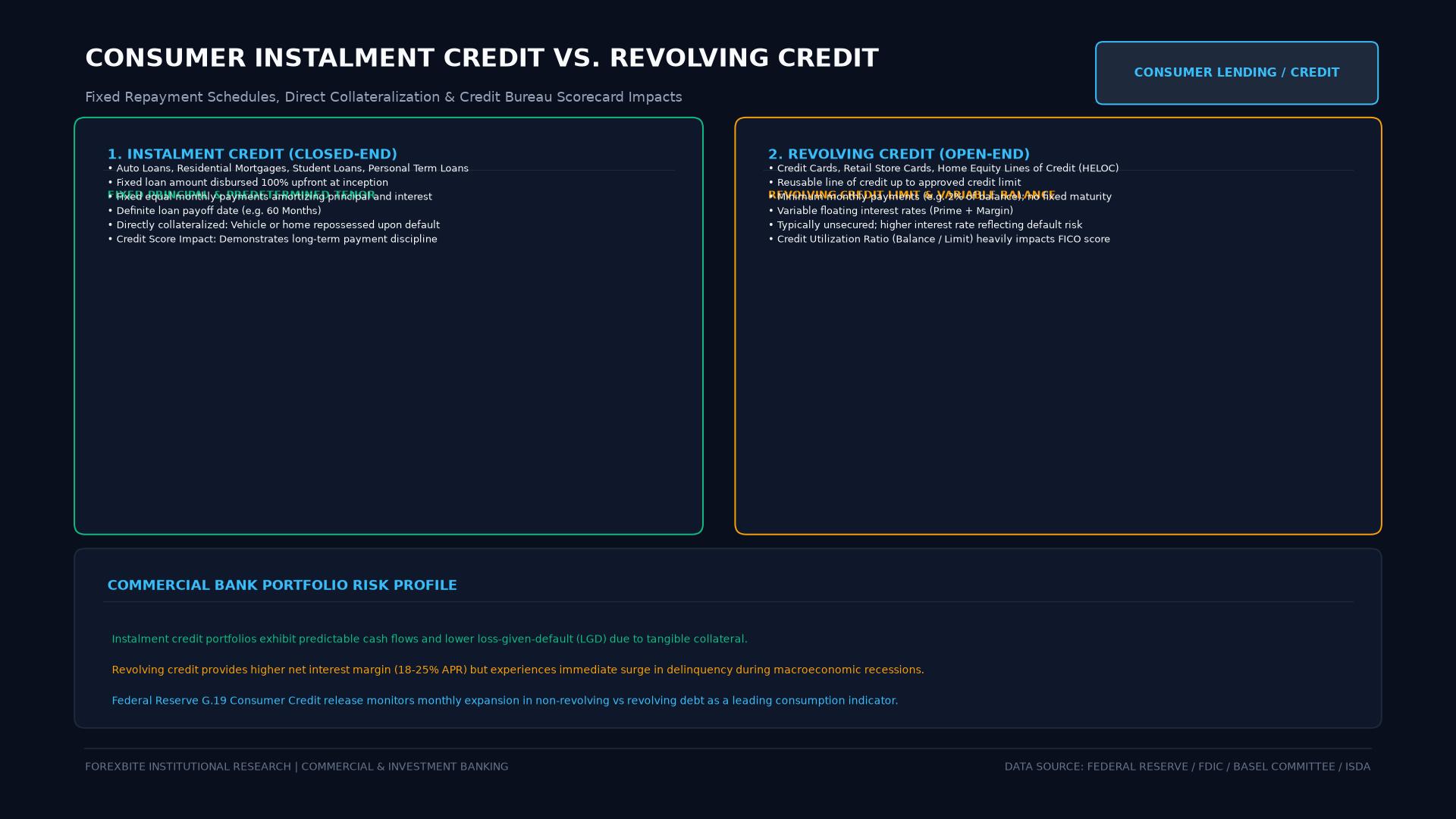 Figure: Fixed-term consumer debt structure: defined repayment tenure, fixed monthly amortizing payments, and declining balance vs open-ended revolving lines.
The Mathematical Framework: Fully Amortized Payment Mechanics
The core operational mechanism of modern instalment credit is the fully amortized loan structure, where each equal periodic payment ($PMT$) is calculated so that the final scheduled instalment reduces the remaining principal balance precisely to zero.
The fixed monthly instalment is derived using the standard annuity formula:
$$PMT = P \times \frac{r(1+r)^n}{(1+r)^n - 1}$$
Where:
- $P$ is the initial principal loan balance advanced to the borrower.
- $r$ is the periodic periodic interest rate (the annual nominal rate divided by the number of payment periods per year, e.g., $\frac{\text{APR}}{12}$).
- $n$ is the total number of scheduled instalment payments over the life of the loan.
The Shifting Interest-Principal Relationship
While the total dollar payment remains identical in every instalment, the internal composition of that payment shifts dynamically throughout the term:
- Early Instalments: Because the outstanding principal balance is at its highest, the interest charge is large. The majority of the borrower’s payment covers accrued interest, leaving a smaller portion to reduce the principal.
- Late Instalments: As consecutive instalments steadily amortize the principal, the outstanding loan balance shrinks. Because interest is charged only on the remaining balance, the interest charge drops, allowing the overwhelming majority of each payment to retire principal.
$$\text{Interest Component}t = \text{Remaining Principal}{t-1} \times r$$
$$\text{Principal Component}_t = PMT - \text{Interest Component}_t$$
Closed-End vs Open-End (Revolving) Credit
In commercial and retail banking, credit facilities are divided into two fundamental structural classes:
| Feature / Metric | Closed-End Instalment Credit | Open-End Revolving Credit |
|---|---|---|
| Capital Disbursement | Single lump sum upfront at origination | Drawn down on demand up to a credit limit |
| Repayment Horizon | Fixed contractual maturity (e.g., 5 years) | Indefinite; revolves as long as paid |
| Payment Structure | Predetermined fixed or adjustable payment | Variable; depends on outstanding balance |
| Re-Borrowing Capability | Forbidden; must apply for a new loan | Automatic; paying balance restores limit |
| Primary Examples | Mortgages, Auto Loans, Student Loans | Credit Cards, Overdrafts, HELOCs |
| Interest Calculation | Amortization schedule across loan term | Average daily balance across billing cycle |
Primary Categories of Instalment Credit
Instalment credit powers significant segments of consumer consumption and business capital formation:
1. Residential Real Estate Mortgages
The largest category of instalment credit by dollar volume, residential mortgages typically feature terms of 15 to 30 years secured by a physical real property lien.
2. Automotive Vehicle Financing
Typically structured over 36 to 84 months, auto loans are secured by a lien on the vehicle title, allowing the lender to repossess the collateral upon default.
3. Student Loans
Financing higher education expenses, student loans feature extended repayment terms (10 to 25 years). In the United States, federal student loans offer statutory income-driven repayment plans.
4. Commercial Equipment Loans
Manufacturing enterprises acquire high-value industrial machinery, transport trailers, and medical imaging systems through closed-end commercial instalment loans, matching loan repayment terms to the asset’s economic useful life.
5. Buy Now, Pay Later (BNPL)
Modern digital commerce platforms (such as Affirm, Klarna, and Afterpay) provide point-of-sale instalment credit, breaking retail purchases into four equal, interest-free bi-weekly payments or multi-month interest-bearing loans.
The Regulatory Framework: TILA, Regulation Z, and the CFPB
Because instalment credit historically exposed consumers to hidden fees and misleading interest quotes, modern financial markets are strictly governed by federal disclosure mandates:
1. The Truth in Lending Act (TILA / Regulation Z)
Codified in 1968 and enforced by the Consumer Financial Protection Bureau (CFPB), Regulation Z requires lenders to provide standardized, written disclosures before executing an instalment credit agreement:
- Annual Percentage Rate (APR): The true cost of credit expressed as a yearly rate, including both the stated interest rate and mandatory upfront finance charges (such as origination points and processing fees).
- Finance Charge: The total dollar amount the credit will cost the borrower over the entire loan term.
- Amount Financed: The net cash amount advanced to the borrower or paid on their behalf.
- Total of Payments: The aggregate dollar amount the borrower will have paid once all scheduled instalments are completed.
2. Prepayment Penalties and the Rule of 78s
Historically, lenders utilized the “Rule of 78s” (a mathematical weighting formula that front-loaded interest charges onto early payments), penalizing borrowers who paid off loans early. The federal Housing and Community Development Act of 1992 outlawed the Rule of 78s for consumer loans with terms exceeding 61 months, requiring lenders to compute early payoff balances using actuarial amortization methods.
Credit Bureau Reporting and Underwriting
Instalment credit plays a critical role in consumer credit bureau scoring models (such as FICO and VantageScore):
- Payment History (35% of FICO): Making regular, on-time monthly instalment payments over multi-year periods is the single most powerful factor in building an elite credit score.
- Credit Mix (10% of FICO): Credit scoring algorithms reward consumers who demonstrate the ability to manage a balanced portfolio containing both revolving accounts (credit cards) and amortizing instalment loans (auto loans or mortgages).
- Debt Service-to-Income (DTI) Ratios: Commercial and mortgage lenders evaluate a borrower’s total monthly instalment debt obligations relative to gross monthly income, enforcing strict DTI ceilings (typically 36 percent to 43 percent) to ensure repayment capacity.
Frequently Asked Questions
What happens if a borrower makes extra payments on an instalment loan?
When a borrower makes payments exceeding the scheduled monthly instalment, the excess funds are typically applied directly toward reducing the principal balance (provided the borrower explicitly specifies “principal paydown”). Reducing principal lowers the base upon which subsequent interest is calculated, shortening the remaining loan term and saving thousands of dollars in lifetime interest charges.
Can an instalment loan have a variable interest rate?
Yes. While most consumer personal and auto loans feature fixed interest rates with identical monthly payments, certain instalment loans, such as Adjustable-Rate Mortgages (ARMs) and private variable student loans, tie the interest rate to a benchmark index (such as the Secured Overnight Financing Rate, or SOFR). If benchmark rates adjust, the lender recalculates the required instalment payment to ensure the loan amortizes within the original term.
Is Buy Now, Pay Later (BNPL) legally classified as instalment credit?
Yes. In May 2024, the Consumer Financial Protection Bureau issued an official interpretive rule confirming that Buy Now, Pay Later providers are credit card and instalment lenders under the Truth in Lending Act and Regulation Z. This ruling requires BNPL operators to provide standard consumer billing dispute rights and credit disclosure protections.
Ready to trade forex?
Open a free demo account with a regulated broker. Practice with virtual funds before risking real money.