Interest
Interest is the monetary compensation paid by a borrower to a lender for the use of borrowed capital, reflecting the time value of money, inflation expectations, and credit risk.
Interest is the foundational price mechanism of modern financial economics. Defined as the financial charge paid by a borrower to an asset owner for the temporary use of capital, interest compensates lenders for deferred consumption, opportunity cost, inflation erosion, and default risk. Operating as the primary transmission mechanism of central bank monetary policy, benchmark interest rates dictate the cost of credit across entire economies, governing consumer borrowing, corporate capital expenditures, sovereign bond yields, and the relative valuation of global currencies in foreign exchange markets.
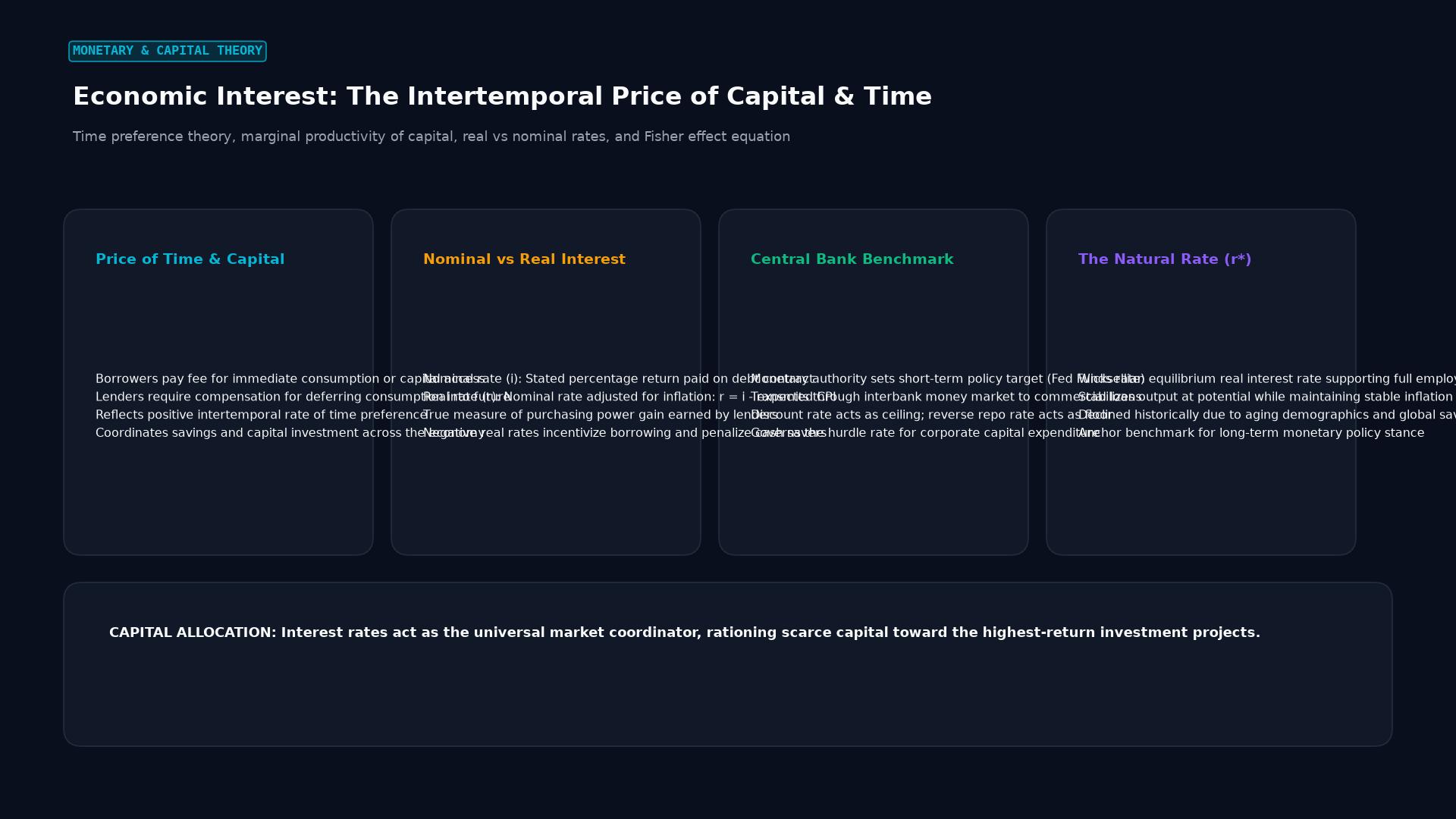 Figure: Time preference theory, marginal productivity of capital, real vs nominal rates, and Fisher effect equation
The Theoretical Foundations: Time Preference and the Fisher Equation
Economic theories explain interest through the concept of “time preference”: human beings inherently value consumption in the present more highly than identical consumption in the distant future. To induce an individual or institution to surrender current purchasing power, a borrower must offer an incentive in the form of interest.
The relationship between nominal interest rates, real interest rates, and inflation was formalized by American economist Irving Fisher in 1930 through the Fisher Equation:
$$(1 + i) = (1 + r)(1 + \pi)$$
Where:
- $i$ represents the nominal interest rate quoted in financial contracts.
- $r$ represents the real interest rate (the true expansion in physical purchasing power).
- $\pi$ represents the expected inflation rate over the lending term.
In low-inflation environments, this relationship is commonly approximated as:
$$r \approx i - \pi$$
If a commercial bank issues a corporate loan at an 8 percent nominal interest rate during a period where consumer price inflation runs at 5 percent, the bank’s real economic return is approximately 3 percent. If inflation unexpectedly surges to 9 percent, the real interest rate turns negative ($-1%$), transferring real wealth from the lender to the borrower.
Mathematical Formulations: Simple, Compound, and Continuous Interest
Financial institutions apply three mathematical conventions to calculate interest charges across credit and investment contracts:
1. Simple Interest
Simple interest is calculated solely on the original principal balance, ignoring interest accumulated in prior periods. It is commonly utilized in short-term money market paper and auto loans:
$$I = P \times r \times t$$
$$A = P(1 + r \times t)$$
Where $P$ is principal, $r$ is the annual interest rate, $t$ is time in years, and $A$ is the final repayment amount.
2. Compound Interest
Described by financiers as the primary engine of wealth accumulation, compound interest calculates charges on both the initial principal and the accumulated interest of preceding periods:
$$A = P \left(1 + \frac{r}{n}\right)^{nt}$$
Where $n$ represents the compounding frequency per year (e.g., $n=12$ for monthly compounding, $n=365$ for daily compounding). As compounding frequency increases, the effective annual yield expands.
3. Continuous Compounding
In quantitative derivatives pricing (such as the Black-Scholes options model) and continuous-time financial mathematics, compounding is assumed to occur continuously across infinite infinitesimal intervals:
$$A = P e^{rt}$$
Where $e$ is the mathematical constant (approximately 2.71828).
$$\text{Effective Annual Rate (EAR)} = \left(1 + \frac{r}{n}\right)^n - 1 \quad \xrightarrow{n \to \infty} \quad e^r - 1$$
| Compounding Method | Formula | Frequency ($n$) | Maturity Balance on $10,000 at 8% (5 Years) |
|---|---|---|---|
| Simple Interest | $P(1 + rt)$ | $0$ (No compounding) | $14,000.00 |
| Annual Compounding | $P(1 + r)^t$ | $1$ | $14,693.28 |
| Monthly Compounding | $P(1 + r/12)^{12t}$ | $12$ | $14,898.46 |
| Daily Compounding | $P(1 + r/365)^{365t}$ | $365$ | $14,917.60 |
| Continuous Compounding | $P e^{rt}$ | $\infty$ | $14,918.25 |
Central Banks and the Transmission Mechanism
Benchmark interest rates in modern market economies are established by central banks (such as the US Federal Reserve, the European Central Bank, and the Bank of Japan). Central banks do not set retail mortgage rates or credit card APRs directly; instead, they control the overnight rate at which commercial banks lend uncollateralized reserves to one another (e.g., the Federal Funds Rate in the United States).
The transmission mechanism of monetary policy flows sequentially through the economy:
       CENTRAL BANK MONETARY TRANSMISSION CHAIN
       ========================================

   [ CENTRAL BANK INCREASES BENCHMARK POLICY RATE ]
                         |
                         v
   [ INTERBANK SHORT-TERM MONEY MARKET RATES RISE (SOFR / €STR) ]
                         |
                         v
   [ COMMERCIAL BANKS INCREASE PRIME RATE & LENDING STANDARDS ]
                         |
                         v
   +-----------------------------------------------------------+
   | IMPACT 1: Corporate borrowing drops; CapEx plans paused   |
   | IMPACT 2: Consumer credit card & mortgage payments expand |
   | IMPACT 3: Savings deposits yield more; consumption falls  |
   | IMPACT 4: Foreign capital flows in; DOMESTIC CURRENCY RISES|
   +-----------------------------------------------------------+
                         |
                         v
   [ AGGREGATE DEMAND CONTRACTS -> INFLATIONARY PRESSURE COOLS ]
When a central bank raises interest rates, it increases the hurdle rate for corporate investment projects, dampening business expansion and slowing wage growth to tame inflation. Conversely, during recessions, the central bank lowers policy rates toward zero (or engages in quantitative easing) to make borrowing cheap, incentivizing investment and consumer purchases.
Foreign Exchange Dynamics: The Interest Rate Parity Engine
In foreign exchange markets, interest rate differentials represent the primary structural driver of currency valuations.
Under the theory of Uncovered Interest Rate Parity (UIP), capital flows naturally from low-yielding currencies to high-yielding currencies in pursuit of higher returns:
- The Carry Trade: Speculative currency traders borrow in low-interest funding currencies (such as the Japanese Yen) and invest the proceeds in high-yielding currencies (such as the US Dollar or Mexican Peso), pocketing the interest rate spread.
- Forward Rate Pricing: In interbank forward foreign exchange markets, forward exchange rates are mathematically determined by interest rate differentials via Covered Interest Parity (CIP):
$$F = S \times \frac{1 + r_{\text{Quote}} \times \frac{d}{360}}{1 + r_{\text{Base}} \times \frac{d}{360}}$$
Where $F$ is the forward exchange rate, $S$ is the spot exchange rate, and $r$ represents the respective interest rates. If a country’s interest rates rise relative to another nation, its forward currency trades at a mathematical discount relative to the spot rate to eliminate riskless cross-border arbitrage.
Frequently Asked Questions
What is the difference between nominal interest rates and real interest rates?
A nominal interest rate is the stated contractual percentage charged on a loan or paid on an investment without adjusting for the eroding effects of inflation. The real interest rate is the nominal rate minus the inflation rate. If an investor earns 6% nominal interest on a corporate bond while inflation is 4%, their real interest return is only 2%.
Why do bond prices fall when interest rates rise?
Bond prices and interest rates share an inverse mathematical relationship. When market interest rates rise, newly issued bonds offer higher coupon yields. Existing bonds paying lower, older coupon rates become less attractive to investors. To bring the yield of an older bond in line with prevailing market yields, its secondary market trading price must decline below par value (trading at a discount).
What is negative interest rate policy (NIRP)?
Negative interest rate policy is an unconventional monetary tool deployed by central banks (including the European Central Bank, the Swiss National Bank, and the Bank of Japan) during severe deflationary slumps. Under NIRP, commercial banks are charged a fee for holding excess cash reserves at the central bank. The objective is to penalize cash hoarding and incentivize commercial banks to lend capital directly into the real economy.
Ready to trade forex?
Open a free demo account with a regulated broker. Practice with virtual funds before risking real money.