Intra-Day Position
An intra-day position refers to any trading exposure in currency pairs, equities, futures, or derivatives that is initiated and completely liquidated within the boundaries of a single official trading day, leaving no open market exposure overnight.
What Is an Intra-Day Position?
An intra-day position (often spelled intraday position) represents an open market commitment in the foreign exchange or financial markets that is executed and subsequently closed prior to the conclusion of the active trading day. In spot foreign exchange, an intra-day position is held strictly between sessions and terminated before the daily interbank rollover cutoff at 5:00 PM Eastern Standard Time (EST) / New York time.
Traders who exclusively operate intra-day positions are known as day traders, scalpers, or high-frequency automated market makers. By terminating all open trades before the session close, the trader converts all open paper profits or floating losses into realized cash equity, resetting their market exposure to zero ($0.00).
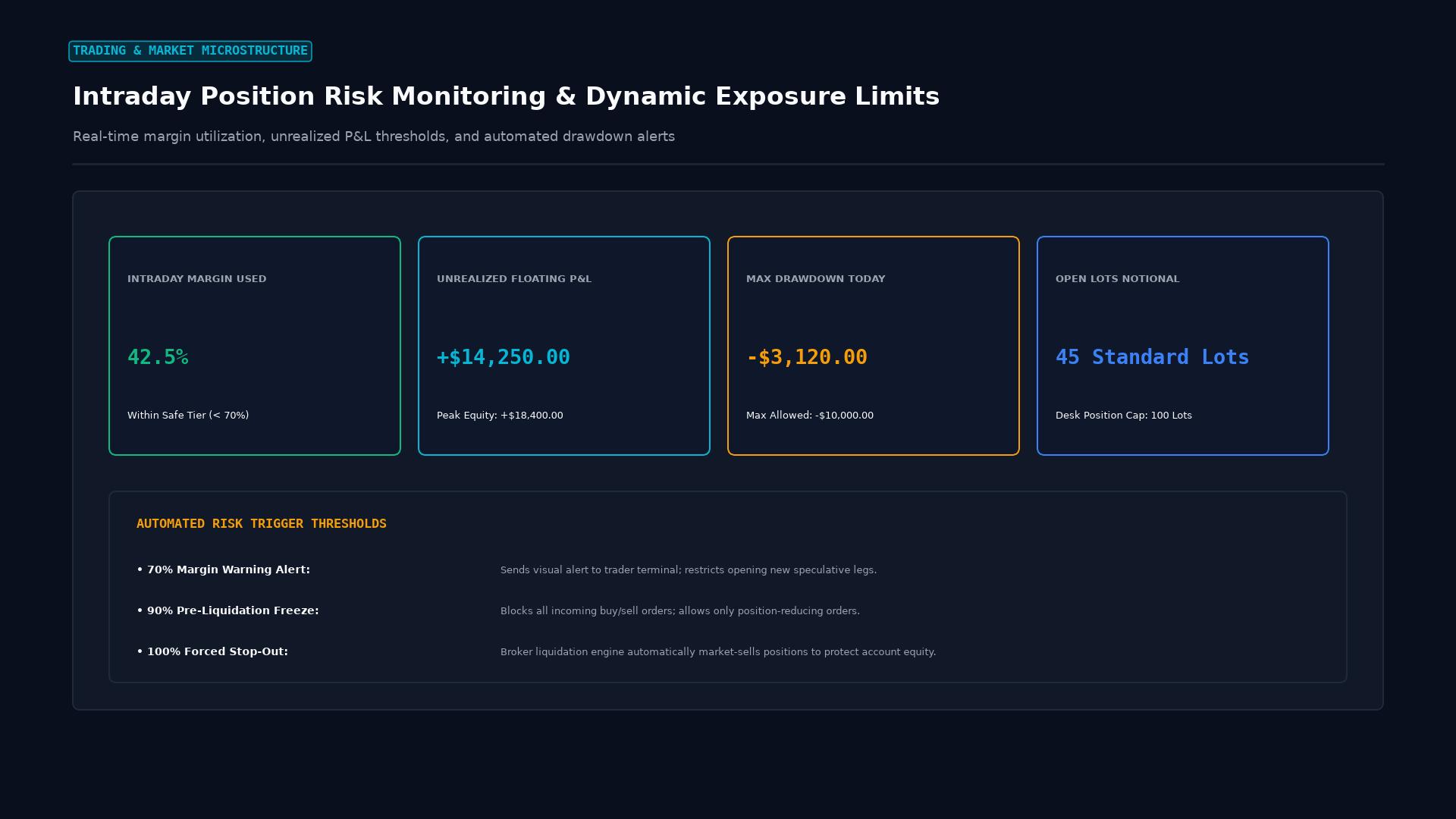 Figure: Real-time trading desk risk management: continuous monitoring of intraday margin utilization, floating unrealized P&L, and automated pre-liquidation warning alerts.
Key Takeaways
- Zero Overnight Gap Risk: By closing all open commitments prior to the close, intra-day traders eliminate the hazard of unexpected geopolitical shocks, central bank emergency announcements, or catastrophic weekend price gaps.
- Exemption from Rollover Swaps: Intra-day positions never incur nor earn overnight interest rate differentials (financing fees or carry swaps) because they are flat during the 5:00 PM EST daily value-date transition.
- Lower Margin Constraints: Many retail brokers and futures clearing merchants (FCMs) offer reduced daytime margin requirements for intra-day trades compared to holding positions overnight.
- Session-Dependent Volatility: Intra-day trade viability heavily depends on trading session overlaps (specifically London and New York), where liquidity is deep and bid-ask spreads compress to fractional pips.
- High Transaction Friction: Because intra-day positions target smaller pip increments (typically 5 to 30 pips), institutional commissions, ECN ticket fees, and bid-ask spreads consume a substantially higher percentage of gross trading profits.
Intra-Day Trading vs. Multi-Day Positioning
Understanding the structural differences between holding intra-day positions versus holding multi-day swing or position trades is fundamental for risk modeling.
| Characteristic | Intra-Day Position | Swing Position | Long-Term Position (Carry) |
|---|---|---|---|
| Holding Duration | Minutes to hours (exited before 5:00 PM EST) | 2 to 10 trading days | Weeks, months, or years |
| Overnight Gap Risk | Zero | Moderate to High | High (absorbed across cycles) |
| Financing / Swaps | None (exempt from Tom-Next rollover) | Accrued or paid nightly | Core determinant of net P&L |
| Target Profit | 5 – 40 pips | 80 – 350 pips | 400 – 1,500+ pips |
| Stop-Loss Proximity | Tight (3 – 15 pips) | Moderate (40 – 100 pips) | Wide (150 – 400+ pips) |
| Broker Margin Rules | Lower intraday margin (e.g., 25%–50% of overnight) | Full regulatory margin required | Full regulatory margin required |
| Capital Velocity | High (capital recycled multiple times daily) | Moderate | Low |
The Mechanics of Intra-Day Rollover Avoidance
In spot forex markets, standard spot contracts settle two business days following transaction execution ($T+2$, with USD/CAD settling on $T+1$). Every day at 5:00 PM New York time, all open contracts undergo a simultaneous overnight swap known as Tomorrow-Next (Tom-Next) rollover.
The broker or clearing bank mathematically closes the open position at the current spot rate and reopens it for the next settlement date at an adjusted price reflecting the interest rate differential between the two national currencies:
$$\text{Swap Points} = \text{Spot Rate} \times \frac{(r_{\text{quote}} - r_{\text{base}}) \times \left(\frac{\text{Days}}{360}\right)}{1 + \left(r_{\text{base}} \times \frac{\text{Days}}{360}\right)}$$
Where $r_{\text{quote}}$ and $r_{\text{base}}$ are the interbank deposit rates for the counter and base currencies. An intra-day position liquidated at 4:45 PM EST completely avoids this process, guaranteeing that negative carry or widenings of weekend swap charges (such as triple swaps charged on Wednesday nights) never affect the trader’s net equity balance.
Practical Application: The London-New York Overlap Strategy
Consider an institutional day trader monitoring the EUR/USD currency pair.
- Market Context: The London session opens at 08:00 GMT, establishing an initial daily range between 1.0820 and 1.0860.
- Setup: At 13:30 GMT (8:30 AM EST), the U.S. Bureau of Labor Statistics releases Non-Farm Payrolls (NFP). EUR/USD dips to test support at 1.0815.
- Execution: The trader enters a long intra-day position of 10 standard lots (EUR 1,000,000 notional) at 1.0820 at 13:35 GMT, placing a 12-pip protective stop-loss at 1.0808 ($1,200 risk).
- Target & Management: As price accelerates through morning highs, the trader secures profits at 1.0870 (+50 pips) at 15:45 GMT, booking a gross gain of $5,000.
- Session Resolution: Even if technical indicators suggest further continuation, the trader ensures all residual partial lots are closed flat by 16:30 EST (21:30 GMT), well ahead of the 17:00 EST rollover window. The trader logs off with 100% cash balances and zero exposure to evening geopolitical developments.
Risk Management & Common Pitfalls
- The “Overnight Conversion” Trap: One of the most destructive behavioral errors occurs when a day trader refuses to realize a floating loss before the close, converting an intra-day position into an overnight swing trade. This exposes an undercapitalized position with a tight stop to overnight spread widening and unpredictable news gaps.
- Spread Expansion at Session Transitions: Bid-ask spreads widen significantly between 4:55 PM and 5:15 PM EST as New York books close and Australian desks open. Closing intra-day positions during this liquidity vacuum results in excessive slippage.
- Overtrading and High Execution Drag: Executing dozens of intraday positions daily can create severe transaction drag. A trader making 20 trades a day with a 1.2-pip combined spread and commission pays 24 pips daily to the market broker, which amounts to $240 per standard lot in overhead before generating any net profit.
Frequently Asked Questions (FAQ)
Can an intra-day position be held over the weekend?
No. By definition, an intra-day position must be closed before the daily close. Holding an intra-day position through Friday evening turns it into a weekend position, exposing the account to weekend gap risk where opening market prices on Sunday afternoon may bypass protective stop-losses.
Do intra-day traders pay commission fees?
Yes. Depending on the broker’s account structure, intra-day traders pay either a markup embedded in the bid-ask spread (typical in dealing desk or STP accounts) or a separate ticket commission per million traded / per lot (common in raw spread ECN accounts). Because trade frequency is high, minimizing transaction costs is critical.
What is intraday margin?
Intraday margin (especially prevalent in regulated futures trading on exchanges like the CME) is a reduced collateral requirement permitted by brokers during active market hours. For example, a futures contract requiring $6,000 in maintenance margin to hold overnight might only require $500 to $1,000 in intraday margin, provided the trade is liquidated before exchange market close.
Ready to trade forex?
Open a free demo account with a regulated broker. Practice with virtual funds before risking real money.