Jobber
A jobber is a specialized market maker or independent floor trader who trades securities, commodities, or currencies for their own account, capturing short-term bid-ask spreads while assuming inventory risk rather than acting as a client agent.
What Is a Jobber?
Historically, a jobber (or stockjobber) was an independent market professional on the London Stock Exchange (LSE) who acted exclusively as a market-making principal. Under the traditional LSE system that endured until the “Big Bang” reforms of October 1986, the exchange enforced a strict single-capacity rule: a firm could operate as either a stockbroker (an agent representing public clients for a commission) or a stockjobber (a principal making continuous two-way prices with their own capital), but never both.
In modern financial and foreign exchange trading, the term “jobber” persists colloquially to describe a short-term scalper, local floor trader, or algorithmic liquidity provider whose sole objective is capturing fractions of the bid-ask spread through rapid inventory turnover, closing positions flat by the end of each session.
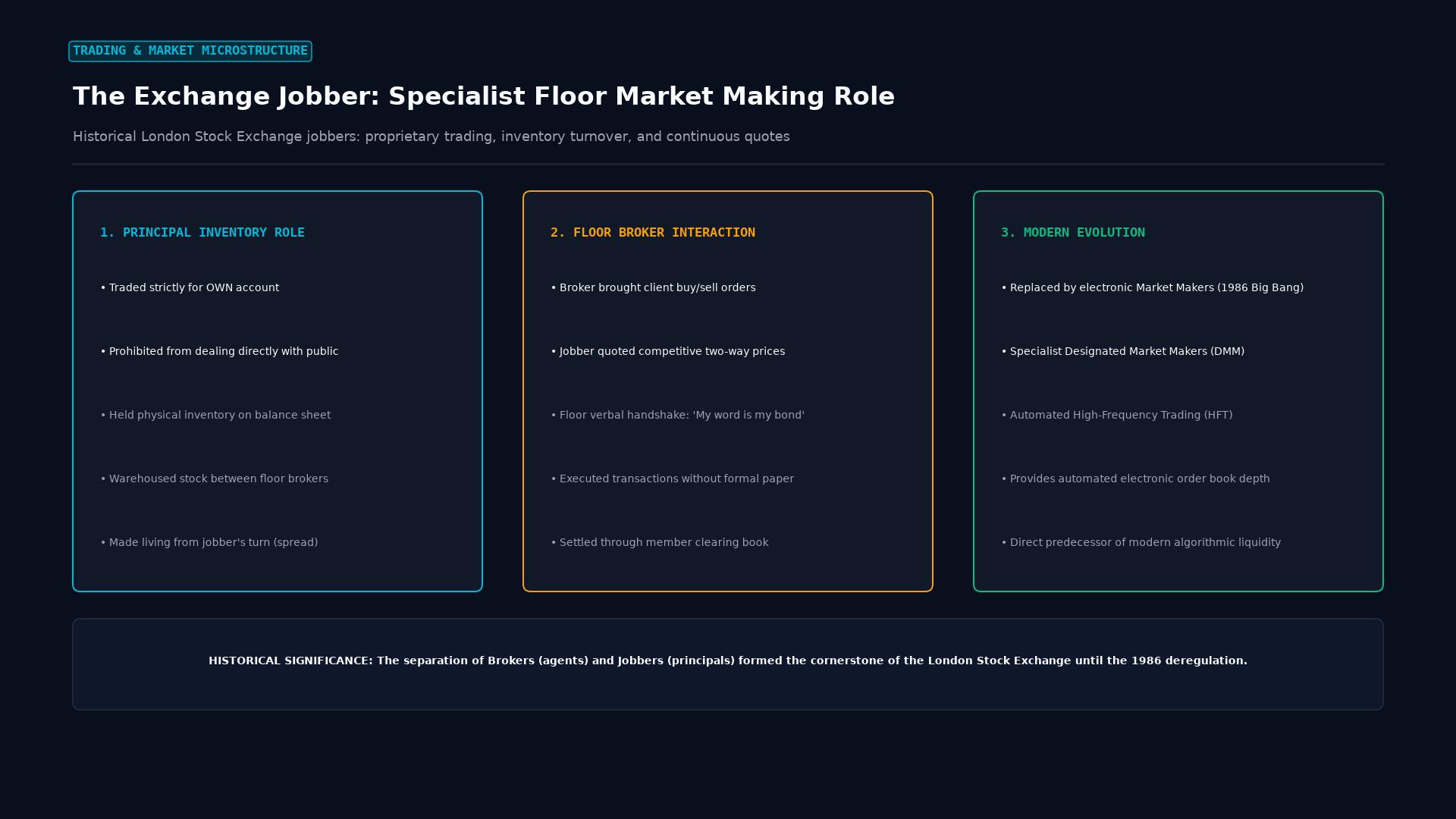 Figure: Historical market maker role: trading strictly for proprietary inventory on exchange floors, providing continuous two-way liquidity to floor brokers prior to electronic automation.
Key Takeaways
- Principal vs. Agent: Jobbers never took retail or institutional client orders directly. They traded solely as principals with licensed brokers who represented end-investors.
- The “Jobber’s Turn”: The primary source of income for a jobber was the bid-ask spread—known historically as the jobber’s turn—earned by purchasing at the lower bid and selling at the higher offer.
- The 1986 “Big Bang” Abolition: The Financial Services Act of 1986 dismantled single capacity on the LSE, permitting integrated investment banks to merge broker-agency and jobber-dealer capacities into modern “broker-dealer” operations.
- Modern Counterpart: Today’s functional equivalents of the historical jobber include high-frequency trading (HFT) firms, Designated Market Makers (DMMs) on the NYSE, and Tier-1 interbank FX quoting desks.
- Inventory Risk Management: A jobber survived not by predicting long-term macroeconomic trends, but by dynamically skewing bid and ask quotes to flatten excess inventory before market movements erased accumulated spread gains.
Evolution: Historical Jobbers vs. Modern Electronic Market Makers
The structural shift from physical trading pits to automated electronic limit order books (CLOBs) transformed the jobber role from manual pit negotiation into algorithmic liquidity provisioning.
| Dimension | Historical Stockjobber (Pre-1986 LSE) | Modern Electronic Market Maker / Jobber |
|---|---|---|
| Trading Venue | Physical exchange floor (London Stock Exchange) | Electronic matching engines (EBS, Refinitiv, CME, Currenex) |
| Capacity | Strict single capacity (principal only) | Dual capacity (broker-dealer or pure proprietary algorithmic firm) |
| Quote Method | Verbal quotation to visiting brokers in the pit | Sub-millisecond FIX API streaming price ladders |
| Inventory Holding Time | Minutes to days | Microseconds to hours |
| Spread Capture | Fixed fractional pennies (e.g., 1/8, 1/16) | Sub-pip increments (tenths of a pip, e.g., 0.1 pip on EUR/USD) |
| Risk Hedging | Phone/telex matching with other jobbers | Automated statistical arbitrage across correlated futures/ETFs |
| Key Players | Wedd Durlacher Mordaunt, Akroyd & Smithers | Citadel Securities, Jane Street, Optiver, XTX Markets, Deutsche Bank |
Mechanics: The “Jobber’s Turn” and Inventory Skewing
To illustrate how a jobber captured revenue while neutralizing directional market exposure, consider a market maker quoting British Pound sterling (GBP/USD).
$$\text{Jobber’s Turn (Spread)} = P_{\text{Ask}} - P_{\text{Bid}}$$
- Initial Two-Way Quote: The jobber quotes 1.2500 / 1.2502 for £5,000,000 notional.
- Client Flow Absorption: A buying broker lifts the jobber’s offer at 1.2502. The jobber is now short £5,000,000 and holds an unwanted short inventory position.
- Price Skewing (Inventory Control): To dissuade additional buyers and attract incoming sellers to rebalance their book, the jobber raises their two-way quote to 1.2501 / 1.2503:
- The higher bid (1.2501) makes the jobber the best buyer in the market, encouraging sellers to hit their bid.
- The elevated offer (1.2503) discourages further buying.
- Inventory Neutralization: A second broker sells £5,000,000 to the jobber at 1.2501.
- Gross Profit Realization: The jobber is flat (£0 exposure) and has secured £0.0001 (1 pip) across £5,000,000, realizing a net profit of $500 without gambling on market direction.
Case Study: The 1986 Big Bang and the Extinction of Pure Jobbers
Prior to October 27, 1986, the UK capital markets were partitioned into rigid guilds. Five major jobbing firms—dominated by Wedd Durlacher Mordaunt & Co. and Akroyd & Smithers—controlled over 80% of all UK equity and gilt market turnover.
However, fixed minimum commissions charged by brokers and wide spreads enforced by jobbers stifled international competitiveness against Wall Street.
The Margaret Thatcher government and the Bank of England implemented the Big Bang:
- Abolished fixed brokerage commissions.
- Abolished the separation between brokers and jobbers, ushering in modern “dual capacity.”
- Permitted outside international ownership of exchange member firms.
Within months, global commercial and investment banks acquired the traditional jobbing partnerships (e.g., Barclays acquired Wedd Durlacher to form Barclays de Zoete Wedd / BZW; SG Warburg acquired Akroyd & Smithers). The physical floor emptied as automated quotes migrated to the SEAQ (Stock Exchange Automated Quotations) electronic screens, permanently transforming jobbing into digital algorithmic market making.
Risks and Pitfalls of Jobbing Strategies
- Adverse Selection: When large institutional order flow enters the market driven by fundamental macro news, a jobber quoting static prices is systematically “picked off” by informed traders, leaving them holding massive underwater inventory.
- Inventory Illiquidity (Toxic Flow): In volatile or crashing markets, counterparty buy orders evaporate. A jobber attempting to capture spreads is forced into absorbing one-way selling pressure, which can rapidly exhaust capital reserves.
- Execution Latency: In modern electronic trading, manual jobbing or retail scalping is vulnerable to algorithmic front-running and colocation latency advantages, where institutional algorithms adjust quotes in microseconds.
Frequently Asked Questions (FAQ)
What is the difference between a broker and a jobber?
A broker is an agent who acts on behalf of clients (investors or institutions), routing their orders to the market and receiving a commission for trade execution. A jobber is a principal who trades directly with brokers using their own proprietary capital, earning the bid-ask spread and bearing full inventory risk.
Do jobbers exist in modern forex trading?
While the formal title of “jobber” is no longer used on modern exchanges, the economic function is identical to modern non-bank liquidity providers (such as XTX Markets or Citadel Securities) and interbank FX spot desks who stream electronic prices to platforms like EBS, Currenex, and retail broker aggregators.
Why was single capacity abolished during the Big Bang?
Single capacity forced institutional investors to pay two layers of cost: a fixed commission to the broker and the jobber’s spread to the market maker. Abolishing it enabled foreign investment banks to provide combined execution and liquidity, drastically narrowing spreads, reducing trading costs, and establishing London as the premier international financial hub.
Ready to trade forex?
Open a free demo account with a regulated broker. Practice with virtual funds before risking real money.