Lapse
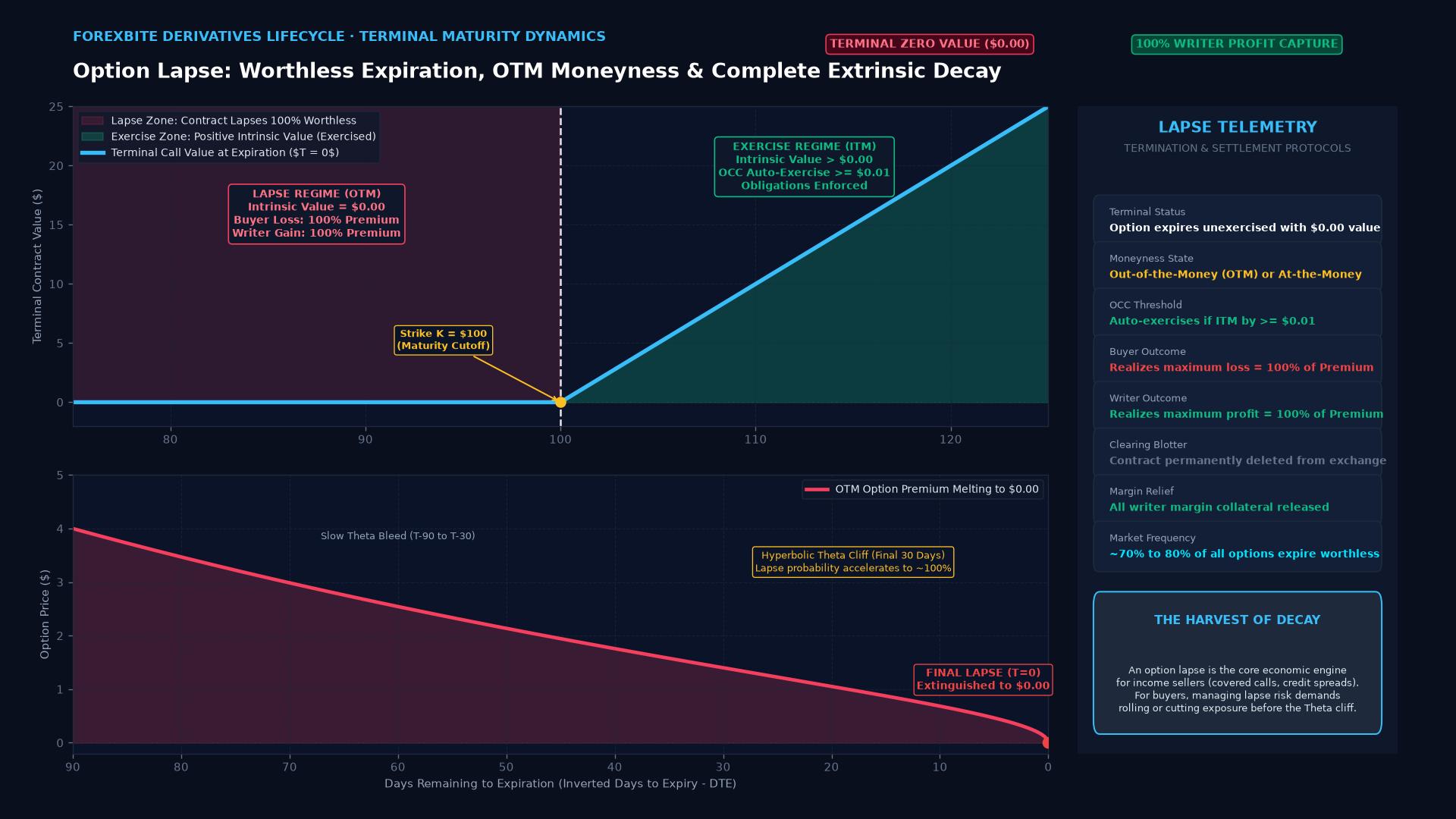
In options and derivatives trading, a lapse occurs when an option contract reaches its official expiration date without being exercised, terminating all rights of the holder, extinguishing the obligations of the writer, and expiring completely worthless.
What Is a Lapse?
A lapse in options and derivatives markets represents the terminal expiration of an unexercised contract. When an option lapses, the legal agreement between the buyer and the seller is permanently extinguished: the option holder’s right to purchase (call) or sell (put) the underlying currency pair, commodity, or equity at the agreed strike price dissolves into zero economic value, and the option writer (seller) is released from any potential assignment obligations.
An option lapses when its intrinsic value is zero at the moment of maturity. Because exercising the contract would produce a financial loss relative to prevailing spot market prices, the rational decision for the option holder is to let the contract expire worthless. The buyer forfeits 100% of the initial upfront premium paid, while the writer retains 100% of the premium as realized net profit.
Key Takeaways
- Worthless Expiration: An option lapses strictly when it expires out-of-the-money (OTM) or at-the-money (ATM), where market spot prices make exercise economically irrational.
- Asymmetric Outcome: For the option buyer, a lapse results in a defined, capped loss equal to the total premium paid. For the option seller (writer), a lapse represents the ideal scenario: maximum possible profit without delivery obligations.
- The Core Goal of Premium Sellers: Income-generating options strategies—such as covered calls, cash-secured puts, iron condors, and credit spreads—are engineered specifically to profit from contracts lapsing unexercised.
- Automatic Exercise Thresholds: Regulated clearing corporations (such as the Options Clearing Corporation, OCC) automatically exercise contracts that finish in-the-money by even $0.01 unless explicit “do not exercise” instructions are filed. Contracts failing to meet this threshold lapse automatically.
- Theta Decay Acceleration: The probability of an out-of-the-money option lapsing accelerates exponentially during the final 30 days before expiration as time value (extrinsic value) decays toward zero.
The Economics of a Lapse: Intrinsic vs. Extrinsic Value
The total price of an option is governed by two components:
$$\text{Option Premium} = \text{Intrinsic Value} + \text{Extrinsic Value (Time Value)}$$
At the precise moment of contract expiration ($T$), extrinsic time value mathematically collapses to zero:
$$\lim_{t \to T} \text{Extrinsic Value} = 0$$
Therefore, the terminal payoff is solely determined by intrinsic value:
$$\text{Call Value at Expiration} = \max(S_T - K, 0)$$
$$\text{Put Value at Expiration} = \max(K - S_T, 0)$$
Where $S_T$ is the spot exchange rate at expiration and $K$ is the contract strike price.
If $S_T \le K$ for a call option, or $S_T \ge K$ for a put option, the intrinsic value is mathematically $0$. Because no rational market participant would purchase an asset above current spot prices or sell below spot prices, the contract lapses.
Expiration Outcomes: Exercise vs. Assignment vs. Lapse
| Metric | In-The-Money (ITM) | At-The-Money (ATM) | Out-Of-The-Money (OTM) |
|---|---|---|---|
| Spot vs. Strike (Call) | Spot > Strike ($S_T > K$) | Spot = Strike ($S_T = K$) | Spot < Strike ($S_T < K$) |
| Spot vs. Strike (Put) | Spot < Strike ($S_T < K$) | Spot = Strike ($S_T = K$) | Spot > Strike ($S_T > K$) |
| Terminal Action | Exercise / Assignment | Lapse | Lapse |
| Option Value | Realized intrinsic value | Expired worthless ($0.00) | Expired worthless ($0.00) |
| Buyer P&L | $(\text{Intrinsic Value} - \text{Premium})$ | $-100%$ of Premium Paid | $-100%$ of Premium Paid |
| Writer P&L | $(\text{Premium} - \text{Intrinsic Value})$ | $+100%$ of Premium Kept | $+100%$ of Premium Kept |
| Margin Requirement | Converted to spot/futures position | Collateral released | Collateral released |
Real-World Case Study: FX Carry-Trade Protection That Lapsed
A London-based hedge fund held a large long position in the Australian Dollar (AUD/USD) to capture attractive yield differentials against the U.S. Dollar.
- Hedge Implementation: Fearing a sudden hawkish pivot by the Federal Reserve, the fund manager purchased a 3-month AUD/USD Put Option with a strike price of 0.6400, paying a premium of 85 pips ($8,500 per AUD 1,000,000 contract). Spot AUD/USD was trading at 0.6550.
- Market Conditions: Over the 90-day holding period, the Reserve Bank of Australia raised domestic cash rates twice, while U.S. inflation data moderated. AUD/USD strengthened steadily to 0.6720.
- Maturity Resolution: At the 10:00 AM New York expiration cut, the spot rate was 0.6720.
- Exercising the put option would require selling AUD at 0.6400, which would sacrifice $0.0320 (320 pips) per dollar compared to selling in the open spot market.
- The put option lapsed unexercised.
- Strategic Result: While the $8,500 option premium was a complete write-off, the fund happily accepted the lapse: the underlying spot AUD/USD position gained 170 pips ($17,000), and the carry trade accrued interest, yielding a highly profitable net campaign. The lapsed option functioned exactly as intended—like an uncashed insurance policy.
Critical Trading Pitfalls Associated with Lapsing
- Holding Speculative Long Options to Expiration: Novice retail traders often hold losing, out-of-the-money options all the way to expiration in the futile hope of a miraculous last-minute reversal. Selling an option with even 5% or 10% of remaining extrinsic value recovers valuable capital; letting it lapse guarantees a total 100% loss.
- Pin Risk on Near-the-Money Expirations: If an option expires exactly at the strike price (e.g., spot EUR/USD at 1.0900 on a 1.0900 call), the writer faces extreme uncertainty over whether the clearing firm or counterparty will exercise or let the option lapse. If the writer assumes a lapse and market prices move sharply after the Friday close, they may find themselves assigned an unwanted spot position over the weekend.
Frequently Asked Questions (FAQ)
What percentage of options lapse worthless?
Industry data from derivatives exchanges such as the Chicago Board Options Exchange (CBOE) indicates that approximately 30% to 35% of all options contracts lapse worthless at expiration. The remaining 65% to 70% are either closed out via offsetting transactions prior to expiration or exercised in-the-money.
Does letting an option lapse require any action or broker fees?
No. Letting an option lapse is a passive event. If an option is out-of-the-money at expiration, the clearing exchange and broker automatically extinguish the contract from your account. In fact, letting an OTM option lapse avoids the closing commission fee that would be charged for executing an offsetting exit trade.
Why do institutional traders sell options if they can lose infinite money?
Professional market makers and option sellers utilize mathematical probability models, strict risk boundaries, and offsetting hedges (such as delta hedging or spread structures). Because the vast majority of out-of-the-money extrinsic value decays to zero over time, selling overpriced options that ultimately lapse is one of the most profitable systematic institutional trading strategies.
Ready to trade forex?
Open a free demo account with a regulated broker. Practice with virtual funds before risking real money.