Out of the Money
An out-of-the-money (OTM) option is a derivative contract that possesses zero intrinsic value because its strike price is currently unfavorable relative to the prevailing market price of the underlying asset—above the spot price for a call, or below the spot price for a put.
What Is Out of the Money (OTM)?
In options trading, out of the money (OTM) is a core moneyness classification describing an options contract whose exercise price (strike price) is mathematically disadvantageous compared to the current spot price of the underlying asset. If an OTM option were exercised immediately, it would produce zero positive cash flow; therefore, an out-of-the-money option has zero intrinsic value.
The entire market price (premium) of an OTM option consists exclusively of extrinsic value (also known as time value or volatility value). This extrinsic value reflects the statistical probability that the underlying asset’s price will move sufficiently prior to expiration to cross the strike price and finish with real intrinsic value:
$$\text{Option Premium} = \underbrace{\text{Intrinsic Value}}_{= 0} + \text{Extrinsic Value}$$
If an OTM option reaches its expiration date without the underlying asset crossing the strike price, the option expires completely worthless, resulting in a 100% loss of the premium paid for the buyer, and a 100% maximum profit for the option seller (writer).
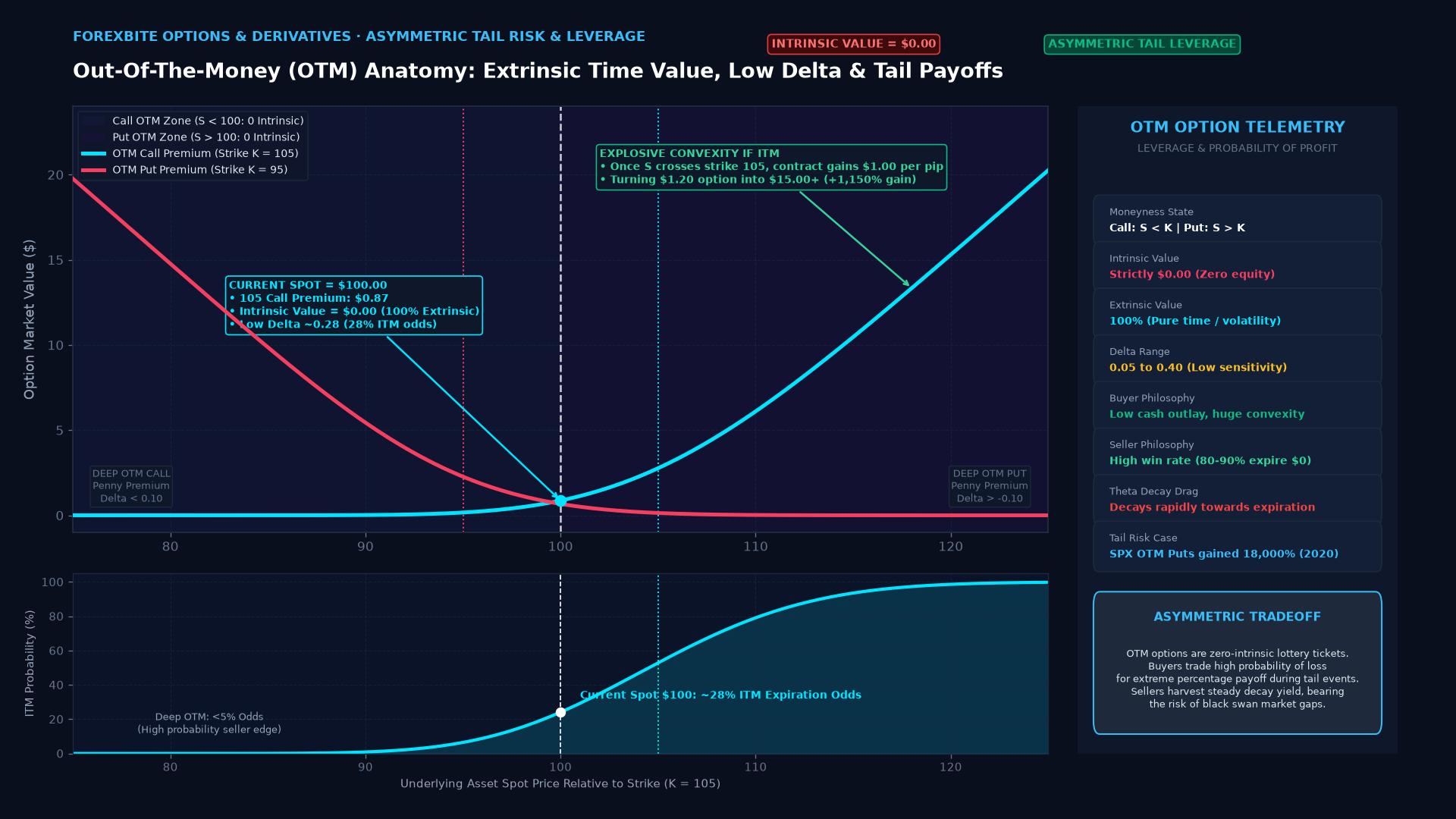
Moneyness Conditions: Calls vs. Puts
The condition for being out-of-the-money is mathematically defined by the relationship between the underlying asset price ($S$) and the strike price ($K$):
1. OTM Call Options: $K > S$
- A call grants the right to buy the asset at price $K$.
- If the underlying stock is trading at $150 and the call has a strike price of $165, no rational investor would exercise the option to buy shares at $165 when they could buy them on the open exchange for $150.
- Therefore, the $165 Call is out of the money by $15.00.
2. OTM Put Options: $K < S$
- A put grants the right to sell the asset at price $K$.
- If the underlying stock is trading at $150 and the put has a strike price of $135, no rational investor would exercise the option to sell shares at $135 when they could sell them on the open exchange for $150.
- Therefore, the $135 Put is out of the money by $15.00.
Intrinsic vs. Extrinsic Value Across Moneyness States
The following table contrasts the financial anatomy of In-the-Money (ITM), At-the-Money (ATM), and Out-of-the-Money (OTM) contracts:
| Moneyness Classification | Call Condition | Put Condition | Intrinsic Value | Extrinsic (Time) Value | Delta ($\Delta$) Magnitude |
|---|---|---|---|---|---|
| Deep In-the-Money (ITM) | $S \gg K$ | $S \ll K$ | Very High ($ | S - K | $) |
| In-the-Money (ITM) | $S > K$ | $S < K$ | Moderate ($S - K$) | Moderate | 0.50 to 0.85 (-0.50 to -0.85) |
| At-the-Money (ATM) | $S \approx K$ | $S \approx K$ | Zero ($\approx 0$) | Maximum | Approximately 0.50 (-0.50) |
| Out-of-the-Money (OTM) | $S < K$ | $S > K$ | Zero ($0$) | Moderate to Low | 0.15 to 0.45 (-0.15 to -0.45) |
| Far Out-of-the-Money (Far OTM) | $S \ll K$ | $S \gg K$ | Zero ($0$) | Very Low (Penny premium) | Less than 0.10 (-0.10) |
The Risk-Reward Asymmetry of Trading OTM Options
Traders utilize OTM options across two contrasting institutional philosophies:
1. The Retail / Speculative Buyer’s Perspective (High Leverage, Low Probability)
OTM options are significantly cheaper than ITM or ATM options. A trader with $1,000 can buy dozens of OTM contracts instead of a single ITM contract.
- Leverage: If an unexpected catalyst (such as an earnings surprise or geopolitical shock) propels the stock dramatically higher, an OTM option with a Delta of 0.20 can surge by 500% to 1,000% within hours.
- The Decay Drag: However, the statistical probability of profit (POP) is low. Because extrinsic value erodes daily due to Theta decay, most OTM options expire worthless, eroding capital steadily over time.
2. The Institutional Writer’s Perspective (Income Generation)
Quantitative hedge funds and options income funds frequently write (sell) OTM options (e.g., selling 10-delta or 15-delta puts and calls via short strangles or iron condors).
- The Edge: By selling contracts that have an 85% to 90% statistical probability of expiring worthless, writers harvest daily Theta decay and capture the volatility risk premium (implied volatility trading higher than realized volatility).
- The Tail Risk: Unhedged OTM option sellers face severe black-swan risk if a market crash drives prices far beyond the strike price.
Real-World Case Study: The Tail-Risk Payoff of OTM Puts in March 2020
In January 2020, ahead of the global COVID-19 pandemic, the S&P 500 traded at all-time highs near 3,350. Implied volatility was extremely subdued, with the CBOE Volatility Index (VIX) hovering near 12.0.
- The Trade: A tail-risk hedge fund (following an asymmetric risk strategy popularized by Nassim Nicholas Taleb) allocated a small recurring budget (0.15% of assets per month) to purchase Far OTM Puts on the S&P 500 (SPX 2,400 Puts expiring in late March, approximately 28% out-of-the-money).
- Cost: These far OTM contracts traded for less than $1.20 per contract ($120 each).
- The Shock: In late February and March 2020, global lockdowns caused the fastest 30% drop in stock market history. The S&P 500 plummeted to 2,191 by March 23, and VIX spiked to 82.69.
- The Payoff: The SPX 2,400 Puts moved deep in-the-money, trading above $220.00 per contract. A contract bought for $120 exploded to over $22,000—a return exceeding 18,000%, providing the fund with hundreds of millions in liquid capital to deploy into depressed assets at the market bottom.
Frequently Asked Questions
Can an out-of-the-money option be sold before expiration?
Yes. You do not need to wait for expiration or exercise an option to exit the trade. An investor who bought an OTM option can execute an offsetting closing sale (“Sell to Close”) at any time during market hours to lock in gains if the premium has risen due to increased volatility or favorable price movement.
What is Delta and how does it relate to OTM options?
Delta ($\Delta$) measures the expected change in option price for a $1.00 move in the underlying asset. In derivatives pricing, an option’s Delta also serves as an approximate proxy for the market’s implied probability that the contract will expire in the money. For example, a call option with a Delta of 0.25 has an approximately 25% chance of expiring in-the-money.
Why do far out-of-the-money options still have value?
Even when an option strike is far away from the current price, investors are willing to pay a small price for two reasons: (1) Time Remaining: There is still time for a dramatic price move before expiration; and (2) Implied Volatility / Tail Risk: Unexpected macro events, corporate takeovers, or earnings explosions can cause large, sudden price gaps.
Ready to trade forex?
Open a free demo account with a regulated broker. Practice with virtual funds before risking real money.