Expiration Date
The expiration date is the final calendar date and specific cutoff time at which a derivative contract—such as an option, futures, or forward—terminates, triggering final exercise, cash settlement, or physical asset delivery.
What Is an Expiration Date?
An expiration date (often referred to simply as expiry) is the terminal calendar date and exact time on which a financial derivative contract ceases to be valid and active. After this moment, the contract is officially extinguished. For an option holder, the expiration date represents the final deadline to either exercise the contract or allow it to expire worthless. For futures and forward market participants, expiration dictates the final settlement price and triggers cash reconciliation or physical delivery of the underlying asset.
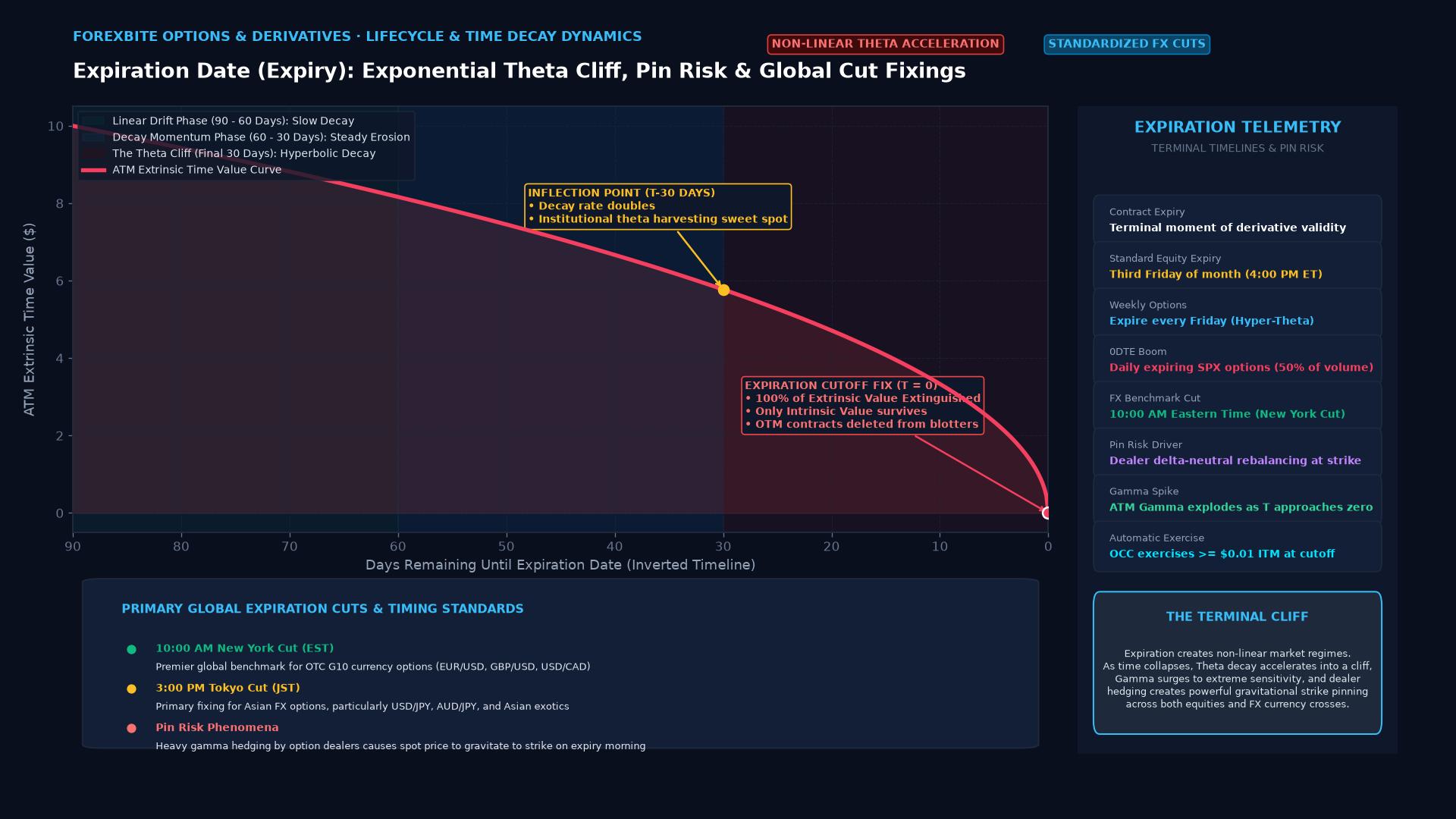
In the global foreign exchange (FX) market, expiration dates govern billions of dollars in daily transactions. Unlike equities, which typically expire at market close, institutional currency options expire at standardized daily times known as “Cuts”—most notably the 10:00 AM New York Cut and the 3:00 PM Tokyo Cut—which frequently trigger sharp intraday volatility as dealers hedge large expiring strike exposures.
Key Takeaways
- Contract Termination: After the expiration cutoff, unexercised options have zero legal standing and cannot be revived or traded.
- The 10:00 AM New York Cut: The premier global expiration benchmark for Over-the-Counter (OTC) currency options, causing concentrated spot FX volume between 09:30 AM and 10:00 AM EST.
- Exponential Time Decay (Theta): During the final days before expiration, an option’s extrinsic time value evaporates at an accelerating pace.
- Pin Risk: When the spot exchange rate trades immediately adjacent to a heavily populated strike price on expiration morning, dealers hedging the strike can cause the spot rate to become “pinned” to that exact level until the cutoff passes.
Global FX Expiration Cuts and Benchmarks
Because foreign exchange trades 24 hours a day across global financial centers, market participants rely on specific regional fixings to settle expiring contracts:
| Expiration Cut / Fix | Local Time | UTC / GMT Equivalent | Key Impacted Currency Pairs |
|---|---|---|---|
| Tokyo Cut | 15:00 JST | 06:00 UTC | USD/JPY, EUR/JPY, AUD/JPY |
| London Fix (WMR) | 16:00 London | 16:00 UTC (15:00 BST) | Benchmark for sovereign reserve rebalancing and equity hedges |
| New York Cut | 10:00 AM EST | 15:00 UTC | The global gold standard for OTC FX options (EUR/USD, GBP/USD, USD/CAD) |
| CME Futures Settlement | 14:00 CST | 20:00 UTC | Quarterly CME currency futures settlement (IMM dates) |
Pin Risk and Gamma Scalping Dynamics at Expiry
As an option nears its expiration cutoff, its Gamma (the rate of change of Delta) reaches extreme levels for strikes near the current spot price. This phenomenon generates pin risk:
Dealer Delta Hedging Leading to a Strike Pin:
1. Massive open interest exists at 1.0800 EUR/USD expiring at 10:00 AM NY Cut.
2. If spot rises to 1.0805: Short gamma dealers must SELL spot EUR/USD to hedge,
   pushing the spot rate back down toward 1.0800.
3. If spot falls to 1.0795: Dealers must BUY spot EUR/USD to cover hedges,
   pulling the spot rate back up toward 1.0800.
4. RESULT: The currency becomes magnetically "pinned" to 1.0800 until 10:00 AM.
5. Immediately after 10:00 AM: The pin breaks, often releasing explosive volatility.
Managing Expiration: Rolling Futures Contracts
Because spot forex contracts roll over continuously every evening via financing swaps, spot traders do not deal with fixed expirations. However, currency futures (traded on the CME) and forward contracts have rigid expiration dates.
To maintain continuous market exposure without taking physical delivery of currency:
- The Futures Roll: Traders close out their front-month contract (e.g., September IMM contract) several days before expiration and simultaneously open an identical position in the next deferred contract (e.g., December).
- Calendar Spread: This rollover is executed as a single order known as a calendar spread, locking in the forward interest rate differential between the two expirations.
Frequently Asked Questions
What happens if an option expires in-the-money but the trader takes no action?
In modern institutional clearing houses (such as the CME or Options Clearing Corporation - OCC), expiring contracts that are in-the-money by a minimum threshold (typically $0.01 or 1 pip) are automatically exercised on behalf of the trader. In retail brokerages, the broker will either automatically credit the cash intrinsic value or auto-exercise into an open spot position if sufficient margin is available.
Why do stock index options have “Triple Witching” expirations?
“Triple Witching” (or Quadruple Witching) occurs on the third Friday of March, June, September, and December. On these days, stock options, index options, index futures, and single-stock futures expire simultaneously, generating massive global trading volume and volatility that frequently spills over into foreign exchange markets.
What is the “IMM Date” in foreign exchange?
The International Monetary Market (IMM) date is the international standard settlement date for currency futures and OTC forward contracts. IMM dates fall on the third Wednesday of March, June, September, and December.
Ready to trade forex?
Open a free demo account with a regulated broker. Practice with virtual funds before risking real money.