Lay Off
In interbank dealing and broker risk management, to lay off a position means executing an offsetting transaction in the wholesale market to eliminate inventory risk inherited from client orders, returning the dealer's book to a flat or square exposure.
What Does It Mean to Lay Off a Position?
In foreign exchange and institutional financial markets, to lay off a position (or execute a lay-off trade) is the practice of passing on an accumulated market exposure to another wholesale participant or external liquidity pool. When a market maker or broker fills a large client buy or sell order, the dealer initially absorbs the opposite side of the transaction onto their proprietary balance sheet.
If the dealer does not wish to speculate directionally on the currency pair or if the position exceeds the firm’s internal Value-at-Risk (VaR) or inventory limits, the dealer immediately “lays off” the trade. By buying or selling the identical notional volume in the interbank market (via platforms like EBS, Refinitiv Matching, or bilateral Tier-1 bank connections), the dealer neutralizes directional price risk and returns their trading book to square (zero net open exposure).
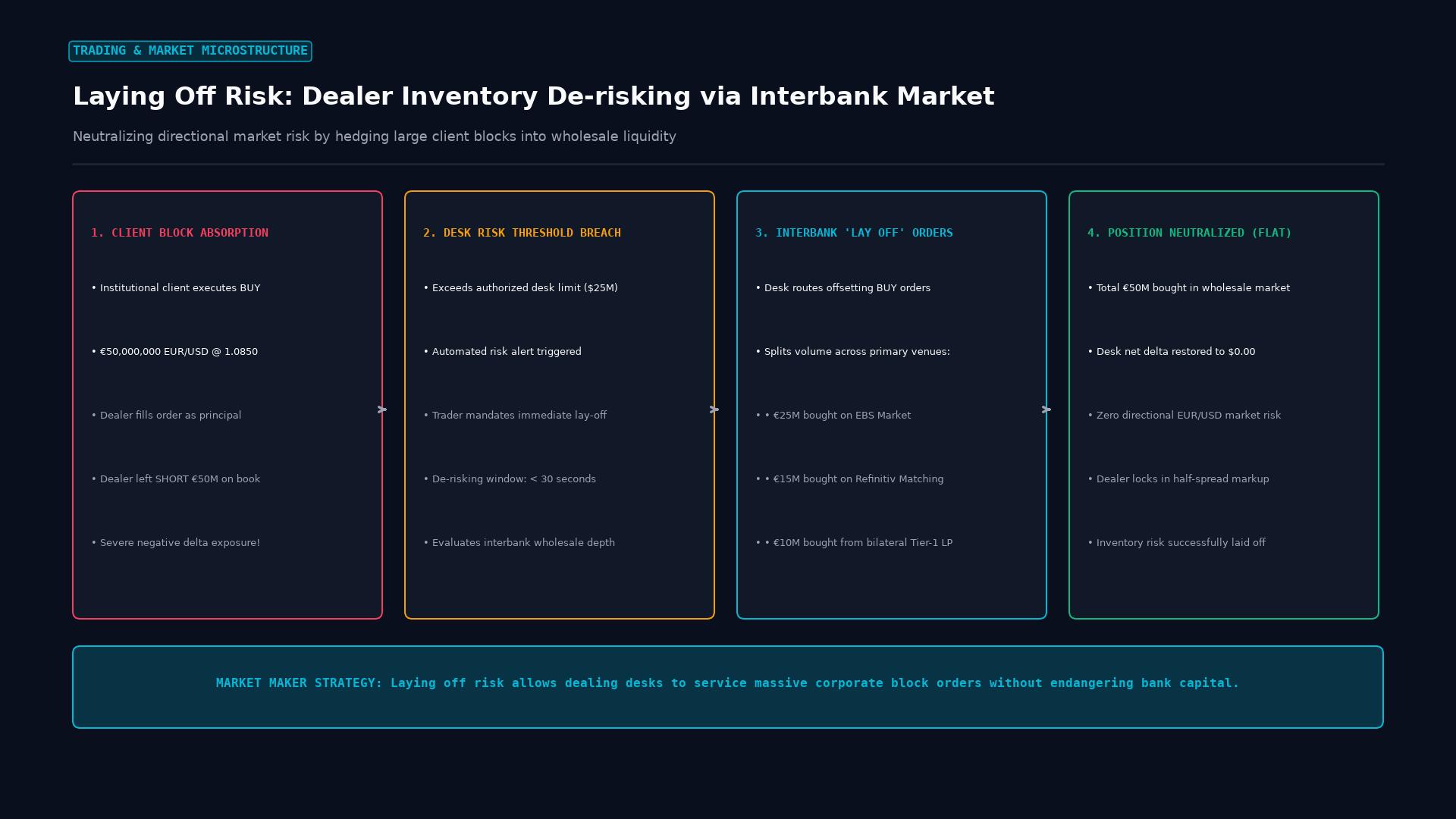 Figure: Dealer inventory management: laying off excess directional customer exposure into interbank ECN liquidity pools to maintain flat risk limits.
Key Takeaways
- Risk Transfer Mechanism: Laying off is the foundational technique market makers use to earn the bid-ask spread while outsourcing market volatility risk to external counterparties.
- Returning to “Square”: The definitive objective of a lay-off trade is achieving a net flat position where fluctuations in the exchange rate produce zero mark-to-market P&L impact.
- A-Book vs. B-Book Dynamics: In retail forex broker architecture, laying off a trade is synonymous with Straight-Through Processing (STP) or “A-Book” routing, where retail orders are hedged directly with institutional prime-of-prime liquidity providers.
- Market Impact Management: Dealers laying off large institutional block trades often slice orders into smaller algorithmic “child orders” (such as TWAP or VWAP) to prevent causing adverse price slippage in the interbank market.
- Asymmetric Internalization: Modern electronic market makers rarely lay off 100% of their trades; instead, they internalize offsetting client flows (e.g., crossing retail buyers with retail sellers) and only lay off the residual net directional imbalance.
Institutional Dealing Mechanics: Internalization vs. Laying Off
Tier-1 forex dealing desks optimize their profitability by balancing the spread revenue of internalized flow against the capital costs of laying off risk.
$$\text{Net Dealer Exposure} = \sum \text{Client Longs} - \sum \text{Client Shorts}$$
$$\text{Lay-off Volume} = \max\left( |\text{Net Dealer Exposure}| - \text{Internal VaR Limit}, ; 0 \right)$$
If Bank A’s corporate desk buys €100M from an exporter and sells €80M to an importer:
- Internalized Flow: €80M is matched internally at zero hedging cost, capturing the full bid-ask spread on both transactions.
- Residual Imbalance: Bank A retains a net long position of €20M.
- The Lay-Off: Bank A sells €20M EUR/USD into the EBS interbank book. The desk locks in spread profits across all €180M of volume while carrying zero overnight currency risk.
Comparative Analysis: Warehousing vs. Laying Off vs. Internalizing
| Risk Dimension | Warehousing Risk (B-Book) | Laying Off Risk (A-Book / STP) | Flow Internalization |
|---|---|---|---|
| Market Exposure | Full directional price risk on balance sheet | Zero directional price risk (net flat) | Zero net exposure across matched client orders |
| Revenue Driver | Client trading losses + spreads | Fixed markup or clearing commission | Capture of both sides of the bid-ask spread |
| Capital Requirement | High (must absorb massive drawdowns) | Low (collateral held at prime broker) | Moderate (temporary buffer between fills) |
| Execution Speed | Instant (virtual execution against broker) | Dependent on interbank liquidity fill | Sub-millisecond matching engine |
| Slippage Hazard | Absorbed by broker or passed to client | Vulnerable to wholesale market slippage | None (matched internally) |
Real-World Case Study: The SNB Franc Shock of January 15, 2015
The catastrophic importance of laying off positions was demonstrated during the Swiss National Bank (SNB) de-pegging crisis.
- Context: Retail brokers held massive leveraged long EUR/CHF client positions based on the SNB’s stated 1.2000 floor.
- The Shock: At 09:30 GMT on January 15, 2015, the SNB abruptly terminated the peg. EUR/CHF collapsed from 1.2000 to below 0.8500 in minutes.
- The Failure to Lay Off: Brokers operating automated STP (lay-off) engines attempted to lay off client stop-loss orders into Tier-1 interbank books (Citigroup, Deutsche Bank, Barclays).
- Outcome: Interbank liquidity providers pulled all bids from electronic feeds. Because dealers could not find counterparties to lay off the tsunami of sell orders, trades filled hundreds of pips below client stop levels. Firms that failed to lay off risk ahead of the event (or whose prime brokers rejected lay-off orders) suffered hundreds of millions in negative equity deficits, forcing major brokerages into insolvency.
Execution Risks When Laying Off Positions
- Latency Arbitrage: High-frequency traders (HFTs) monitoring public exchange tapes can detect a dealer’s incoming lay-off order and rapidly adjust interbank quotes, forcing the dealer to lay off at unfavorable prices (the “winner’s curse”).
- Toxic Order Flow: If an institutional hedge fund executes an informed macro trade right before a surprise interest rate decision, a dealer attempting to lay off the trade milliseconds later will find the wholesale market moving faster than their hedging algorithm, incurring severe execution losses.
- Prime Broker Credit Line Bottlenecks: During periods of extreme financial stress, a dealer’s credit line with their clearing prime broker may become saturated, preventing them from laying off trades and stranding dangerous inventory on their books.
Frequently Asked Questions (FAQ)
What does “square” mean in relation to laying off?
In interbank trading jargon, being “square” means that a trader’s aggregate purchases exactly equal their aggregate sales in a given currency pair, resulting in zero open position, zero directional exposure, and zero sensitivity to future exchange rate movements.
Do retail forex brokers lay off all customer trades?
No. Retail brokers utilize hybrid risk models. Unprofitable, small-scale retail traders are often “warehoused” internally (B-Book) where the broker takes the opposite side of the trade. Consistently profitable traders, large institutional accounts, and high-notional orders are systematically “laid off” (A-Book) to wholesale liquidity providers to eliminate broker insolvency risk.
What is the difference between hedging and laying off?
Hedging is a broad term encompassing any strategy used to offset investment risk, including buying options or trading correlated proxy assets. Laying off is a specific, direct operational action where a dealer liquidates the identical asset in the interbank market to immediately neutralize inventory created by a client transaction.
Ready to trade forex?
Open a free demo account with a regulated broker. Practice with virtual funds before risking real money.