Square
A financial state where a trader, market-making desk, or investment portfolio has neutralized all open market exposure, holding zero net long or short positions and bearing zero directional risk; functionally synonymous with being 'flat'.
What Does Being “Square” Mean?
In financial market and interbank trading terminology, being square (frequently termed being flat) describes a position where a market participant holds zero net directional exposure. All prior buy and sell commitments have been completely matched, offset, or liquidated, leaving the dealing desk or trader with no open market risk.
The phrase originates from the historical practice of “squaring the book” (or squaring up), wherein physical ledger clerks and pit traders balanced their trading blotters at the end of each session to ensure that total purchases precisely equaled total sales.
When a trader is square:
- Market fluctuations—regardless of how violent or unexpected—have zero impact on account equity.
- The trader is immune to overnight gap risk, unexpected geopolitical shocks, and liquidity voids.
- All prior unrealized gains or losses are formally crystallized into realized account capital.
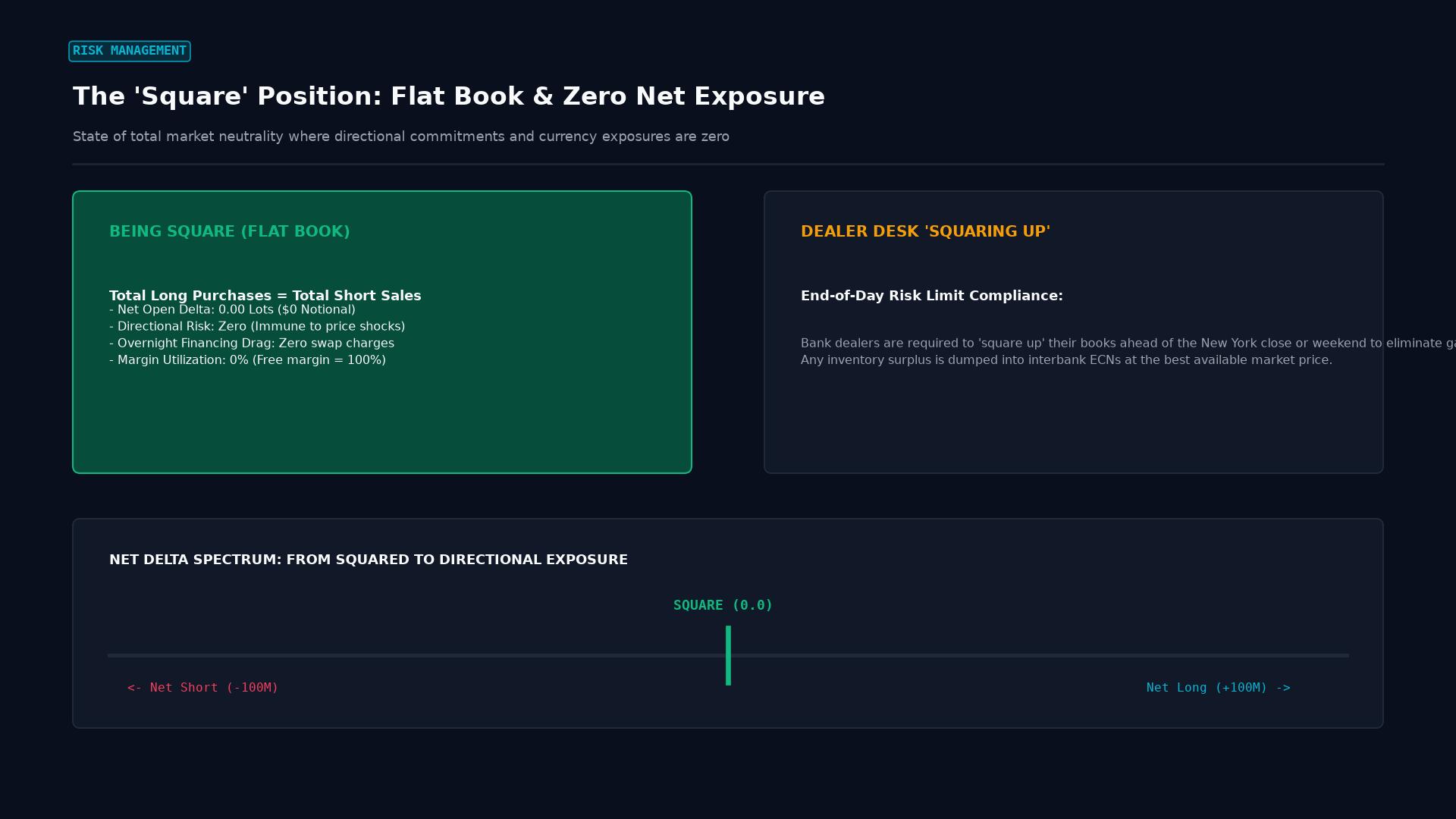 Figure: Total market neutrality: net zero open position delta eliminating directional risk, margin obligations, and overnight financing charges.
Why Financial Desks Systematically “Square Up”
Maintaining a square position is a fundamental risk management mandate across institutional finance, governed by four primary drivers:
1. Eliminating Overnight and Weekend Gap Risk
Foreign exchange markets trade 24 hours a day during the business week, but halt from Friday 5:00 PM EST to Sunday 5:00 PM EST. If an unexpected emergency occurs over the weekend (such as a banking crisis, currency devaluation, or geopolitical outbreak), the Sunday open can gap hundreds of pips past stop-loss orders. Institutional prop desks and retail day traders systematically square all positions before Friday’s close to protect capital.
2. De-Risking Ahead of Tier-1 Economic Catalysts
Prior to monumental binary macroeconomic events—such as U.S. Non-Farm Payrolls (NFP), Federal Open Market Committee (FOMC) rate decisions, or national elections—statistical edge evaporates. Institutional risk officers routinely mandate that discretionary traders square their speculative books 15 to 30 minutes prior to the release.
3. Regulatory Capital and VaR Compliance
Under international banking frameworks (such as Basel III), banks must hold expensive regulatory capital reserves against overnight open market risk. By squaring inventory at the close of the trading day, market makers compress their Value-at-Risk (VaR) metrics, lowering their regulatory capital charge.
Square vs. Flat vs. Fully Hedged
| Position State | Net Directional Delta ($\Delta$) | Gross Market Exposure | Margin Consumed | Realized Profit/Loss |
|---|---|---|---|---|
| Square (Flat) | 0.00 | $0.00 (Zero contracts open) | None ($0.00) | Fully realized and finalized |
| Fully Hedged | 0.00 | Elevated (e.g., Long $1M + Short $1M simultaneously) | Often required (depending on broker rules) | Unrealized; subject to dual bid-ask spread and financing drag |
| Directional Open | $> 0$ (Net Long) or $< 0$ (Net Short) | Active capital commitment | Active maintenance margin locked | Mark-to-market floating P&L |
The Mathematics of a Square Book
For an institutional multi-asset or currency dealing desk, being square is represented mathematically as a net delta of zero across all underlying spot and derivative contracts:
$$\text{Net Position Exposure} = \sum_{i=1}^{k} Q_i \cdot D_i = 0$$
Where:
- $Q_i$: Notional quantity of the $i$-th open contract.
- $D_i$: Trade direction ($+1$ for Long, $-1$ for Short).
In an institutional options book, achieving a “square” profile requires neutralizing multiple Greek sensitivities:
- Delta Neutral ($\Delta = 0$): Directional immunity to small underlying price shifts.
- Gamma Neutral ($\Gamma = 0$): Immunity to accelerating directional shifts.
- Vega Neutral ($\mathcal{V} = 0$): Immunity to implied volatility shocks.
Real-World Institutional Case Study: Desks Squaring Up Before the 2015 SNB Shock
On the morning of January 15, 2015, the Swiss National Bank (SNB) delivered the most devastating shock in modern foreign exchange history by suddenly abandoning its 1.2000 floor on EUR/CHF.
       EUR/CHF INSTITUTIONAL RESILIENCE VS. CATASTROPHE

 Desk Type A: Strict Intraday Squaring Discipline
 - Strategy: High-frequency market-making desk that never held overnight positions.
 - 10:29 CET: Desk held minor inventory; systematically squared book into interbank pool.
 - 10:30 CET: SNB announcement hits; EUR/CHF collapses 3,000 pips in seconds.
 - Outcome: Desk was completely SQUARE (Flat). Suffered ZERO losses.

 Desk Type B: Unhedged Carry Desks (Failed to Square)
 - Strategy: Carried massive leveraged long EUR/CHF positions, trusting the SNB floor.
 - 10:30 CET: Bids completely vanished; liquidity providers pulled pricing.
 - Outcome: Desks suffered negative equity in the tens of millions. Major brokerages
   (such as Alpari UK) were forced into immediate insolvency.
The 2015 event demonstrated that being square is not a passive or cowardly posture; it is the ultimate institutional survival shield.
Frequently Asked Questions
Can an options trader be square directionally while still losing money?
Yes. An options trader can achieve a delta-neutral (directionally square) book by balancing calls and puts. However, if the portfolio maintains a negative Theta ($\Theta$) or negative Vega ($\mathcal{V}$) profile, the trader will still lose money as time passes or if implied volatility surges, even though underlying prices remain flat.
Does a retail trader pay fees when squaring their account?
Yes. Squaring an account requires executing offsetting closing orders. The trader incurs the standard bid-ask spread and any applicable half-turn broker commissions to close the positions. Once square, however, the trader ceases paying overnight swap or rollover financing fees.
What is the psychological benefit of going square?
Going square completely removes psychological stress and emotional attachment to market fluctuations. It allows traders to review past trading performance objectively, reset their mental state, and evaluate future opportunities without the cognitive bias of having capital trapped in open trades.
Ready to trade forex?
Open a free demo account with a regulated broker. Practice with virtual funds before risking real money.