Limit Price
A limit price is the maximum price a trader is willing to pay when buying, or the minimum price a trader is willing to accept when selling, establishing an absolute execution boundary on a limit order.
What Is a Limit Price?
In financial trading and electronic foreign exchange markets, a limit price is the specific price threshold designated by an investor when placing a limit order. It acts as an uncompromising contractual boundary for trade execution:
- For a Buy Limit Order, the limit price represents the maximum price the buyer is willing to pay. The order will execute only at the limit price or lower (a more favorable price).
- For a Sell Limit Order, the limit price represents the minimum price the seller is willing to accept. The order will execute only at the limit price or higher (a more favorable price).
Unlike market orders, which prioritize speed and guarantee immediate execution at prevailing market quotes, an order with a limit price prioritizes price certainty over execution certainty. If the market never touches or penetrates the limit price, the order remains resting in the order book unexecuted.
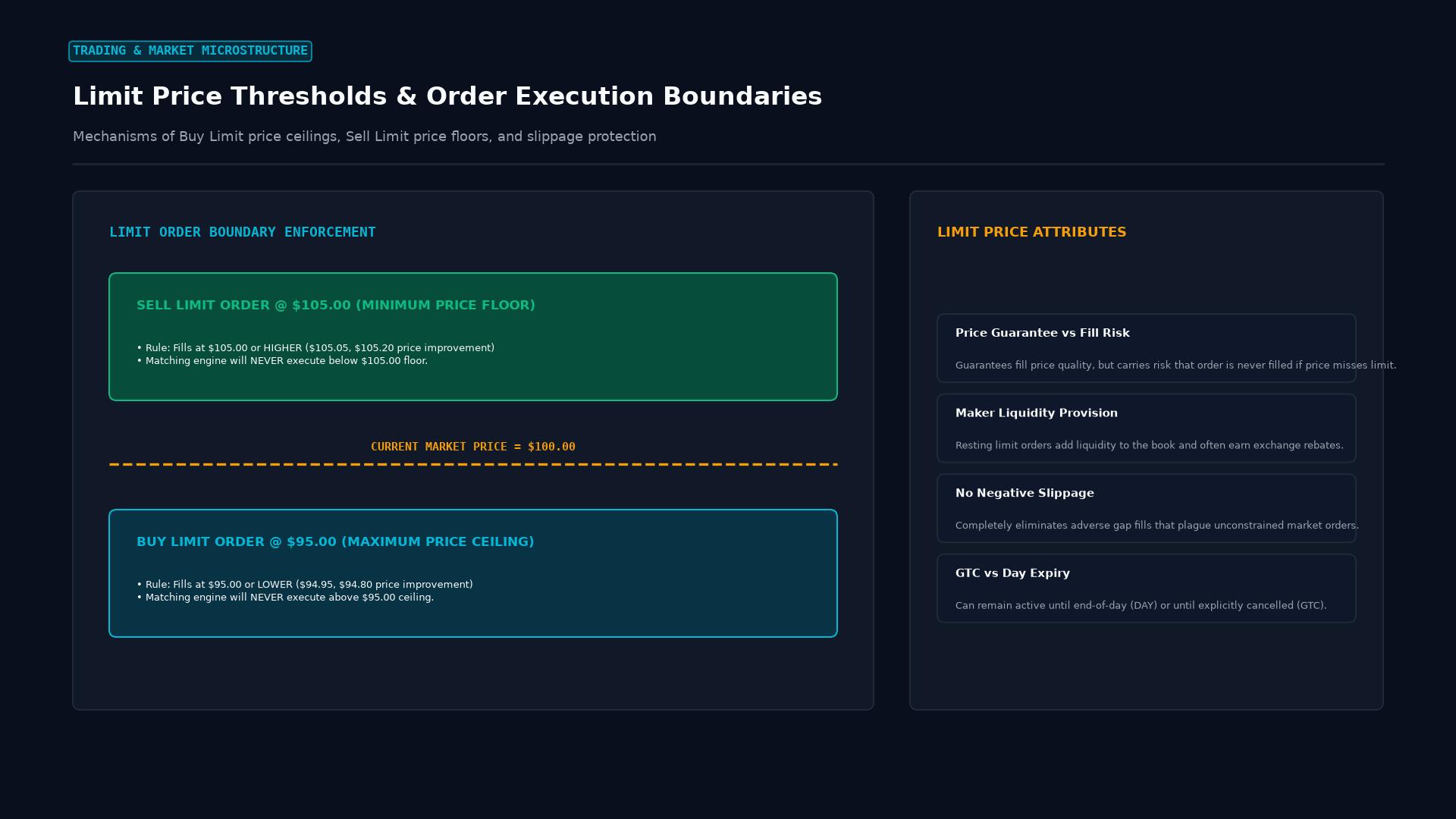 Figure: Order book dynamics of limit orders: buy limit resting below current market and sell limit resting above, guaranteeing execution price ceiling/floor.
Key Takeaways
- Strict Boundary Execution: A limit price guarantees that a trade will never be filled at an adverse price; slippage can only occur in the trader’s favor (positive slippage).
- Execution vs. Price Trade-Off: While a limit price provides total control over entry or exit levels, it introduces execution risk: during rapid market moves, price may turn around a fraction of a pip before hitting the limit price, stranding the trader.
- Liquidity Provision (Maker Status): Resting limit orders provide liquidity to the Central Limit Order Book (CLOB). On institutional ECN platforms, executing via limit orders often qualifies for “maker” fee rebates rather than “taker” commissions.
- Take-Profit Mechanics: In retail forex trading, standard Take-Profit (TP) orders are structurally identical to limit orders governed by a predetermined limit price.
- Queue Priority: On matching exchanges, limit orders are filled based on Price-Time Priority (FIFO): the best limit prices fill first, and orders submitted earlier at the identical price level are filled ahead of newer entries.
Comparative Taxonomy: Limit Price vs. Other Order Mechanics
Understanding how limit prices operate relative to other primary execution types is essential for constructing disciplined trading algorithms and execution strategies.
| Order Type | Limit Price Required? | Execution Certainty | Price Certainty | Slippage Characteristics |
|---|---|---|---|---|
| Market Order | No | Guaranteed | None (Fills at market) | Negative and positive slippage common |
| Limit Order | Yes | Not Guaranteed (Resting) | Guaranteed (Specified or better) | Positive slippage only; zero negative slippage |
| Stop Order | No (Trigger price only) | Guaranteed (Once triggered) | None (Becomes market order) | High negative slippage during volatile breakouts |
| Stop-Limit Order | Yes (Both trigger & limit) | Not Guaranteed | Guaranteed within limit band | Zero fill if market gaps through the limit price |
The Central Limit Order Book (CLOB) Mechanics
In modern electronic communication networks (ECNs) such as Currenex, FastMatch, or CME FX futures, limit prices populate the visual depth of market (Level 2).
Suppose the order book for GBP/USD is currently quoting:
- Best Bid: 1.2650 (Volume: £2,000,000)
- Best Ask: 1.2652 (Volume: £3,000,000)
If a trader submits a Buy Limit Order for £1,000,000 with a Limit Price of 1.2651:
- The limit price sits between the existing bid and ask, creating a new, tighter market inside the spread.
- The order book immediately updates:
- New Best Bid: 1.2651 (Volume: £1,000,000)
- New Best Ask: 1.2652 (Volume: £3,000,000)
- The spread narrows from 2 pips to 1 pip.
- The trader has become a passive liquidity provider. If an incoming seller executes a market order, the trader’s limit order is filled at exactly 1.2651.
Practical Application: Avoiding Spread Gouging During High Volatility
Consider an institutional trader seeking to accumulate 50 standard lots ($5,000,000 notional) of USD/JPY ahead of a Bank of Japan interest rate announcement.
- Market Context: USD/JPY trades around 155.20. As the news release approaches, interbank market makers widen their spreads from 0.3 pips to 4.0 pips (Bid: 155.18 / Ask: 155.22).
- Execution Strategy: If the trader fires a Market Order to buy, they risk paying the full 155.22 ask plus potential negative execution slippage up to 155.30 if institutional bids pull back.
- Limit Price Deployment: The trader places a Buy Limit Order with a Limit Price of 155.19.
- Outcome: A momentary dip in order flow fills the entire 50 lots at 155.19. By enforcing a limit price, the trader saves 3 to 11 pips across $5,000,000 notional—generating direct cost savings of $1,000 to $3,500 compared to an aggressive market fill.
Common Pitfalls and Execution Hazards
- Missed Trend Opportunities: The classic psychological failure occurs when a trader sets a limit price to buy EUR/USD at 1.0800, but the market reverses at 1.0801 and rallies 300 pips. Saving one pip cost the trader the entire multi-hundred-pip macro trend.
- Partial Fills: If you place a limit order for 20 lots at 1.2500, but only 4 lots of matching liquidity exist at that price before the market moves away, your order is partially filled (4 lots open, 16 lots resting), disrupting planned risk-reward ratios.
- Gapping Markets and Stop-Limit Failure: Using a limit price as part of a stop-loss (a Stop-Limit order) is highly dangerous in forex. If high-impact news causes the currency to gap 50 pips through your limit price, the order will never execute, stranding you with an unhedged and rapidly compounding loss.
Frequently Asked Questions (FAQ)
Can a limit order experience slippage?
Under standard market rules, a limit order cannot experience negative slippage (filling worse than your limit price). However, it frequently experiences positive slippage, where your order fills at an even better price than your specified limit due to sudden liquidity arriving at a superior level.
What is the difference between a stop price and a limit price?
A stop price acts as a conditional tripwire: when the market touches it, the order is immediately activated as an aggressive market order to ensure execution. A limit price sets a firm price ceiling or floor: the order will only execute if that exact price or better can be secured.
How long does a limit price remain active?
The lifespan of a limit order depends on its Time-in-Force (TIF) parameter. A Day Order automatically cancels at the end of the trading day; a Good ’Til Canceled (GTC) order remains active until executed or manually removed; and an Immediate-or-Cancel (IOC) order executes whatever volume is available at the limit price immediately and cancels any unfilled residual.
Ready to trade forex?
Open a free demo account with a regulated broker. Practice with virtual funds before risking real money.