Liquid Market
A liquid market is a financial environment characterized by high transaction volumes, deep order books, and diverse market participants, enabling traders to buy or sell substantial volumes rapidly without causing significant price dislocations.
What Is a Liquid Market?
A liquid market is a marketplace where financial instruments—such as foreign exchange pairs, sovereign bonds, or blue-chip equities—can be bought and sold continuously, rapidly, and in massive quantities with negligible bid-ask spreads and minimal price impact. In an intensely liquid market, cash and assets are almost frictionlessly interchangeable: an investor holding an open position can convert it into cash at virtually any microsecond during trading hours at the prevailing market quotation.
The global foreign exchange (Forex) market—recording over $7.5 trillion in daily turnover according to the Bank for International Settlements (BIS)—stands as the most liquid market in human history. Within this ecosystem, major currency pairs like EUR/USD, USD/JPY, and GBP/USD trade with continuous two-way pricing provided by Tier-1 investment banks, sovereign funds, electronic market makers, and institutional prime brokers.
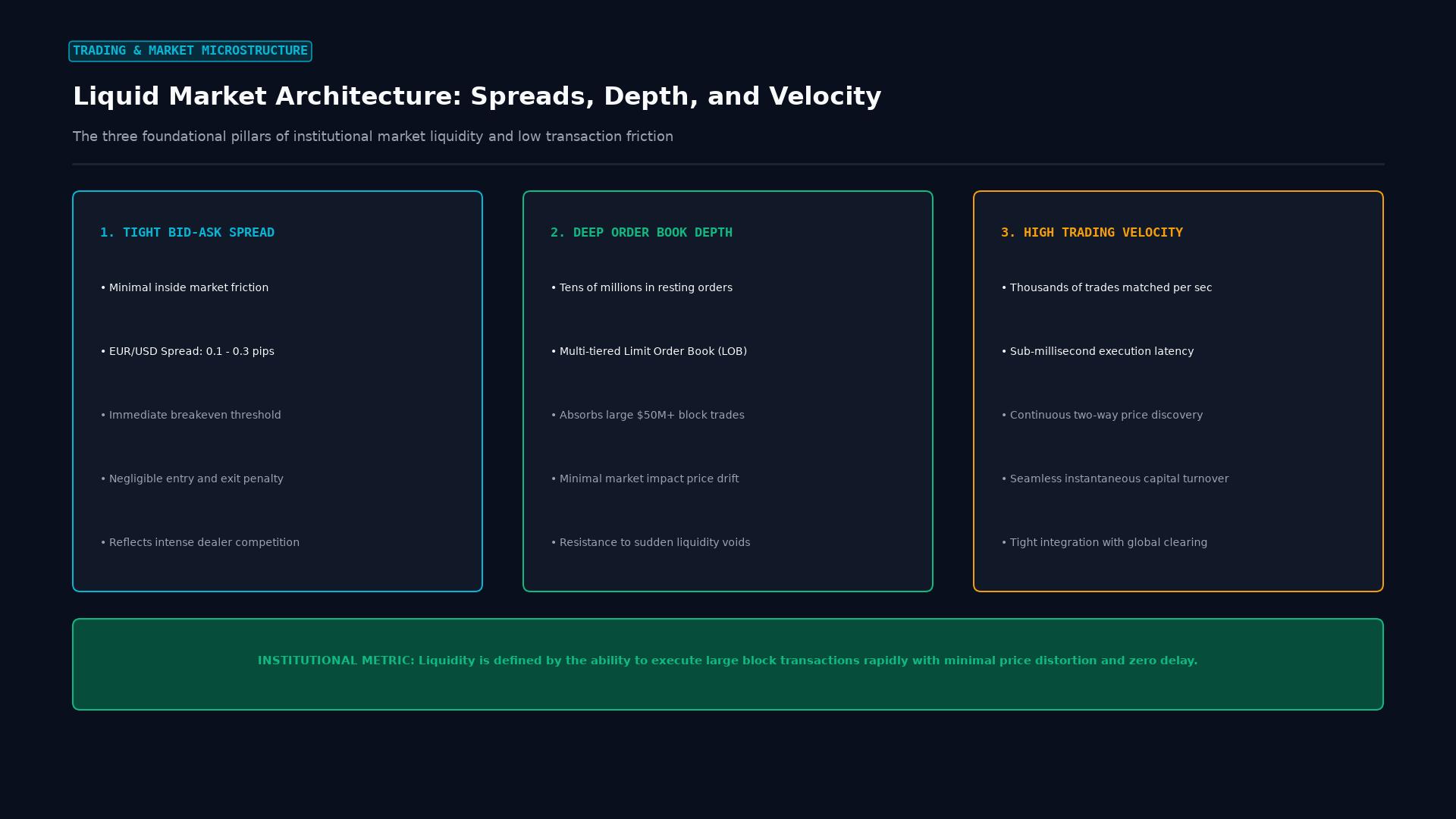 Figure: Microstructure of high-liquidity markets: heavy multi-tier resting volume, sub-pip bid-ask spreads, and zero price impact on block orders.
Key Takeaways
- The Four Dimensions of Liquidity: Economists define market liquidity along four vectors: Tightness (low transaction spreads), Depth (large order volume at and near the bid/ask), Breadth (diversity of independent participants), and Resiliency (the speed at which prices recover from large random orders).
- Narrow Bid-Ask Spreads: In deeply liquid markets, competitive quoting between institutional market makers drives bid-ask spreads down to fractions of a basis point (e.g., 0.1 to 0.5 pips on major currencies).
- Negligible Market Impact: Institutional block orders can be absorbed by the aggregate liquidity pool without causing sudden, artificial price distortions.
- Continuous Price Discovery: Liquid markets reflect news and fundamental macroeconomic data smoothly through continuous price discovery, preventing chaotic price gaps during normal trading hours.
- Vulnerability to “Liquidity Black Holes”: Even the most liquid markets can suffer sudden liquidity evaporation during extreme macro shocks or system outages, leading to flash crashes.
Quantitative Metrics of Market Liquidity
Institutional traders and risk managers employ mathematical metrics to objectively evaluate market liquidity:
1. The Bid-Ask Spread
The most immediate measure of market tightness:
$$\text{Spread Ratio} = \frac{P_{\text{Ask}} - P_{\text{Bid}}}{P_{\text{Mid}}} \times 10,000 ; (\text{expressed in basis points})$$
In liquid majors, this ratio is well below 1.0 bp; in illiquid exotic pairs, it can exceed 25 to 50 bps.
2. Kyle’s Lambda (Price Impact)
Quantifies the market impact per unit of order flow:
$$\Delta P_t = \lambda \cdot Q_t + \epsilon_t$$
Where $Q_t$ is net order volume and $\lambda$ (Kyle’s Lambda) is the price impact coefficient. In an infinitely liquid market, $\lambda \to 0$, meaning buying or selling has no discernible effect on clearing prices.
3. Amihud Illiquidity Ratio
Measures the absolute price change per dollar of daily trading volume:
$$\text{Amihud Ratio} = \frac{1}{D} \sum_{t=1}^{D} \frac{|R_t|}{\text{Volume}_t}$$
A higher value indicates severe illiquidity, where even small dollar flows cause substantial percentage price swings ($R_t$).
Comparative Taxonomy: Liquid vs. Illiquid Trading Venues
| Market Characteristic | Liquid Market (EUR/USD, US 10Y, S&P 500) | Illiquid Market (Exotic FX, Micro-Caps) |
|---|---|---|
| Daily Turnover | Tens to hundreds of billions of dollars | Under a few million dollars |
| Bid-Ask Spread | Razor-thin (0.1 – 0.5 pips / cents) | Wide (20 – 100+ pips / wide spreads) |
| Order Book Depth | Millions of dollars resting at each tick | Shallow; gaps between price levels |
| Execution Speed | Sub-millisecond automated matching | Requotes, delayed fills, partial fills |
| Slippage Severity | Negligible under standard conditions | Substantial slippage on standard lot sizes |
| Market Manipulation | Virtually impossible for single entities | Vulnerable to cornering, pump-and-dump |
Practical Application: Institutional Block Execution
Consider an asset management firm needing to deploy $50,000,000 USD into European sovereign bonds, requiring an initial foreign exchange conversion from USD into EUR.
-
Execution in a Liquid Market (EUR/USD):
- The trader routes the order via an algorithmic smart order router (SOR) into deep interbank venues (EBS, Currenex, 360T).
- Because the EUR/USD order book has tens of millions in resting limit orders within 0.2 pips of the mid-market price, the entire $50M notional is filled across 2.5 seconds.
- The total price impact is less than 0.3 pips, incurring minimal transaction drag of roughly $1,500.
-
Execution in an Illiquid Market (USD/TRY):
- If the same manager attempts to purchase 50 million dollars equivalent in Turkish Lira, the shallow order book cannot absorb the flow.
- Market makers pull their bids back; the order sweeps multiple price levels, moving the exchange rate by 150 pips against the firm.
- Slippage and wide spreads extract tens of thousands of dollars in friction costs.
Liquidity Traps and Systemic Risks
- Flash Crashes and Fragility: High-frequency algorithmic market makers provide massive passive liquidity under calm market conditions, but withdraw their quotes simultaneously when algorithmic volatility filters trip, transforming a liquid market into an illiquid vacuum in milliseconds.
- Time-Zone Liquidity Voids: The spot FX market experiences cyclical liquidity lulls every trading day—most notably between 5:00 PM and 6:00 PM New York time, when U.S. desks close and before Asian liquidity centers (Tokyo, Singapore, Hong Kong) open in volume. Spreads widen substantially during this “witching hour.”
Frequently Asked Questions (FAQ)
Which currency pair has the most liquid market in the world?
EUR/USD (Euro / U.S. Dollar) is the most liquid financial instrument on earth. According to the Bank for International Settlements (BIS), it accounts for nearly a quarter of all global daily foreign exchange turnover, maintaining continuous sub-pip spreads 24 hours a day, five days a week.
Can a liquid market become illiquid?
Yes. During extreme geopolitical crises, natural disasters, or unexpected central bank interest rate announcements, market makers face immense uncertainty and widen their quotes or withdraw limit orders entirely, causing liquidity to evaporate in a phenomenon known as a “liquidity freeze.”
Why do retail forex brokers advertise “zero spreads” in liquid markets?
Retail ECN/STP brokers can offer zero or raw spreads (such as 0.0 or 0.1 pips on EUR/USD) because they aggregate prices from Tier-1 interbank liquidity providers in a deeply liquid market. Instead of profiting from an inflated spread markup, these brokers charge a transparent, fixed commission per lot traded.
Ready to trade forex?
Open a free demo account with a regulated broker. Practice with virtual funds before risking real money.