Lookback Option
A lookback option is an exotic, path-dependent derivative contract that grants the holder the right to determine the exercise price or payout based on the absolute optimal (maximum or minimum) underlying price reached during the entire lifespan of the option.
What Is a Lookback Option?
A lookback option is a sophisticated, path-dependent exotic financial derivative that completely eliminates the investor’s risk of poor market timing. In a standard European vanilla option, the payoff depends exclusively on the spot exchange rate at the exact moment of expiration ($S_T$). If the market stages a massive rally mid-tenor but crashes immediately before expiry, a vanilla call option expires worthless.
In contrast, a lookback option allows the contract holder to retrospectively review or “look back” across the entire lifecycle of the option ($0 \le t \le T$) and select the most favorable price achieved by the underlying asset. By granting the buyer the theoretical ability to “buy at the lowest low” or “sell at the highest high,” lookback options provide the ultimate directional insurance policy, albeit at the highest premium cost among standard exotic options.
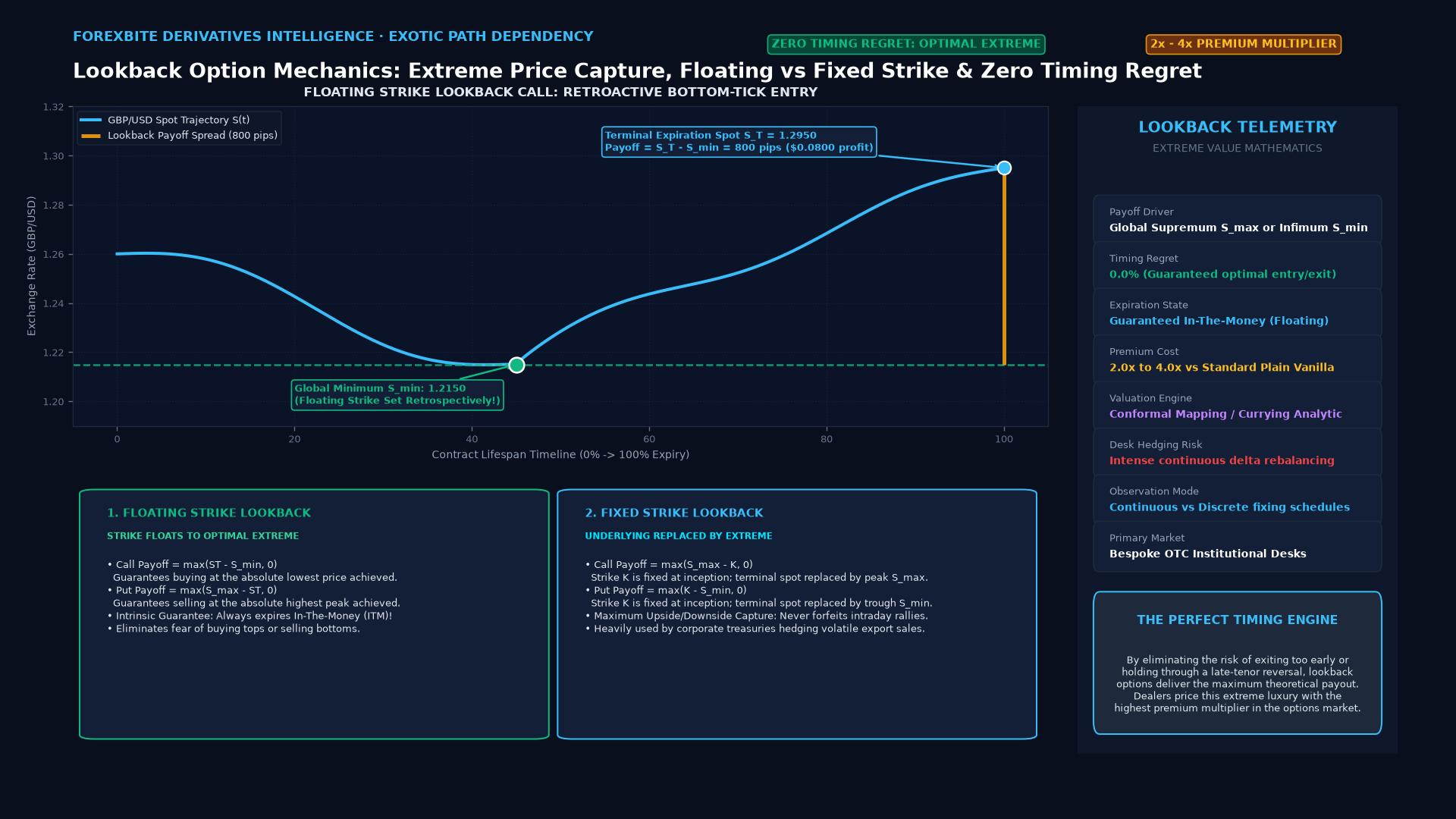 Figure: Floating strike lookback call option trajectory showing retroactive bottom-tick entry at global minimum S_min and terminal payoff capture.
Key Takeaways
- Path-Dependent Payoff: Payout is determined by the extreme price point—the absolute mathematical supremum ($S_{\text{max}}$) or infimum ($S_{\text{min}}$)—reached by the underlying asset over the option’s term.
- Two Core Architectures: Traded primarily as either Floating Strike lookbacks (strike is set to the extreme price) or Fixed Strike lookbacks (underlying terminal price is replaced by the extreme price).
- Zero Timing Regret: The option holder never suffers from exiting too early or holding through a late-stage market collapse; they are guaranteed the most favorable price point.
- Substantial Premium Cost: Because lookback options guarantee maximum payout capture, option writers demand extraordinarily high upfront premiums, often 2x to 4x the price of comparable vanilla options.
- Interbank OTC Execution: Lookback options are almost exclusively traded over-the-counter (OTC) between multinational corporate treasuries, sovereign wealth funds, and Tier-1 investment bank derivatives desks.
Mathematical Payoff Framework: Floating vs. Fixed Strike
Lookback options are categorized into two primary structural variants:
1. Floating Strike Lookback Options
In a floating strike contract, the strike price is variable and determined at maturity based on the extreme price achieved:
- Floating Strike Call: Allows the buyer to retroactively buy at the absolute lowest price: $$\text{Payoff}{\text{Float Call}} = S_T - S{\text{min}}$$
- Floating Strike Put: Allows the buyer to retroactively sell at the absolute highest price: $$\text{Payoff}{\text{Float Put}} = S{\text{max}} - S_T$$
2. Fixed Strike Lookback Options
In a fixed strike contract, the strike price $K$ is agreed at inception, and the payoff uses the extreme price as the settlement reference:
- Fixed Strike Call: $$\text{Payoff}{\text{Fixed Call}} = \max\left( S{\text{max}} - K, ; 0 \right)$$
- Fixed Strike Put: $$\text{Payoff}{\text{Fixed Put}} = \max\left( K - S{\text{min}}, ; 0 \right)$$
Comparative Taxonomy: Exotic Path-Dependent Options
| Option Contract | Path Dependency | Key Settlement Determinant | Timing Protection | Relative Premium Cost |
|---|---|---|---|---|
| Lookback Option | High | Absolute extreme price ($S_{\text{max}}$ or $S_{\text{min}}$) | Complete (Guarantees best price) | Very High (Most expensive) |
| Ladder Option | Moderate | Discrete predetermined threshold “rungs” | Partial (Locks gains at rungs) | High |
| Asian Option | High | Arithmetic average price over the term | Weak (Smooths volatility) | Low (Cheaper than vanilla) |
| Barrier Option | High | Breach of a single knock-in/knock-out level | Conditional (Binary active/inactive) | Low to Moderate |
| Vanilla Option | Zero | Spot price at final expiration cut ($S_T$) only | None (Vulnerable to late drops) | Baseline |
Practical Application: Sovereign Wealth Fund Currency Hedging
Consider a sovereign wealth fund managing a $500,000,000 USD allocation that must be converted into Japanese Yen (JPY) over a 6-month period to fund infrastructure investments in Tokyo.
- Market Uncertainty: USD/JPY trades at 155.00. The fund expects the Yen to experience extreme volatility driven by uncertain Bank of Japan policy shifts, potentially swinging between 140.00 and 165.00.
- Strategy Selection: To ensure the absolute best conversion rate without guessing the top of the USD/JPY rally, the fund purchases an OTC USD/JPY Fixed Strike Lookback Call with a strike of $K = 155.00$ expiring in 6 months.
- Price Evolution:
- At Month 3, hot U.S. inflation data pushes USD/JPY to an intra-tenor peak of $S_{\text{max}} = 161.80$.
- Over Months 4 through 6, aggressive BOJ currency interventions and rate hikes crash USD/JPY down to 142.00 at expiration.
- Settlement:
- A vanilla call at 155.00 would have expired worthless ($142.00 < 155.00$).
- The Fixed Strike Lookback Call settles against the historical maximum: $$\text{Payoff} = S_{\text{max}} - K = 161.80 - 155.00 = 6.80 \text{ JPY per USD}$$
- The fund receives a cash settlement of 3.4 billion Yen, completely insulating the sovereign portfolio from the post-intervention currency collapse.
Hedging Difficulties for Option Sellers
For the investment bank writing a lookback option, dynamic risk management is notoriously perilous:
- Discontinuous Greeks: Whenever the underlying spot price reaches a new all-time high or low, the option’s delta jumps abruptly, forcing the dealer to dynamically buy or sell large blocks of spot currency to maintain delta-neutrality.
- High Vega Exposure: Lookbacks have massive exposure to implied volatility (Vega). A sudden expansion in market volatility exponentially increases the mathematical expectation of the underlying asset establishing more extreme highs and lows, causing the value of the option to surge.
Frequently Asked Questions (FAQ)
Can retail traders trade lookback options on MetaTrader?
No. Lookback options are complex over-the-counter (OTC) derivatives requiring sophisticated analytical pricing models (such as Goldman-Sosin-Gatto closed-form solutions or Monte Carlo simulations). They are traded exclusively between institutional market participants, banks, and hedge funds.
What is continuous vs. discrete sampling in lookback options?
In continuous sampling, the extreme price is monitored every microsecond of the trading day. In discrete sampling, the extreme price is recorded only at specific times (e.g., official daily 5:00 PM EST closes). Discrete lookbacks are slightly cheaper because momentary intraday spikes that retrace before the daily close are not counted.
Why would anyone buy a lookback option if the premium is so high?
Corporate treasuries and institutional funds purchase lookbacks when hedging multi-billion-dollar transactions where the cost of missing the top or bottom of a volatile market is significantly higher than the premium paid. It functions as absolute insurance against market regret.
Ready to trade forex?
Open a free demo account with a regulated broker. Practice with virtual funds before risking real money.