Macro-hedge
A macro hedge is a risk-mitigation strategy executed at the aggregate portfolio or enterprise balance-sheet level to insulate capital against broad macroeconomic risks such as interest rate shifts, currency fluctuations, inflation surges, and systemic market downturns.
A macro hedge is an investment or treasury risk-mitigation technique implemented to protect an entire portfolio, balance sheet, or corporate capital structure from aggregate macroeconomic disturbances. Unlike a micro hedge, which targets the idiosyncratic risk of a single security (such as purchasing a put option on a specific corporate equity or entering into a commodity contract for a specific physical delivery), a macro hedge addresses systemic factors that influence broader asset classes simultaneously.
Institutional asset managers, sovereign wealth funds, multinational corporations, and global macro hedge funds deploy macro hedges against systematic variables: monetary policy tightening cycles, currency devaluations, sovereign debt spreads, stagflation, and broad equity market crashes. By using aggregate derivatives such as index futures, interest rate swaps, credit default swap indices, and currency forward overlays, a macro hedge isolates structural returns while immunizing the institution against broad economic shocks.
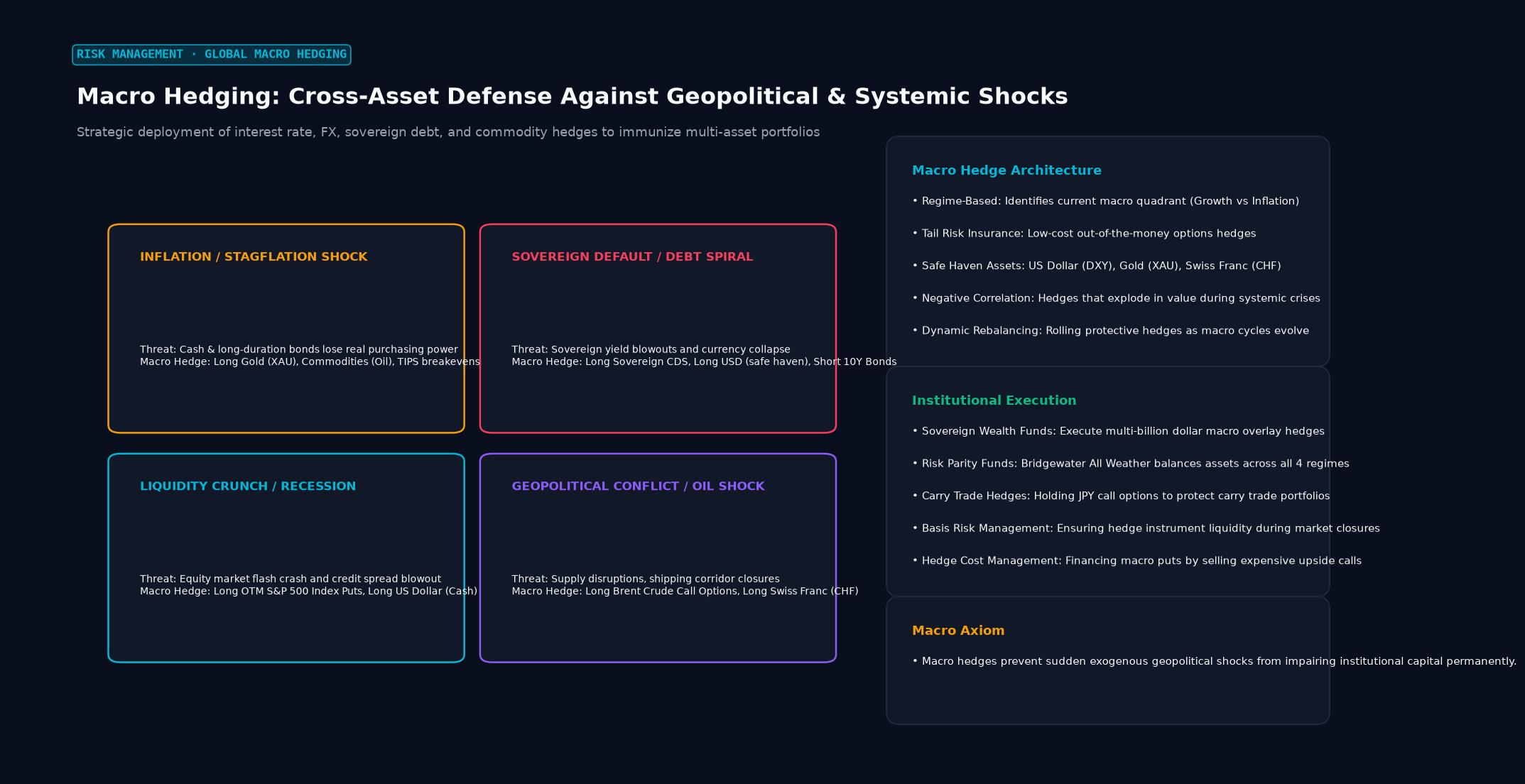 Figure: Strategic deployment of interest rate, FX, sovereign debt, and commodity hedges to immunize multi-asset portfolios
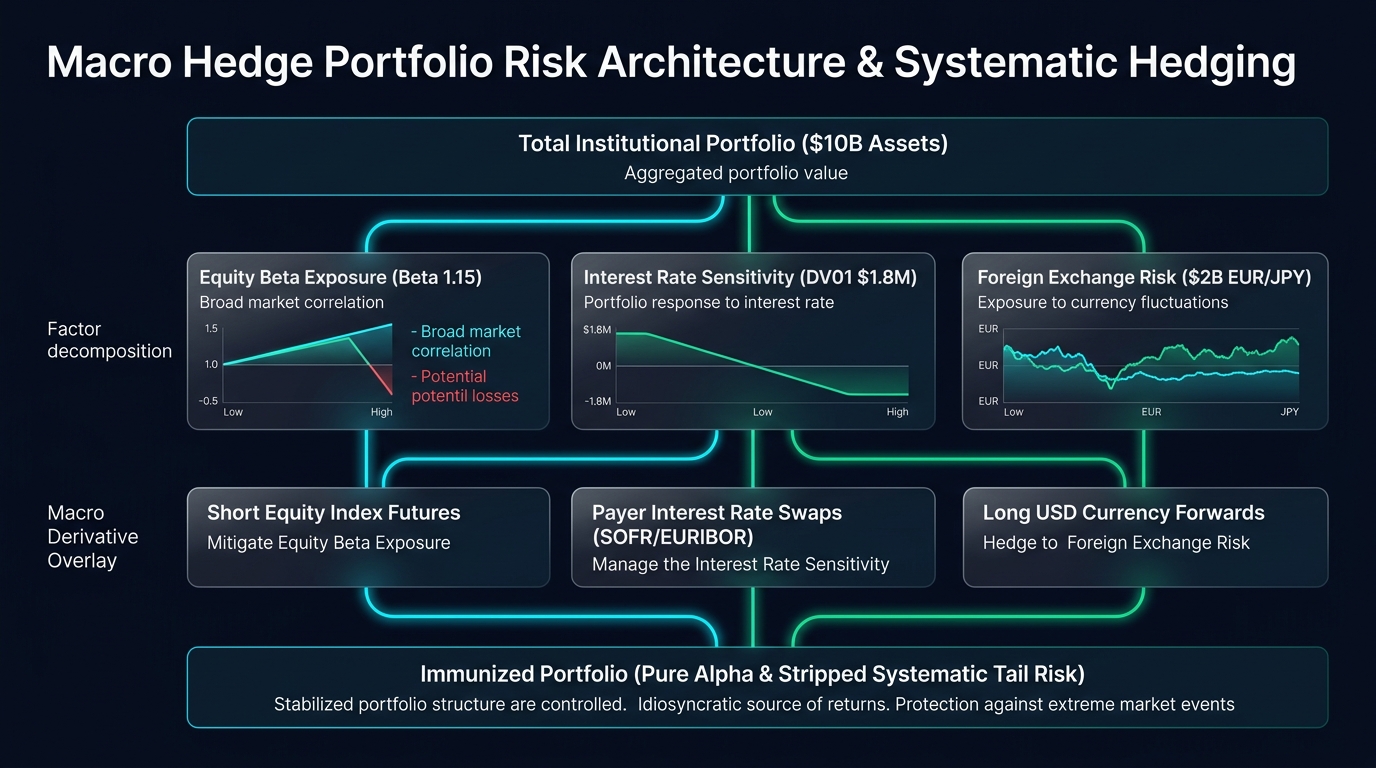
Historical and Theoretical Background
The analytical foundation of macro hedging originates in Modern Portfolio Theory (MPT) established by Harry Markowitz in 1952 and the Capital Asset Pricing Model (CAPM) formulated by William Sharpe, John Lintner, and Jan Mossin in the mid-1960s. These models divided investment variance into two distinct dimensions:
- Unsystematic (Idiosyncratic) Risk: Company-specific operational, legal, and financial hazards that can be diversified away by holding a broad basket of assets.
- Systematic (Market) Risk: Undiversifiable volatility driven by aggregate economic events (macroeconomic shocks) affecting all market participants.
Historically, institutional investors accepted systematic risk as the non-negotiable cost of capturing the market equity risk premium ($ERP$). However, the financial crises of the late 20th and early 21st centuries revealed that diversification alone collapses during liquidity panics. During the 1987 Black Monday crash, the 1998 collapse of Long-Term Capital Management (LTCM), the 2008 Global Financial Crisis, and the 2020 pandemic crash, cross-asset correlations converged toward 1.0.
Assets previously perceived as uncorrelated fell together as institutional market participants liquidated liquid holdings to meet cash variation margins. This structural reality prompted the institutionalization of macro hedging: rather than relying on passive diversification across asset classes, risk officers construct active derivative overlays to neutralize systematic factor sensitivities.
Core Mechanics and Mathematical Formulation
Executing an effective macro hedge requires quantifying aggregate factor exposures and determining the optimal hedge ratio across selected derivative instruments.
1. Portfolio Beta Hedging via Index Futures
To neutralize aggregate equity market risk without liquidating underlying stock positions, an asset manager shorts stock index futures. The optimal number of futures contracts ($N^*$) is calculated using the portfolio beta relative to the futures contract:
$$N^* = \beta_P \left( \frac{V_P}{V_F} \right) = \beta_P \left( \frac{V_P}{F \times M} \right)$$
Where:
- $\beta_P$ is the weighted beta of the cash equity portfolio relative to the reference index.
- $V_P$ is the total cash value of the equity portfolio.
- $V_F$ is the nominal value of a single futures contract.
- $F$ is the current quoted price of the index futures contract.
- $M$ is the contract multiplier (e.g., $50 for CME E-mini S&P 500 futures).
If an institutional fund holds a $500,000,000 equity portfolio with a beta of 1.20 relative to the S&P 500, and the E-mini futures trade at 5,000 with a $50 multiplier ($V_F = $250,000$), the required number of short contracts is:
$$N^* = 1.20 \times \left( \frac{500,000,000}{250,000} \right) = 1.20 \times 2,000 = 2,400 \text{ contracts}$$
2. Duration and Interest Rate Risk Immunization
For fixed-income portfolios exposed to central bank rate hike cycles, managers evaluate the dollar value of a basis point ($DV01$ or $PV01$). The hedge ratio to immunize bond portfolio value using interest rate futures or swaps is expressed as:
$$\text{Hedge Ratio (HR)} = \frac{DV01_{\text{Portfolio}}}{DV01_{\text{Hedge Instrument}}}$$
If a $1 billion sovereign bond portfolio loses $800,000 for every basis point increase in benchmark yields ($DV01 = $800,000$), and a 10-Year Treasury Note futures contract has a $DV01$ of $72 per contract, the required short futures position is:
$$N^*_{\text{bonds}} = \frac{800,000}{72} \approx 11,111 \text{ contracts}$$
Alternatively, the treasury desk can execute an interest rate swap (IRS) paying a fixed rate and receiving a floating rate (SOFR), converting fixed-rate asset exposure into floating cash flows.
                    HEDGING INSTRUMENT SPECTRUM

Macro Risk Factor       Direct Cash Asset           Overlay Derivative Vehicle
----------------------------------------------------------------------------------
Equity Market Crash     Equities / PE Funds         Short S&P 500 / STOXX Futures
Interest Rate Spike     Corporate Bonds, Mortgages  Payer Swaps, Short T-Bond Futures
Currency Devaluation    Foreign Subsidiaries / Debt FX Forward Contracts, Cross Swaps
Credit Spread Blowout   High-Yield Debt, Loans      CDX / iTraxx Credit Default Swaps
Commodity Price Surge   Airlines, Manufacturers     Long Oil / Gas Commodity Swaps
Tail Risk Volatility    Multi-Asset Endowment       Long VIX Call Options / Out-of-Money Puts
3. The Minimum-Variance Hedge Ratio and Basis Risk
When the underlying asset portfolio does not perfectly match the derivative contract, the manager encounters basis risk. The minimum-variance hedge ratio ($h^*$) accounts for the correlation ($\rho$) and standard deviations ($\sigma$) between spot portfolio returns ($\Delta S$) and futures contract returns ($\Delta F$):
$$h^* = \rho_{S,F} \frac{\sigma_S}{\sigma_F} = \frac{\text{Cov}(\Delta S, \Delta F)}{\text{Var}(\Delta F)}$$
Basis risk ($B_t$) at any point in time represents the difference between the spot price of the portfolio assets and the derivative futures price:
$$B_t = S_t - F_t$$
If correlation declines during market turbulence, the macro hedge experiences slippage: the gain on the derivative overlay fails to fully offset the losses on the physical portfolio, or overcompensates, generating unintended directional exposure.
Cost of Carry and Negative Roll Yield
Macro hedges are not free insurance policies. Maintaining an evergreen macro hedge imposes structural costs that drag on long-term performance:
- Option Premium Decay (Theta): Purchasing out-of-the-money put options on equity indices guarantees known maximum losses, but continuous theta decay erodes fund principal during sideways or bull markets.
- Volatility Contango and Negative Roll Yield: Hedging systemic market crashes using volatility derivatives (such as VIX futures or exchange-traded volatility notes) suffers from the steep contango characteristic of normal volatility term structures. When front-month VIX contracts trade lower than subsequent months, rolling contracts forward each month locks in compounding losses.
- Cash Collateral Drag: Holding sufficient cash or short-term Treasury bills to meet potential variation margin calls on short futures or interest rate swaps reduces the capital available for high-yielding productive investments.
            CARRY DRAG COMPARISON: HEDGING VEHICLES

+--------------------+-----------------------+-------------------------+
| Hedging Instrument | Direct Upfront Cost   | Ongoing Carry Drag      |
+--------------------+-----------------------+-------------------------+
| Short Index Futures| Zero (Initial Margin) | Dividend Yield vs Repo  |
| Index Put Options  | High (Option Premium) | Time Decay (Theta Drag) |
| Payer Rate Swaps   | Zero                  | Floating-Fixed Spread   |
| VIX Futures Long   | Zero                  | Steep Contango Drag     |
| FX Forward Overlay | Zero                  | Interest Rate Parity CIP|
+--------------------+-----------------------+-------------------------+
Real-World Case Study: Institutional Portfolio Overlay During the 2022 Rate Shock
In late 2021, a $3 billion multi-asset university endowment faced rising inflation figures, an imminent Federal Reserve quantitative tightening cycle, and historically elevated valuations across both public equities and long-duration government bonds.
Portfolio Vulnerability Audit
- Equity Holdings: $1.8 billion across global tech and private equity (Portfolio Beta = 1.25 relative to MSCI World).
- Fixed-Income Holdings: $900 million in investment-grade corporate bonds and 20-year sovereign debt (Aggregate Duration = 8.5 years; $DV01 = $765,000$).
- Real Estate & Alternatives: $300 million.
A traditional 60/40 balanced asset allocation assumed bonds would hedge equity downturns. However, inflation shocks destroy the negative correlation between stocks and bonds, driving simultaneous sell-offs across both sleeves.
Strategic Macro Hedge Implementation
The investment committee executed a three-pronged synthetic macro overlay in January 2022:
- Equity Downside Protection: Rather than liquidating long-term equity holdings and triggering taxable capital gains, the endowment sold short 1,800 E-mini S&P 500 futures contracts, reducing net equity beta from 1.25 to 0.40.
- Interest Rate Risk Neutralization: The fixed-income desk executed a 10-year Payer Interest Rate Swap on $600 million notional, paying a fixed rate of 1.75% and receiving floating SOFR. This trade slashed portfolio duration from 8.5 years down to 2.1 years.
- Commodity Inflation Overlay: The fund entered long positions in CME WTI crude oil and agricultural swap contracts to capture positive commodity roll yield.
+--------------------------------------------------------------------+
|               2022 ENDOWMENT MACRO HEDGE PERFORMANCE               |
+--------------------------------------------------------------------+
| Cash Asset Unhedged Losses:                                       |
| - Public Equities Drawdown (-19.5%):              -$351,000,000    |
| - Fixed-Income Duration Drawdown (-16.0%):         -$144,000,000    |
| Total Gross Asset Loss:                            -$495,000,000    |
+--------------------------------------------------------------------+
| Derivative Macro Overlay Gains:                                    |
| + Short Equity Futures Gains:                     +$245,000,000    |
| + Payer Swap Mark-to-Market Valuation Gain:        +$118,000,000    |
| + Commodity Overlay Realized Returns:              +$62,000,000     |
| Total Macro Overlay Offset:                        +$425,000,000    |
+--------------------------------------------------------------------+
| Net Institutional Portfolio Loss:                   -$70,000,000    |
| Unhedged Portfolio Loss:                           -16.5%           |
| Net Hedged Portfolio Loss:                          -2.3%           |
+--------------------------------------------------------------------+
The macro hedge preserved $425 million of institutional capital, insulating the endowment from one of the most severe simultaneous stock-bond bear markets in modern financial history.
Regulatory and Accounting Frameworks
Deploying macro hedges across institutional balance sheets involves complex regulatory and financial reporting requirements:
IFRS 9 and ASC 815 Hedge Accounting
Under International Financial Reporting Standards (IFRS 9) and US GAAP (ASC 815), derivatives are marked to market through profit and loss (FVTPL) by default. If a company hedges an aggregate balance-sheet risk (macro hedge) rather than an identifiable, designated contractual exposure (micro hedge), qualifying for hedge accounting is rigorous. Without designated hedge accounting, mark-to-market fluctuations on the derivative overlay generate sharp quarterly earnings volatility, even though the hedge economically protects the firm.
To qualify for macro hedge accounting (such as macro cash flow hedging or fair value portfolio hedging of interest rate risk), treasury teams must:
- Formally document the risk management objective and strategy at inception.
- Demonstrate that the hedging relationship satisfies the economic relationship test (the derivative and hedged item move in opposite directions in response to the common macro factor).
- Continuously verify that credit risk does not dominate the fair value movements.
Dodd-Frank and EMIR Clearing Requirements
Title VII of the Dodd-Frank Act in the United States and the European Market Infrastructure Regulation (EMIR) mandate central clearing for standardized over-the-counter (OTC) derivatives, including interest rate swaps and index credit default swaps. Entities implementing macro hedges must post initial margin (IM) through authorized clearing brokers and exchange daily cash variation margin (VM). Risk officers must preserve substantial liquidity reserves to ensure macro overlay positions are not liquidated during temporary basis disconnections.
Frequently Asked Questions
What is the primary difference between a micro hedge and a macro hedge?
A micro hedge targets the specific risk of an individual transaction, contractual asset, or company. Examples include buying put options on Apple stock or entering a forward contract to sell British pounds received from a specific invoice. A macro hedge addresses broad, systemic risk factors affecting an entire multi-asset portfolio or commercial balance sheet simultaneously, using aggregate instruments such as index futures, interest rate swaps, or credit indices.
Why do some portfolio managers avoid permanent macro hedges?
Permanent macro hedging carries significant ongoing costs, known as negative carry or drag. Purchasing put options continuously causes losses through time decay (theta). Maintaining short index futures forfeits equity dividend yields and creates financing costs. Volatility-based hedges suffer from steep futures contango. Over extended bull markets, these cumulative costs substantially suppress the net compound return of the portfolio.
How does basis risk impact the performance of a macro hedge?
Basis risk occurs when the price movements of the hedging derivative do not align with the price movements of the portfolio being protected. For instance, if an investor hedges a portfolio of mid-cap technology equities using S&P 500 mega-cap index futures, the portfolio could suffer idiosyncratic losses while the large-cap index rises, causing the investor to lose capital on both the underlying cash assets and the short futures overlay.
Ready to trade forex?
Open a free demo account with a regulated broker. Practice with virtual funds before risking real money.