Macro risk
Macro risk refers to the financial vulnerability of asset prices, corporate cash flows, and institutional portfolios to aggregate macroeconomic, geopolitical, and systemic economic factors that cannot be eliminated through simple diversification.
Macro risk represents the exposure of an investment portfolio, corporate enterprise, or national banking system to aggregate economic, political, monetary, and demographic shifts. Unlike micro risk, which stems from factors specific to an individual company or asset (such as operational failures, product recalls, or executive turnover), macro risk originates at the systemic level. It affects entire markets, asset classes, and economic sectors simultaneously.
Investors, multinational corporations, and sovereign treasuries encounter macro risk in various forms: central bank interest rate decisions, inflation shocks, currency devaluations, fiscal deficit crises, trade wars, commodity price spikes, and geopolitical conflicts. Because macro risk is systematic, it cannot be eliminated through conventional cross-asset diversification alone. It requires targeted hedging, dynamic asset allocation, and scenario-based stress testing.
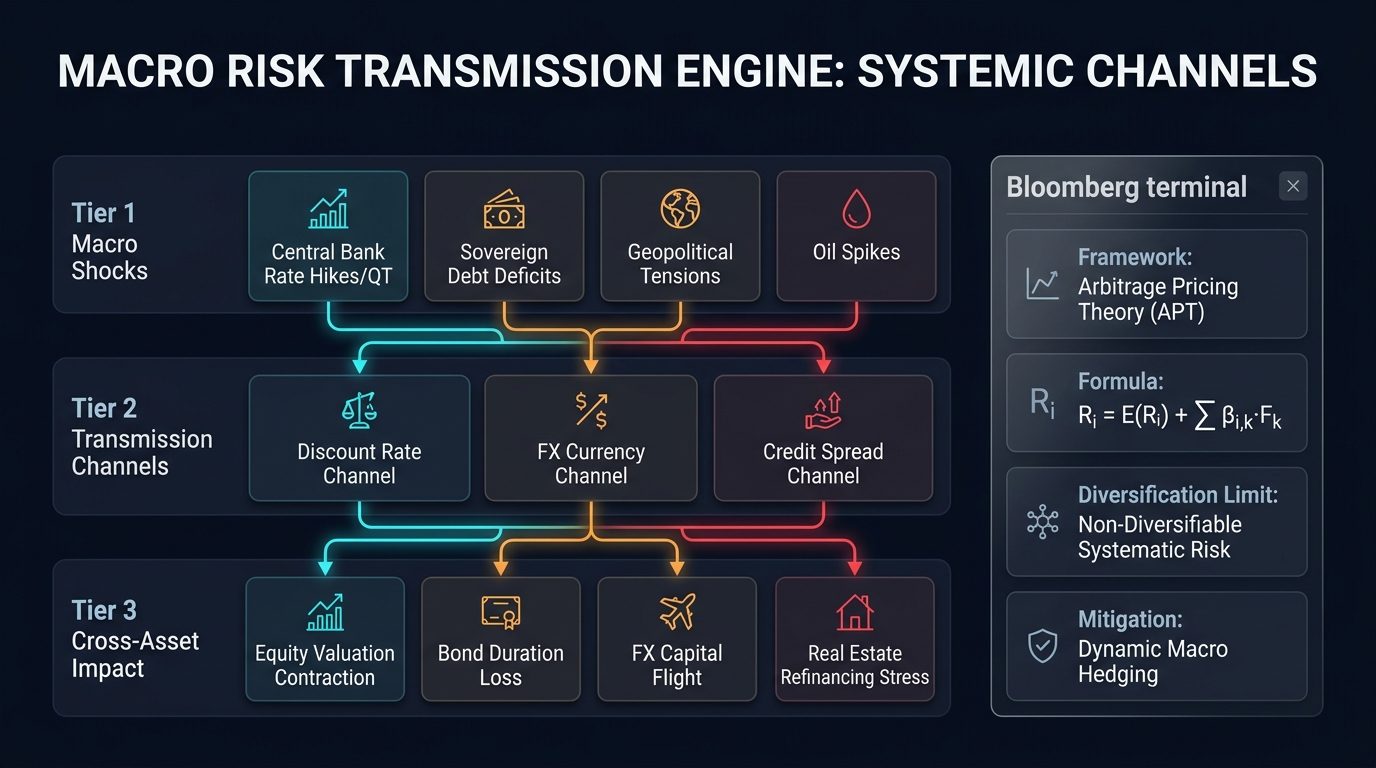
                   MACRO RISK TRANSMISSION ENGINE

+----------------------------------------------------------------+
| Primary Macro Drivers:                                         |
| - Central Bank Monetary Policy (Interest Rates, QT/QE)         |
| - Fiscal Policy (Sovereign Deficits, Taxation, Debt Caps)      |
| - Geopolitical Shocks (Wars, Trade Embargoes, Sanctions)       |
| - Global Supply Chain & Commodity Disruptions                  |
+----------------------------------------------------------------+
                               |
                               v
+----------------------------------------------------------------+
| Transmission Channels:                                         |
| 1. Discount Rate Channel: Higher yields compress asset P/E.    |
| 2. FX Channel: Currency depreciation triggers imported infl.   |
| 3. Credit Channel: Widening spreads increase borrowing costs.  |
| 4. Aggregate Demand Channel: Weak consumer demand cuts rev.    |
+----------------------------------------------------------------+
                               |
                               v
+----------------------------------------------------------------+
| Balance Sheet & Asset Impact:                                  |
| - Equities: Multiple contraction & margin compression          |
| - Fixed Income: Duration capital losses & spread widening      |
| - FX / Sovereign Debt: Capital flight & currency peg breaks    |
| - Real Estate: Cap-rate expansion & debt refinancing stress    |
+----------------------------------------------------------------+
Theoretical Framework: Systematic Risk and Factor Models
Financial economists analyze macro risk using multi-factor asset pricing models. While the traditional Capital Asset Pricing Model (CAPM) summarized systematic risk into a single market beta ($\beta_m$), Stephen Ross developed the Arbitrage Pricing Theory (APT) in 1976 to capture multiple macroeconomic risk factors explicitly.
Under APT, the return of any asset $i$ is modeled as a linear combination of sensitivities to macroeconomic factors:
$$R_i = E(R_i) + \beta_{i,1} F_1 + \beta_{i,2} F_2 + \dots + \beta_{i,K} F_K + \epsilon_i$$
Where:
- $E(R_i)$ is the expected return of asset $i$.
- $F_k$ represents the unexpected deviation or shock in macroeconomic factor $k$.
- $\beta_{i,k}$ is the factor loading (sensitivity) of asset $i$ to macro factor $k$.
- $\epsilon_i$ is the idiosyncratic, firm-specific error term with $E(\epsilon_i) = 0$.
Total portfolio variance can be decomposed into systematic macro variance and diversifiable idiosyncratic variance:
$$\sigma^2(R_P) = \sum_{j=1}^K \sum_{k=1}^K \beta_{P,j} \beta_{P,k} \text{Cov}(F_j, F_k) + \sigma^2(\epsilon_P)$$
As the number of assets in a portfolio expands ($N \to \infty$), the idiosyncratic variance term ($\sigma^2(\epsilon_P)$) approaches zero:
$$\lim_{N \to \infty} \sigma^2(\epsilon_P) = 0$$
However, the systematic macro risk term persists:
$$\sigma^2_{\text{systematic}} = \sum_{j=1}^K \sum_{k=1}^K \beta_{P,j} \beta_{P,k} \text{Cov}(F_j, F_k)$$
Investors who build portfolios containing hundreds of securities remain exposed to aggregate factor covariance.
       TOTAL RISK COMPOSITION AS PORTFOLIO DIVERSIFIES

Portfolio
Variance
   ^
   |  * Total Risk
   |   \
   |    \   Unsystematic / Idiosyncratic Risk (Diversifiable)
   |     \
   |      \-------------------------------------------
   |       Systematic / Macro Risk (Undiversifiable)
   |       -------------------------------------------
   +---------------------------------------------------->
   0           10          20          30          50+
                       Number of Securities
Primary Dimensions of Macro Risk
Institutional risk managers categorize macro risk into distinct, interacting categories:
1. Monetary Policy and Interest Rate Risk
Central banks steer economic cycles by altering benchmark policy rates (such as the Federal Funds Rate or ECB Deposit Rate) and expanding or contracting their balance sheets (QE and QT). Changes in interest rates alter the risk-free rate ($R_f$) used in Discounted Cash Flow (DCF) models:
$$P_0 = \sum_{t=1}^{\infty} \frac{\text{CF}_t}{(1 + R_f + ERP)^t}$$
When central banks hike rates to curb inflation, the discount denominator expands, reducing the present value of distant cash flows. High-growth technology stocks, long-duration government bonds, and leveraged real estate assets suffer steep downward revaluations.
2. Inflation and Purchasing Power Risk
Unanticipated inflation erodes the real purchasing power of contractual nominal cash flows. Fixed-income securities with unindexed coupons suffer real capital destruction. Inflation also triggers margin compression for businesses unable to pass rising input costs (energy, raw materials, labor) to consumers.
3. Currency and Balance of Payments Risk
Foreign exchange rate fluctuations alter the competitiveness of exporting firms, the purchasing power of domestic consumers, and the local-currency burden of foreign-denominated debt. When a nation runs persistent current account deficits financed by short-term capital inflows, any sudden shift in foreign investor sentiment can trigger sudden stops, currency depreciation, and capital flight.
4. Sovereign and Political Risk
Sovereign risk encompasses the probability that a government defaults on its external or internal debt obligations, imposes emergency capital controls, expropriates private assets, or changes tax laws. Political risk includes regime changes, civil unrest, regulatory overhauls, and trade embargoes that disrupt commercial activities.
               TAXONOMY OF SYSTEMIC MACRO RISKS

+--------------------+-----------------------+-------------------------+
| Risk Category      | Underlying Catalyst   | Primary Vulnerability   |
+--------------------+-----------------------+-------------------------+
| Monetary / Yield   | Central Bank Hikes    | High-Duration Bonds, PE |
| Inflationary       | Supply Chains, Energy | Fixed Cash Flows, Retail|
| FX / Devaluation   | Current Account Gaps  | Foreign Debt Issuers    |
| Sovereign / Fiscal | Deficit Expansion     | Local Sovereign Paper   |
| Geopolitical       | Conflict, Sanctions   | Global Supply Chains    |
+--------------------+-----------------------+-------------------------+
Measuring and Stress-Testing Macro Risk
Institutional frameworks quantify macro risk using quantitative risk metrics and forward-looking simulation models:
Value at Risk (VaR) and Expected Shortfall (ES)
Value at Risk calculates the maximum expected loss of a portfolio over a specific time horizon ($T$) at a given confidence level ($1 - \alpha$, typically 99%):
$$\text{VaR}_{\alpha}(P) = -\inf { l \in \mathbb{R} : P(L > l) \le 1 - \alpha }$$
Expected Shortfall (Conditional VaR) measures the average loss incurred when the VaR threshold is breached, capturing fat-tail distribution risks common during macroeconomic crises:
$$\text{ES}{\alpha}(P) = E[L \mid L \ge \text{VaR}{\alpha}(P)]$$
Macro Scenario Analysis and Stress Testing
Because standard historical covariance matrices fail during structural regime shifts, bank regulators mandate scenario analysis. Under the US Federal Reserve Comprehensive Capital Analysis and Review (CCAR) and Dodd-Frank Act Stress Testing (DFAST), banks must simulate portfolio resilience against hypothetical macroeconomic scenarios:
- Severely Adverse Scenario: A 4.5% decline in real GDP, unemployment rising to 10%, commercial real estate prices falling 40%, and equity markets plunging 50%.
- Stagflationary Scenario: Headline inflation accelerating above 9%, central bank rates rising by 400 basis points, and corporate earnings falling 25%.
               ENTERPRISE MACRO STRESS-TEST PROCESS

+--------------------------------------------------------------+
| Step 1: Define Macroeconomic Scenario Parameters             |
| (e.g., Oil spikes to $140/bbl, Fed hikes 200 bps, GDP -3.0%) |
+--------------------------------------------------------------+
                               |
                               v
+--------------------------------------------------------------+
| Step 2: Factor Sensitivity Mapping                           |
| Translate macro shocks into asset-level returns via APT beta |
+--------------------------------------------------------------+
                               |
                               v
+--------------------------------------------------------------+
| Step 3: Capital Adequacy & Liquidity Impact Calculation      |
| Compute stressed Common Equity Tier 1 (CET1) & LCR ratios    |
+--------------------------------------------------------------+
                               |
                               v
+--------------------------------------------------------------+
| Step 4: Contingency Action & Capital Conservation Plan       |
| Deploy macro hedges, suspend dividends, or raise liquidity   |
+--------------------------------------------------------------+
Real-World Case Study: The 2022 UK Gilt Crisis
The UK government bond (Gilt) crisis of September and October 2022 offers a vivid demonstration of how fiscal macro risk can trigger a self-reinforcing liquidity cascade across institutional balance sheets.
The Fiscal Macro Shock
On September 23, 2022, the UK government unveiled a mini-budget containing £45 billion of unfunded tax cuts alongside massive energy subsidies, without publishing accompanying fiscal forecasts from the Office for Budget Responsibility (OBR). International investors perceived this fiscal policy as incompatible with the Bank of England’s efforts to control 10% inflation.
The Transmission Mechanism: Liability-Driven Investment (LDI)
UK defined benefit (DB) pension funds manage over £1.5 trillion in assets. To match their long-term pension liabilities to future retirees, these funds deployed Liability-Driven Investment (LDI) strategies. LDIs utilized interest rate swaps and repo contracts to obtain leveraged duration exposure.
+--------------------------------------------------------------------+
|               THE 2022 UK GILT LIQUIDITY SPIRAL                    |
+--------------------------------------------------------------------+
| 1. Unfunded Fiscal Mini-Budget announced.                          |
| 2. Foreign investors sell Gilts: 30-year yield jumps 150 bps in    |
|    three trading sessions (unprecedented volatility).              |
| 3. Leveraged LDI funds face massive variation margin calls from    |
|    clearing houses and counterparty banks.                         |
| 4. Pension funds lack immediate cash; forced to dump physical     |
|    Gilts into an illiquid market to meet margin calls.             |
| 5. Gilt prices collapse further -> higher yields -> more margin   |
|    calls (systemic doom loop).                                     |
| 6. Bank of England intervenes with £65B emergency backstop to      |
|    purchase long-dated Gilts and restore financial stability.      |
+--------------------------------------------------------------------+
The 30-year UK Gilt yield surged from 3.75% to over 5.00% within days. LDI managers were overwhelmed by margin calls totaling tens of billions of pounds. Because pension funds could not liquidate private assets or property overnight, they sold the only liquid asset they held: UK Gilts. This created a classic liquidity fire-sale spiral.
The Bank of England was forced to halt its planned quantitative tightening program on September 28, 2022, announcing temporary purchases of long-dated index-linked and conventional Gilts of up to £65 billion to stabilize the financial system. The crisis demonstrated that even in a sovereign nation issuing debt in its own currency, uncontrolled fiscal macro risk can threaten domestic pension solvency within days.
Managing and Mitigating Macro Risk
Institutional investors and corporate treasuries employ three primary methods to mitigate macro risk:
- Strategic Macro Overlay Hedging: Employing exchange-traded derivatives (index futures, options, interest rate swaps) to dynamically adjust duration, equity beta, and currency exposures without disrupting core underlying holdings.
- True Structural Diversification: Allocating capital across uncorrelated asset classes that exhibit positive real returns in differing economic regimes. For instance, allocating to commodities, infrastructure, and trend-following managed futures (CTAs) that generate positive carry during inflation or market dislocation.
- Liquidity Buffers and Cash Conservation: Maintaining sufficient unencumbered high-quality liquid assets (HQLA) to absorb margin calls and debt rollovers during systemic liquidity contractions.
Frequently Asked Questions
Can macro risk be completely eliminated from an investment portfolio?
Macro risk cannot be completely eliminated while maintaining positive expected investment returns. Achieving a zero-macro-risk position requires converting an entire portfolio into cash or risk-free short-term sovereign Treasury bills held to maturity. However, this strategy exposes the investor to purchasing power risk (inflation). In active investing, macro risk is managed, hedged, or budgeted rather than eradicated.
How does macro risk differ from systematic risk?
The terms are frequently used interchangeably. Systematic risk is the formal financial theory term for undiversifiable market-wide volatility that affects all securities in an economy. Macro risk is a broader operational term that specifies the exact fundamental drivers of systematic risk, including central bank monetary policy shifts, sovereign fiscal instability, currency crises, inflation spikes, and geopolitical events.
Which financial models are best suited for evaluating macro risk?
Institutional risk officers rely on multi-factor models such as Arbitrage Pricing Theory (APT), Barra factor models, and macroeconomic scenario stress testing. Standard variance-covariance models and historical Value at Risk (VaR) often fail during macro crises because historical asset correlations shift toward 1.0 when liquidity dries up. Stress tests that simulate structural economic shocks provide a more realistic assessment of portfolio vulnerability.
Ready to trade forex?
Open a free demo account with a regulated broker. Practice with virtual funds before risking real money.