Market Close
The market close refers to the official daily or weekly cessation of trading activity within a financial market, most critically defined in foreign exchange as the 5:00 PM Eastern Time daily rollover cut and the Friday evening weekend closure.
What Is the Market Close?
In traditional centralized equity and futures exchanges, the market close is a definitive physical and electronic event—such as the 4:00 PM EST closing bell of the New York Stock Exchange (NYSE)—signaling the exact moment after which trading halts until the subsequent morning’s opening bell.
However, because the global foreign exchange (Forex) market is a decentralized, over-the-counter (OTC) market operating 24 hours a day, five days a week across global time zones, the concept of a “market close” requires a specialized operational definition. In global currency trading, market close refers to two distinct milestones:
- The Daily Operational Close (5:00 PM EST): The official end-of-day cutoff recognized worldwide by interbank dealers, central banks, and retail brokers. At this moment, trading days are partitioned for accounting, daily candle closure on charts, and the calculation of overnight Tomorrow-Next (Tom-Next) financing swap debits and credits.
- The Weekly Weekend Close (Friday, 5:00 PM EST): The true cessation of global retail and wholesale trading. Desks in New York close, liquidity providers pull quotes, and retail trading platforms freeze until markets reopen in Wellington and Sydney on Sunday afternoon at 5:00 PM EST.
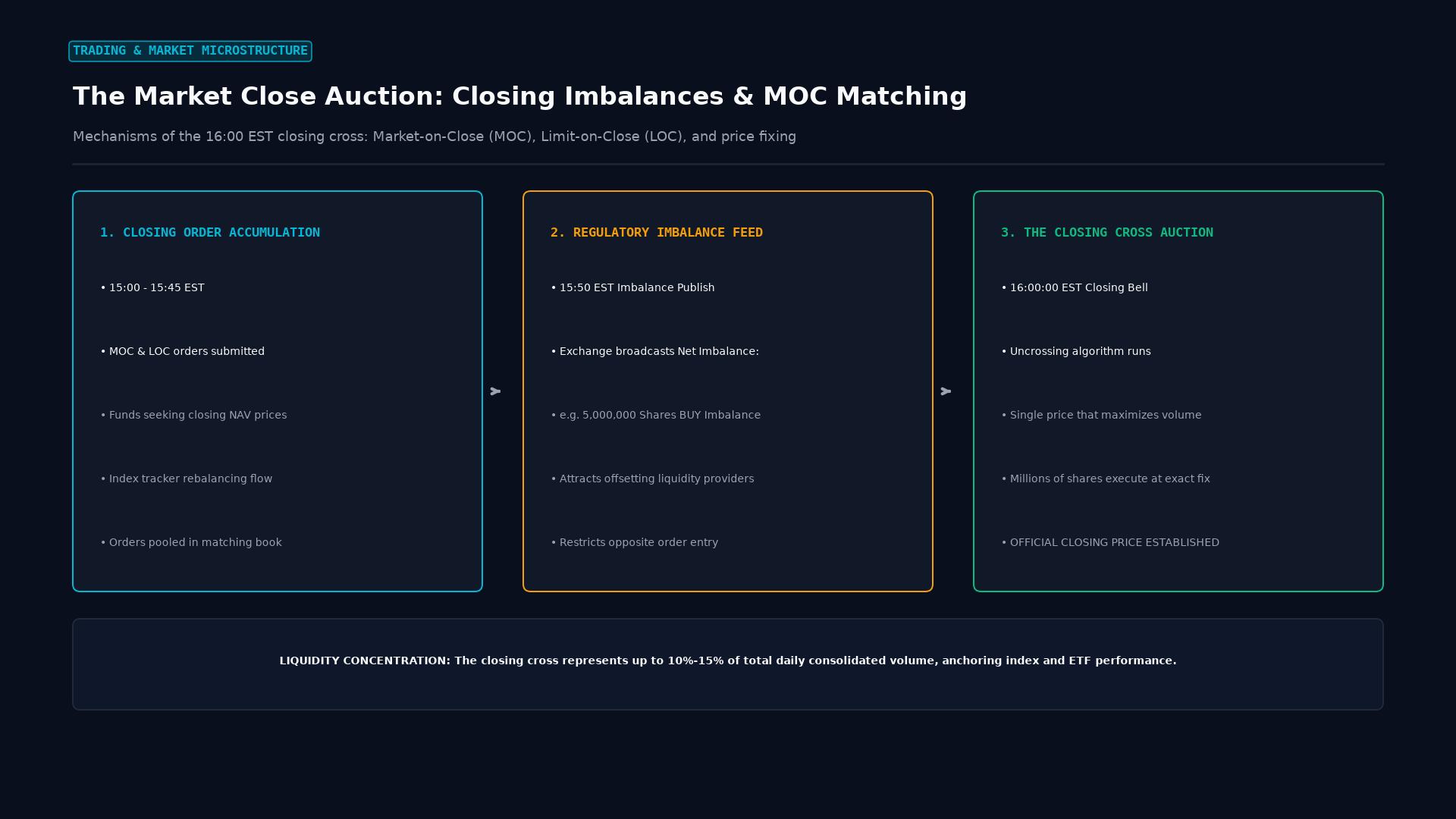 Figure: Global 24-hour foreign exchange timeline: New York 5:00 PM EST daily settlement roll, weekend liquidity gaps, and Tokyo/Sydney handover.
Key Takeaways
- The Universal Benchmark: Financial data providers (Bloomberg, Refinitiv) and retail charting software standardize the 5:00 PM New York (EST/EDT) close as the official end of the 24-hour foreign exchange day.
- Overnight Swap Application: Any position held open across the 5:00 PM EST threshold is deemed to be held overnight, incurring or earning daily financing swap fees.
- Triple-Swap Wednesday: Because spot forex trades settle two business days later ($T+2$), positions held across Wednesday’s 5:00 PM EST close are charged or credited three full days of swap interest to account for the weekend settlement roll.
- Liquidity Drain & Spread Spikes: Between 4:55 PM and 5:15 PM EST, market makers withdraw limit orders to rebalance daily books, causing bid-ask spreads to blow out from 0.1 pips to 5–15+ pips on major pairs.
- Weekend Price Gaps: Over the weekend close (Friday 5:00 PM to Sunday 5:00 PM EST), retail traders cannot exit trades, exposing open positions to catastrophic opening price gaps caused by weekend geopolitical or financial news.
Comparative Taxonomy: Market Close Dynamics
| Market Type | Daily Close Schedule | Weekly Close Schedule | Overnight Action | Spread Behavior at Close |
|---|---|---|---|---|
| Spot Forex | Continuous (5:00 PM EST accounting cut) | Friday 5:00 PM EST to Sunday 5:00 PM EST | Daily Tom-Next rollover swaps applied | Severe widening (4:55 PM – 5:15 PM EST) |
| Equity Exchanges (NYSE/Nasdaq) | Strict halt at 4:00 PM EST | Friday 4:00 PM EST to Monday 9:30 AM EST | After-hours electronic trading only | Closing Cross auction sets official benchmark |
| CME Currency Futures | Daily 1-hour maintenance halt (5:00–6:00 PM EST) | Friday 5:00 PM EST to Sunday 6:00 PM EST | Daily mark-to-market variation margin cash debit/credit | Order book halts; zero execution |
| Cryptocurrency Markets | None (True 24/7/365 continuous) | None (Trades through weekends/holidays) | Funding rates charged every 8 hours | No systematic close-related spread widening |
The Mechanics of Triple-Swap Wednesday at Market Close
The calculation of rollover swaps during the daily market close follows institutional settlement day arithmetic. Spot FX contracts settle on a $T+2$ basis (two business days from the transaction date).
$$\text{Trade Execution (Wednesday 16:59 EST)} \implies \text{Value Date: Friday}$$
$$\text{Rollover Past Cutoff (Wednesday 17:00 EST)} \implies \text{Value Date advances to Monday}$$
Because global interbank clearing systems (such as CLS Bank) do not settle commercial payments on Saturday or Sunday, the value date leaps over the weekend from Friday to Monday—a span of three calendar days.
Consequently, any position held open across the Wednesday 5:00 PM EST market close automatically incurs or earns triple rollover swaps, a vital variable that swing traders and algorithmic carry traders must rigorously model.
Real-World Case Study: The 2017 French Presidential Election Weekend Gap
Weekend market closes create the most dangerous execution risk in retail forex: the unhedgeable opening gap.
- Context: On Friday, April 21, 2017, the forex market closed for the weekend at 5:00 PM EST with EUR/USD trading at 1.0725. The first round of the French presidential election was scheduled for Sunday.
- The Risk: Geopolitical analysts warned of a potential victory for anti-EU candidates, leading many traders to enter aggressive short EUR/USD positions heading into the weekend close.
- The Sunday Reopening: When preliminary exit polls on Sunday revealed centrist Emmanuel Macron leading comfortably, institutional risk sentiment exploded.
- The Gap: When markets reopened on Sunday afternoon at 5:00 PM EST, EUR/USD did not resume at 1.0725. It opened with a massive 160-pip upward gap at 1.0885.
- Execution Disaster: Retail short-sellers who placed protective stop-losses at 1.0760 were filled at 1.0885 due to slippage, suffering losses more than triple their planned risk parameters because zero trading occurred between the Friday close and the Sunday open.
Tactical Rules for Managing the Market Close
- Close Day Trades Before 4:45 PM EST: Intraday scalpers and day traders should exit all open positions at least 15 minutes before the 5:00 PM EST daily rollover window to avoid being executed across inflated, illiquid spreads.
- Flatten Before Friday 5:00 PM EST: Unless trading a defined long-term swing or carry strategy with wide stops and modest leverage, retail traders should never hold high-leverage positions through the Friday weekend close.
- Account for Wide Spreads on Pending Orders: Stop-loss orders resting near the market at 4:59 PM EST can be triggered prematurely by the temporary spread widening, stopping you out at the exact worst price before spreads normalize at 5:15 PM EST.
Frequently Asked Questions (FAQ)
What time does the forex market close on Friday?
The global foreign exchange market officially closes for the weekend on Friday at 5:00 PM Eastern Standard Time (EST) / 10:00 PM GMT. Individual retail brokers may suspend client trading a few minutes earlier (e.g., 4:55 PM EST) to protect their risk engines from extreme spread expansion.
What is the “witching hour” in daily forex trading?
The period between 4:55 PM and 5:15 PM EST is colloquially referred to by traders as the “witching hour” or “twilight zone.” As the New York session ends and before Asian markets gain liquidity, the order book becomes virtually empty. Spreads expand dramatically, and slippage on market orders reaches daily highs.
Does the market close change with Daylight Saving Time?
Yes. Because the global standard is pegged to 5:00 PM New York time, the exact market close in GMT shifts by one hour twice a year (transitioning between 9:00 PM GMT and 10:00 PM GMT) when the United States shifts between Eastern Standard Time (EST) and Eastern Daylight Time (EDT).
Ready to trade forex?
Open a free demo account with a regulated broker. Practice with virtual funds before risking real money.