Maximum Leverage
Maximum leverage is the absolute regulatory or contractual ceiling on the ratio of total market exposure to deposited margin capital that a broker or exchange permits a trader to deploy on a position.
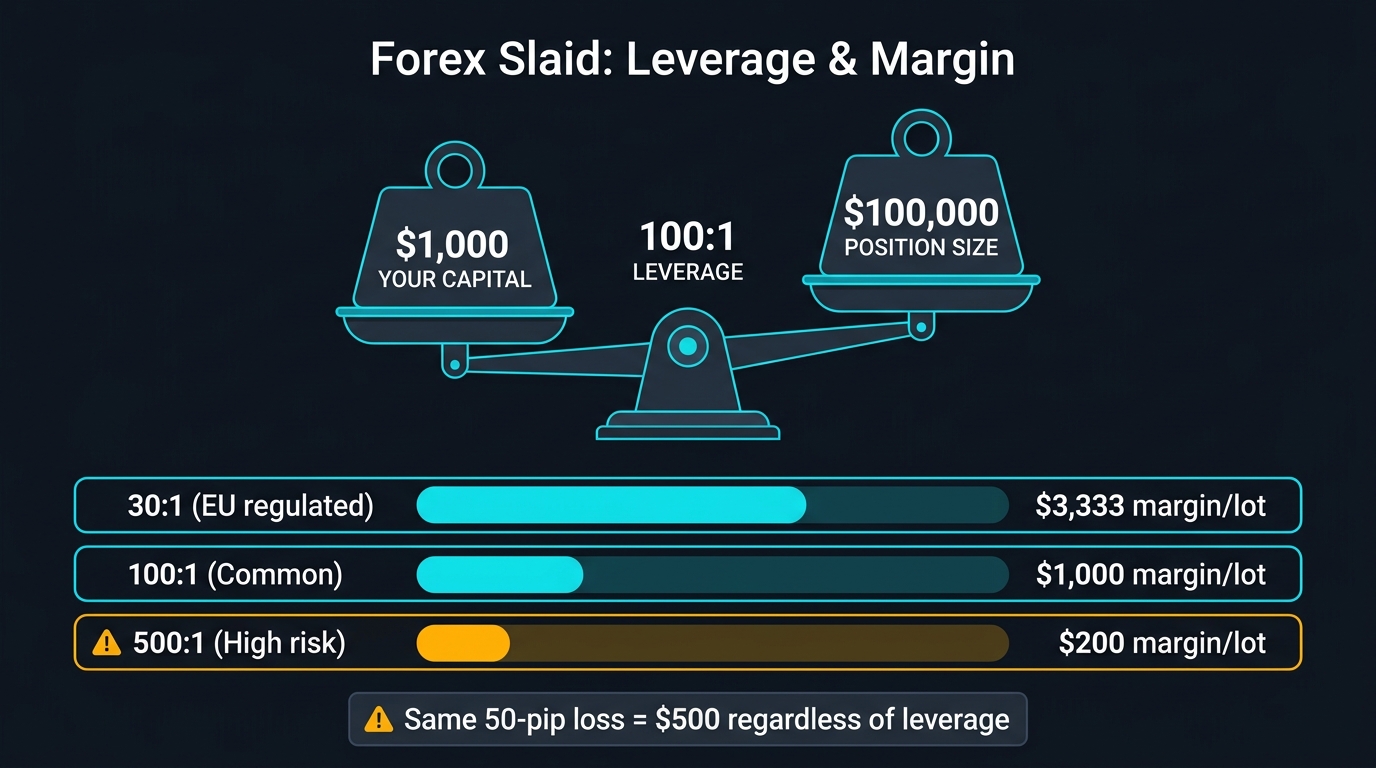
What Is Maximum Leverage?
In financial trading and foreign exchange markets, maximum leverage represents the highest legal or contractual ratio of total market purchasing power to the trader’s actual cash collateral (margin) permitted by a brokerage firm or financial regulatory authority. Expressed as a ratio (such as 1:30, 1:50, or 1:500), maximum leverage dictates the absolute ceiling of market exposure a trader can command per dollar of deposited capital.
While leverage functions as a financial multiplier that enables traders to generate meaningful cash returns from fractional exchange rate movements, maximum leverage is heavily scrutinized by financial supervisors. Because higher leverage exponentially reduces a trading account’s tolerance to normal market volatility—accelerating the speed at which an adverse price fluctuation triggers an automated margin call or stop-out—international regulatory bodies impose statutory ceilings on the maximum leverage licensed brokers can offer to retail investors.
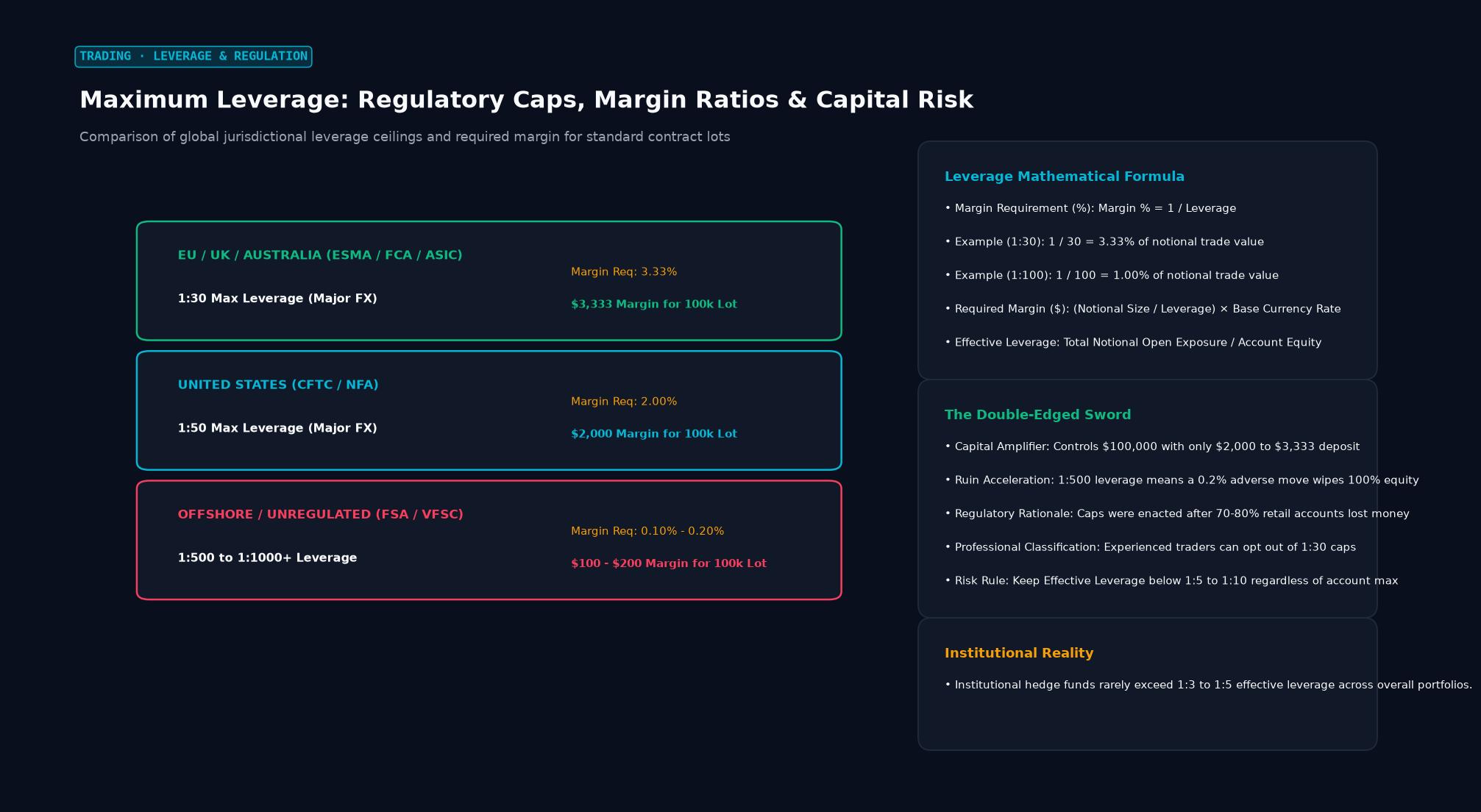 Figure: Comparison of global jurisdictional leverage ceilings and required margin for standard contract lots
Key Takeaways
- Inverse Mathematical Relationship: Maximum leverage is the exact mathematical inverse of the mandatory margin requirement: $\text{Margin Requirement} = \frac{1}{\text{Leverage Ratio}}$.
- The Regulatory Intervention: Major Tier-1 regulators have slashed retail maximum leverage—capping major forex pairs at 1:30 in the European Union (ESMA), the UK (FCA), and Australia (ASIC), and 1:50 in the United States (CFTC).
- Extreme Noise Sensitivity: At high maximum leverage (such as 1:500), an ordinary market retracement of just 15 to 20 pips can completely eradicate an account’s equity buffer, triggering a forced broker liquidation.
- Retail vs. Professional Distinction: Regulatory leverage caps apply strictly to retail clients; institutional and elective professional traders who pass wealth and volume suitability tests can access significantly higher leverage tiers.
- Double-Edged Sword: Maximum leverage does not increase your statistical edge or probability of winning; it merely increases the velocity of capital turnover and compounds transaction friction costs.
Comparative Taxonomy: Global Maximum Leverage Regulations
Regulatory philosophies differ dramatically across jurisdictions, partitioning the global brokerage market into strictly regulated onshore hubs and high-leverage offshore centers.
| Regulatory Authority | Jurisdiction | Retail Major FX Max Leverage | Retail Minor/Exotic FX | Equity CFDs | Negative Balance Protection? |
|---|---|---|---|---|---|
| ESMA | European Union | 1:30 (3.33% Margin) | 1:20 (5.0% Margin) | 1:5 (20% Margin) | Mandatory |
| FCA | United Kingdom | 1:30 (3.33% Margin) | 1:20 (5.0% Margin) | 1:5 (20% Margin) | Mandatory |
| CFTC / NFA | United States | 1:50 (2.00% Margin) | 1:20 (5.0% Margin) | Banned (No CFDs) | Not Statutorily Mandated |
| ASIC | Australia | 1:30 (3.33% Margin) | 1:20 (5.0% Margin) | 1:5 (20% Margin) | Mandatory |
| JFSA | Japan | 1:25 (4.00% Margin) | 1:25 (4.00% Margin) | 1:5 (20% Margin) | Prohibited by Law |
| FSA / VFSC | Offshore (Seychelles, Vanuatu) | 1:500 to 1:2000 | 1:100 to 1:500 | 1:20 to 1:50 | Discretionary by Broker |
The Mathematics of Leverage and Margin Depletion
To illustrate how maximum leverage dictates account survivability, consider the formula governing required margin and adverse price tolerance:
$$\text{Required Margin} = \frac{\text{Contract Notional}}{\text{Maximum Leverage}}$$
$$\text{Adverse Price Movement to 100% Loss (%)} = \frac{1}{\text{Leverage Ratio}} \times 100$$
Numerical Comparison Across Leverage Tiers:
Suppose a retail trader deposits $1,000 and opens a 1.00 Standard Lot position ($100,000 notional) on EUR/USD at 1.0800 (where 1 pip = $10.00):
-
Scenario A: Under 1:30 Maximum Leverage (Regulated UK/EU Broker):
- Required Margin = $\frac{$100,000}{30} = \mathbf{$3,333}$.
- The trader cannot open the position: the platform rejects the order because the account has only $1,000 in equity. The regulation successfully prevents the trader from entering an over-leveraged trade.
-
Scenario B: Under 1:500 Maximum Leverage (Offshore Broker):
- Required Margin = $\frac{$100,000}{500} = \mathbf{$200}$.
- The order executes immediately, leaving $800 in Free Margin.
- Margin Call Vulnerability: A drop of only 80 pips ($80 \times $10 = $800$ loss) completely depletes free margin. At a 50% stop-out level, the broker liquidates the trade after an adverse move of just 70 pips (a normal 3-hour fluctuation on EUR/USD), wiping out 90% of the trader’s net worth.
Real-World Case Study: The 2018 ESMA Retail Protection Mandate
Prior to August 2018, European retail forex brokers routinely offered maximum leverage ratios of 1:200, 1:400, and 1:500.
- The Investigation: A comprehensive empirical study by the European Securities and Markets Authority (ESMA) revealed that between 74% and 89% of all retail investor accounts lost money, with aggregate retail losses exceeding billions of Euros annually.
- The Root Cause: ESMA identified excessive maximum leverage as the primary driver of rapid retail insolvency: traders were routinely wiped out by ordinary market volatility before their analytical theses had time to play out.
- The Intervention: On August 1, 2018, ESMA enacted product intervention measures capping retail leverage at 1:30 for major currency pairs and 1:20 for non-major pairs, while mandating standardized risk warnings and negative balance protection.
- Outcome: While broker transaction volumes initially contracted and some speculative flow migrated offshore, empirical post-implementation reviews showed a significant decrease in rapid retail wipe-outs, proving that lowering maximum leverage directly extended retail account lifespans.
Pitfalls of Chasing Excessive Offshore Leverage
- Instant Stop-Outs During Economic News: Operating near maximum offshore leverage leaves zero buffer for the momentary spread widening that occurs during releases like Non-Farm Payrolls, guaranteeing liquidation on execution spikes.
- Absence of Legal Recourse: Trading with unregulated offshore brokerages offering 1:1000 leverage deprives you of statutory investor compensation schemes (such as the UK’s FSCS or Europe’s ICF) if the broker becomes insolvent or refuses withdrawal requests.
Frequently Asked Questions (FAQ)
Can I choose to trade with less leverage than the broker’s maximum?
Yes. Maximum leverage is simply an upper limit. Your effective leverage is determined entirely by your position size relative to your account balance. For example, if you have $10,000 in an account with 1:500 maximum leverage, but you only open a mini-lot ($10,000 notional), your effective leverage is just 1:1.
Why do offshore brokers offer 1:500 to 1:2000 leverage?
Offshore regulators have minimal capital adequacy requirements and consumer protection rules. Brokers offer ultra-high leverage to attract small retail deposits ($10 to $100) and maximize commission turnover, knowing that high leverage mathematically ensures rapid account turnover and client losses.
What is the maximum leverage allowed for US citizens?
Under regulations enforced by the Commodity Futures Trading Commission (CFTC) and the National Futures Association (NFA), the maximum leverage permitted for retail forex traders resident in the United States is 1:50 on major currency pairs and 1:20 on all other pairs.
Ready to trade forex?
Open a free demo account with a regulated broker. Practice with virtual funds before risking real money.