MetaTrader 4 (MT4)
MetaTrader 4 (MT4) is an electronic trading platform developed by MetaQuotes Software widely adopted in retail foreign exchange for automated algorithmic trading, technical analysis, and custom indicator development via MQL4.
What Is MetaTrader 4 (MT4)?
Developed by MetaQuotes Software and released in July 2005, MetaTrader 4 (MT4) is the benchmark electronic trading platform in the global retail foreign exchange industry. While designed primarily for spot forex trading, MT4 is also deployed by brokerage firms to offer retail access to contracts for difference (CFDs) on equities, commodities, cryptocurrencies, and sovereign index futures.
MT4 revolutionized retail trading by democratizing institutional-grade technical analysis and algorithmic execution. Through its proprietary programming language, MetaQuotes Language 4 (MQL4), the platform allowed everyday retail traders to backtest quantitative strategies, build custom technical indicators, and deploy fully automated trading robots—known universally as Expert Advisors (EAs)—without requiring enterprise-grade institutional hardware.
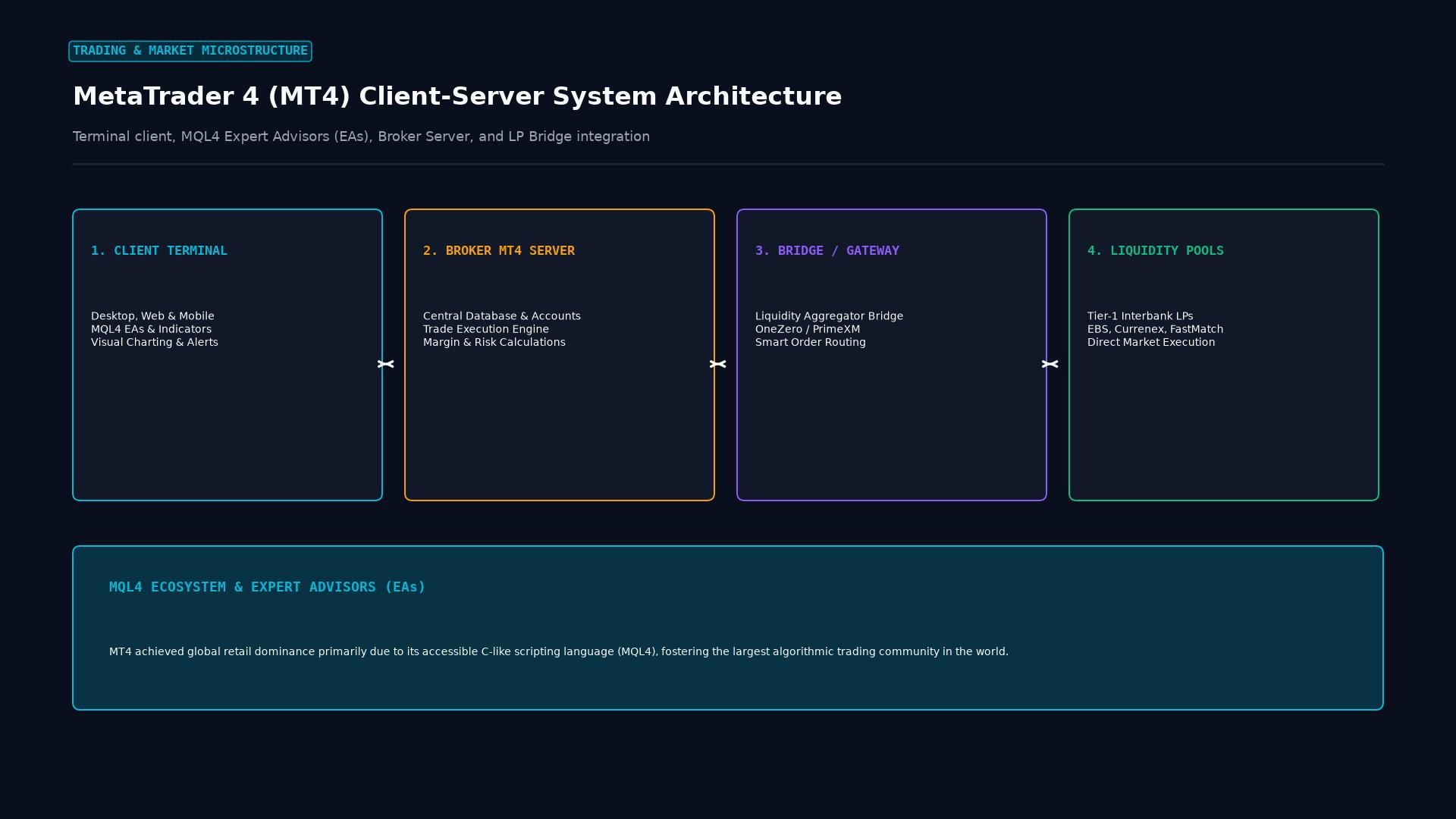 Figure: MetaTrader 4 client-server ecosystem: client terminal, MQL4 Expert Advisors, broker data server, and FIX liquidity bridge.
Technical Architecture & MQL4 Algorithmic Execution
The MT4 terminal operates on a client-server architecture. The desktop client connects to the broker’s server via an encrypted, proprietary 256-bit protocol running over standard TCP/IP port 443.
The MQL4 Execution Cycle
Automated trading robots in MT4 run on an event-driven execution loop anchored by the OnTick() handler:
// Simplified MQL4 Event Loop Structure
void OnTick()
{
   double askPrice = MarketInfo(Symbol(), MODE_ASK);
   double bidPrice = MarketInfo(Symbol(), MODE_BID);

   if(SignalCondition() == BUY_SIGNAL && OrdersTotal() == 0)
   {
      int ticket = OrderSend(Symbol(), OP_BUY, 1.0, askPrice, 3,
                             askPrice - 50*Point, askPrice + 100*Point,
                             "Algorithmic Order", 12345, 0, clrGreen);
   }
}
Execution Latency & Round-Trip Modeling
Algorithmic execution speed in MT4 is governed by the total round-trip time ($T_{\text{RTT}}$):
$$T_{\text{RTT}} = 2 \times T_{\text{network_transit}} + T_{\text{server_queue}} + T_{\text{bridge_execution}}$$
Where:
- $T_{\text{network_transit}}$: Physical latency between the trader’s terminal (or VPS) and the broker’s primary data server.
- $T_{\text{server_queue}}$: Server processing time required to validate margin and account permissions.
- $T_{\text{bridge_execution}}$: Interbank bridge latency required to pass the order to tier-1 liquidity providers.
To minimize $T_{\text{network_transit}}$ to sub-1 millisecond, professional algorithmic traders host their MT4 terminals on specialized Virtual Private Servers (VPS) co-located in the same data centers (such as Equinix LD4 in Slough, UK, or NY4 in Secaucus, New Jersey) as the broker’s core MT4 trade servers.
Comparative Matrix: MT4 vs. MT5 vs. cTrader
| Platform Feature | MetaTrader 4 (MT4) | MetaTrader 5 (MT5) | Spotware cTrader |
|---|---|---|---|
| Release Year | 2005 | 2010 | 2011 |
| Asset Class Focus | Spot Forex & CFDs | Multi-Asset (Stocks, Futures, FX) | Spot Forex & CFDs |
| Programming Language | MQL4 (Procedural C-like) | MQL5 (Object-Oriented C++) | C# (.NET framework) |
| Order Execution | Hedging natively supported | Netting (Exchange) & Hedging | Hedging & Netting |
| Timeframes | 9 standard timeframes | 21 timeframes | 54 timeframes |
| Market Depth (DoM) | Level I (Basic) | Level II Depth of Market | Level II Depth of Market (VWAP) |
| Backtesting Engine | Single-threaded | Multi-threaded / Cloud Network | Multi-threaded / Advanced |
Real-World Case Study: The Multi-Decade Market Dominance of MT4
When MetaQuotes released MetaTrader 5 in 2010, the company intended to phase out MT4 within a few years. In 2018, MetaQuotes officially discontinued the sale of new MT4 server licenses to new brokerage clients to force migration toward MT5.
Why MT4 Defied Obsolescence:
1. The Codebase Network Effect: Over more than a decade, millions of traders, programmers, and proprietary firms authored a vast global library of custom MQL4 indicators, Expert Advisors, and trade copiers.
2. Incompatible Architectures: MQL4 and MQL5 are not backward-compatible; migrating an EA from MT4 to MT5 requires complete architectural rewrites.
3. Broker Infrastructure: Leading financial technology firms (such as OneZero, Gold-i, and PrimeXM) built mission-critical liquidity bridges and risk-management plugins optimized specifically for MT4 server architecture.
4. Market Share Persistence: By 2024—nearly twenty years after its original release—MT4 remained the most heavily utilized retail trading platform in the world by daily active retail trading volume.
The enduring reign of MT4 is considered one of the most prominent examples of software network effects in modern financial technology.
Frequently Asked Questions (FAQ)
Why is MT4 still preferred by many traders over the newer MT5?
The primary reason is the immense ecosystem of legacy trading tools. Traders have invested years developing, optimizing, and purchasing custom Expert Advisors, automated scripts, and custom technical indicators coded in MQL4. Because MQL4 code does not run natively on MT5, transitioning to the newer platform requires rewriting or repurchasing these tools. Additionally, MT4’s user interface is simpler and consumes significantly fewer system resources.
What is an Expert Advisor (EA) in MetaTrader 4?
An Expert Advisor (EA) is an automated trading script written in MQL4 that executes trading operations directly on the MT4 platform without human intervention. An EA monitors live tick data, analyzes market indicators (such as moving averages or RSI), calculates risk parameters and lot sizing, and automatically opens, modifies, and closes trades according to its coded quantitative rules.
How does a Virtual Private Server (VPS) improve MT4 trading performance?
An automated Expert Advisor must run continuously while markets are open. Running MT4 on a home personal computer exposes the trader to internet outages, power failures, operating system updates, and latency spikes. A Forex VPS provides a dedicated, cloud-hosted Windows server that operates 24/7 with 99.99% uptime. When located in the same data center complex as the broker’s servers, a VPS reduces execution ping from 50–150 milliseconds down to 1–2 milliseconds, minimizing execution slippage.
Ready to trade forex?
Open a free demo account with a regulated broker. Practice with virtual funds before risking real money.