Trading Platforms
A trading platform is a software and network infrastructure that connects market participants to financial exchanges, electronic communication networks (ECNs), and liquidity providers, facilitating real-time price discovery, technical analysis, and automated order execution.
What Is a Trading Platform?
A trading platform is an integrated software application and telecommunications interface that enables traders and institutional investors to interact electronically with financial markets. Modern trading platforms aggregate multi-asset streaming quotes, provide charting and algorithmic analysis suites, manage account equity and margin parameters, and transmit trade instructions to execution venues.
Historically conducted via open-outcry pits and telephonic broker desks, contemporary financial trading relies almost entirely on electronic platforms. These systems range from retail graphical user interfaces (GUIs) engineered for ease of use to high-performance institutional Execution Management Systems (EMS) and Order Management Systems (OMS) that process millions of transactions per second with microsecond latency.
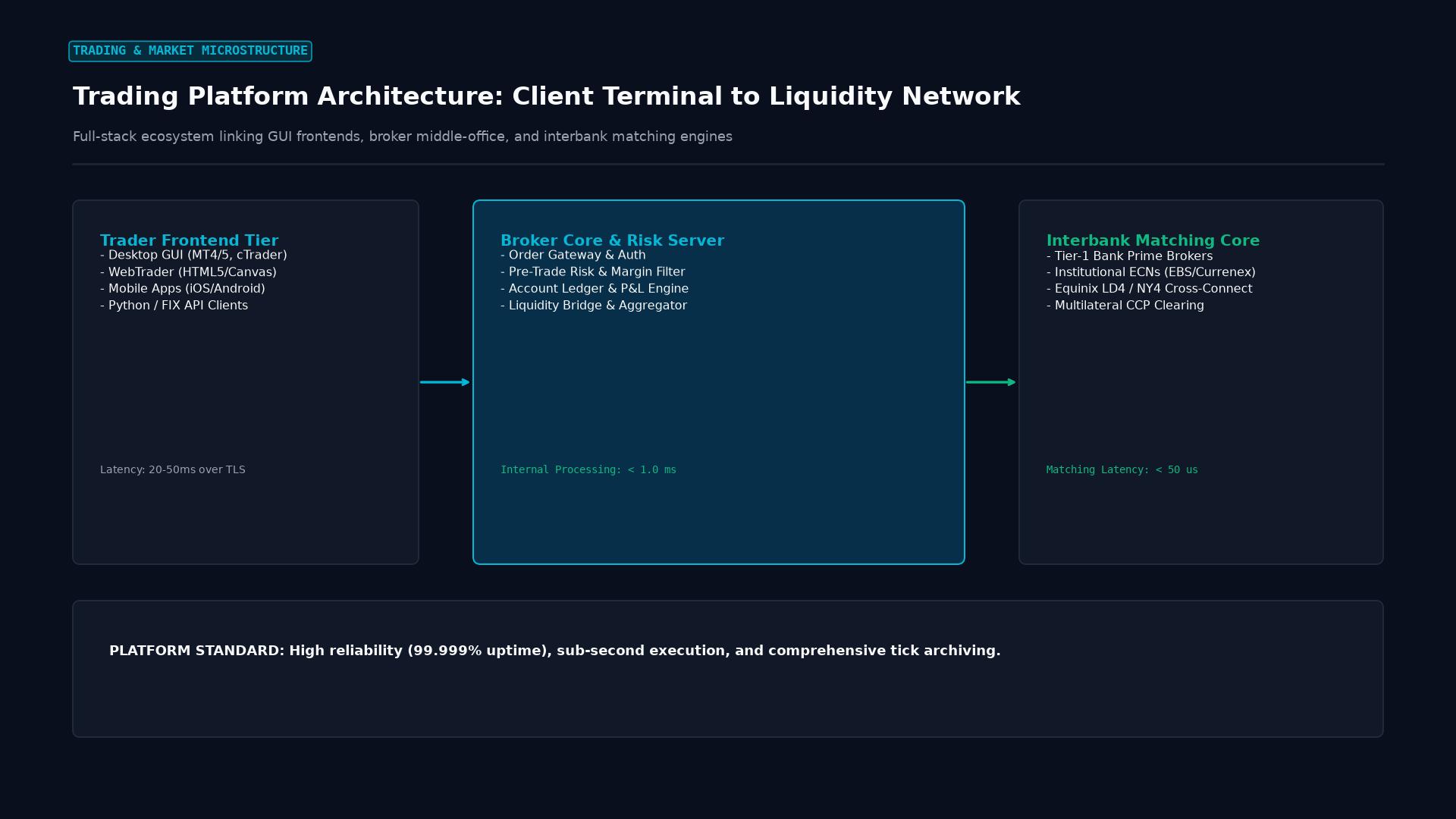 Figure: Full-stack brokerage infrastructure: frontend user terminals, broker risk management servers, FIX protocol bridges, and interbank matching engines.
Technical Architecture & Performance Metrics
The institutional efficacy of a trading platform is evaluated across latency, execution throughput, and fill quality.
1. Latency & Round-Trip Time (RTT)
Latency measures the elapsed duration required for an order payload to travel from the trader’s terminal to the liquidity venue and receive execution confirmation:
$$\text{RTT} = t_{\text{network_outbound}} + t_{\text{gateway_risk}} + t_{\text{matching_engine}} + t_{\text{network_ack}}$$
In high-frequency trading (HFT) and institutional market making, platforms co-locate their core servers within matching facility data centers (such as Equinix LD4 in London or NY4 in Secaucus, New Jersey), compressing network latency from tens of milliseconds ($10^{-2}\text{ s}$) to sub-microseconds ($< 10^{-6}\text{ s}$).
2. Execution Slippage
Slippage measures the variance between the expected price when an order is submitted and the final filled price recorded by the exchange matching engine:
$$\text{Slippage (pips)} = \frac{P_{\text{executed}} - P_{\text{requested}}}{\text{Pip Size}}$$
Low-latency trading platforms utilize Smart Order Routing (SOR) algorithms to slice large institutional orders across disparate liquidity pools, minimizing adverse market impact and slippage.
3. Queueing Capacity & Peak Throughput
Under high-volatility events (e.g., Non-Farm Payrolls or central bank rate decisions), order volume surges exponentially. Under the $M/M/1$ queueing model, queue length ($L_q$) and waiting time ($W_q$) expand dramatically as arrival rate ($\lambda$) approaches service rate ($\mu$):
$$L_q = \frac{\lambda^2}{\mu(\mu - \lambda)}, \quad W_q = \frac{\lambda}{\mu(\mu - \lambda)}$$
Institutional platforms employ distributed memory architectures and kernel-bypass networking (Solarflare OpenOnload) to prevent message congestion and system freezes during volume spikes.
Platform Taxonomy: Retail vs. Institutional
Trading platforms vary significantly based on user demographic, asset coverage, and execution mechanics:
| Platform Category | Leading Systems | Target User Base | Primary Strengths | Limitations |
|---|---|---|---|---|
| Retail Workhorses | MetaTrader 4/5, cTrader | Independent retail traders, prop firm participants | Automated Expert Advisors (EAs), low resource overhead, broad broker support. | Legacy architecture, basic Level 2 depth, single-broker lock-in. |
| Cloud Charting / Social | TradingView | Retail and semi-pro technical analysts | Browser-native, superior UX/UI, Pine Script community, cross-broker APIs. | Execution relies on third-party webhook/broker bridges; not optimized for sub-second fills. |
| Institutional Terminals | Bloomberg Terminal, Refinitiv Eikon / Workspace | Investment banks, central banks, hedge fund portfolio managers | Comprehensive macroeconomic data, real-time news, chat networks (IB Chat), multi-asset pricing. | High annual subscription cost ($24,000+ per terminal); steep learning curve. |
| Execution Management Systems (EMS) | FlexTrade, Portware, Bloomberg EMSX | Buy-side institutional trading desks | Multi-broker execution, sophisticated algorithmic routing, compliance transaction cost analysis (TCA). | Complex enterprise deployment; requires direct prime brokerage connectivity. |
Connectivity Protocols: The Role of FIX
Institutional trading platforms communicate using the Financial Information eXchange (FIX) protocol, an international open standard for real-time electronic financial transactions.
Client Trading Platform                  Broker / Liquidity Gateway
         |                                           |
         | -------- Logon (MsgType = A) -----------> |
         | <------- Logon Ack (MsgType = A) -------- |
         |                                           |
         | --- New Order Single (MsgType = D) -----> |  (Symbol: EUR/USD, Qty: 5M)
         | <--- Execution Report (MsgType = 8) ----- |  (ExecType = 0: New)
         | <--- Execution Report (MsgType = 8) ----- |  (ExecType = F: Filled @ 1.08502)
By decoupling the graphical front-end from back-end liquidity providers, FIX Protocol enables algorithmic funds to bypass retail platform bottlenecks and interact directly with interbank market makers.
Real-World Institutional Case Study: The Knight Capital Disaster (August 1, 2012)
On the morning of August 1, 2012, Knight Capital Group—then the largest market maker in US equities, handling roughly $17%$ of NYSE trade volume—deployed a routine software update to its automated trading platform across eight market-facing servers.
The deployment team inadvertently omitted updating the eighth server, leaving legacy, dormant test code known as “Power Peg” active on that machine. When the NYSE opened at 9:30 AM, the platform began processing incoming retail orders. However, the corrupted server misinterpreted incoming order routing signals, triggering an endless execution loop.
[August 1, 2012: 9:30 - 10:15 AM EDT]
Platform Server 8 Runs Corrupted Routing Software
                      |
                      v
Endless Loop: Buys Shares at Offer, Sells Immediately at Bid
                      |
                      v
4 Million Unintended Executions across 154 Stocks in 45 Minutes
                      |
                      v
Gross Market Exposure Reaches $7 Billion
                      |
                      v
Result: Net Loss of $460 Million in 45 Minutes -> Knight Capital Insolvency & Emergency Sale
Because the platform lacked automated pre-trade kill-switches and global position limits, it liquidated Knight Capital’s regulatory net capital in less than an hour. The disaster led to the implementation of SEC Rule 15c3-5 (the “Market Access Rule”), mandating that all electronic trading platforms maintain non-bypassable, automated financial risk controls and kill-switches.
Frequently Asked Questions
What is the difference between a white-label and proprietary trading platform?
A white-label platform is turnkey software developed by a third party (such as MetaQuotes or Spotware) that a brokerage licenses and brands with its own corporate identity. A proprietary platform is custom software engineered in-house by a financial institution or broker, offering unique execution algorithms, custom order types, and tailored liquidity routing.
Why do institutional traders prefer desktop platforms over web browsers?
Desktop trading applications are compiled in high-performance native languages (such as C++ or Rust) and run directly on operating system threads with hardware-accelerated graphics. Web-based platforms run inside a sandboxed JavaScript runtime, introducing memory garbage collection pauses, higher CPU overhead, and network serialization latencies that make them less suitable for high-frequency or multi-screen algorithmic execution.
How does server co-location improve trading platform execution?
Co-location involves housing a trading platform’s physical execution servers inside the exact same data center facility that hosts the exchange’s matching engine. By eliminating long-distance fiber-optic transmission routes, co-location reduces latency from several milliseconds to nanoseconds, ensuring trade instructions arrive ahead of competing orders and minimizing execution slippage.
Ready to trade forex?
Open a free demo account with a regulated broker. Practice with virtual funds before risking real money.