Straight-Through Processing (STP)
Straight-Through Processing (STP) is an automated financial execution mechanism that routes orders seamlessly from entry through clearing and settlement without manual human intervention.
What Is Straight-Through Processing (STP)?
In financial market microstructure and electronic brokerage architecture, Straight-Through Processing (STP) refers to the end-to-end automation of financial transactions from initial order initiation to final clearing and settlement without requiring manual dealer intervention, paper handling, or re-keying of trade parameters.
In the retail and institutional foreign exchange markets, an STP broker operates an automated liquidity bridge that routes incoming client orders directly to external liquidity providers (tier-1 investment banks, non-bank market makers, and institutional multilateral trading facilities). By replacing human trading desks with algorithmic execution bridges, STP drastically reduces execution latency, eliminates dealer requotes, and aligns the broker’s business incentives with client transaction volume rather than client trading losses.
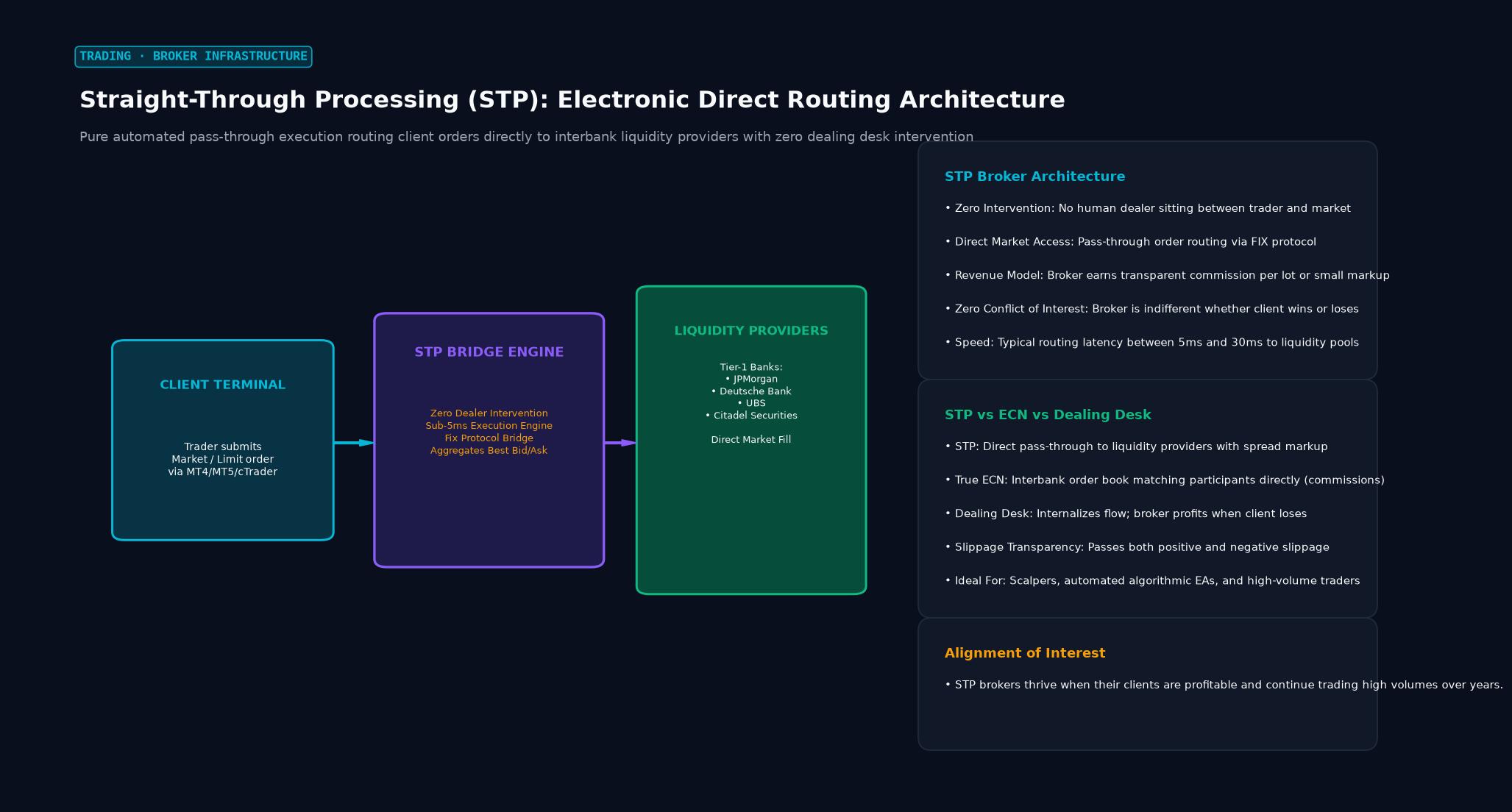 Figure: Pure automated pass-through execution routing client orders directly to interbank liquidity providers with zero dealing desk intervention
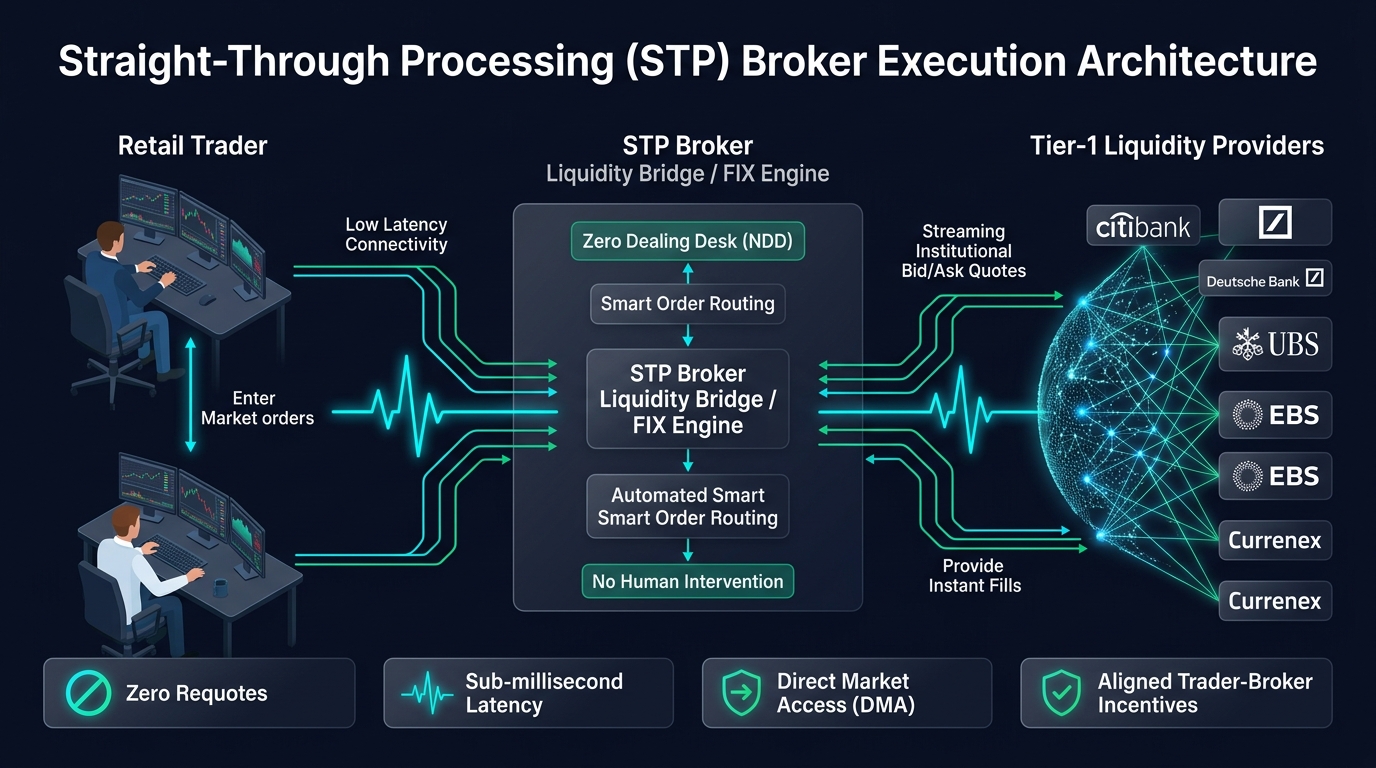
Technical Mechanics & Latency Economics
The technical architecture of an STP system relies on the Financial Information eXchange (FIX) protocol (commonly FIX 4.2 or 4.4). When a trader executes an order, the broker’s bridge software immediately parses the request and matches it against an aggregated pricing engine.
End-to-End Latency Formulation
Total execution latency ($T_{\text{exec}}$) across an STP pipeline is formulated as:
$$T_{\text{exec}} = T_{\text{client_ingress}} + T_{\text{bridge_routing}} + T_{\text{LP_match}} + T_{\text{network_ack}}$$
Where:
- $T_{\text{client_ingress}}$: Time taken for the order packet to travel from the trader’s terminal to the broker’s access server.
- $T_{\text{bridge_routing}}$: Algorithmic processing time required by the aggregation bridge (e.g., OneZero, PrimeXM) to select the optimal bid/ask quote.
- $T_{\text{LP_match}}$: Execution time inside the selected liquidity provider’s core matching engine.
- $T_{\text{network_ack}}$: Round-trip return confirmation sent back to the client terminal.
Under high-performance fiber-optic cross-connections in co-located institutional data centers (such as Equinix LD4 in London or NY4 in New Jersey), total STP latency is compressed to sub-5 milliseconds.
Revenue and Spread Model
STP brokers typically monetize order flow through a transparent spread markup or a fixed volume commission:
$$\text{Quoted Spread}{\text{Client}} = \left( \min{j} \text{Ask}j - \max{j} \text{Bid}_j \right) + \text{Broker Spread Markup}$$
Because the broker passes market risk directly to the liquidity provider, the broker earns its markup regardless of whether the client’s trade is profitable or unprofitable.
Comparative Matrix: Execution Brokerage Architectures
| Feature | Straight-Through Processing (STP) | Electronic Communication Network (ECN) | Dealing Desk (Market Maker / B-Book) |
|---|---|---|---|
| Order Routing | Direct to external liquidity providers | Interacts within a Central Limit Order Book | Internalized on broker’s internal risk book |
| Counterparty | External Tier-1 Bank / Prime Broker | Other network participants (banks, funds, traders) | The broker itself |
| Conflict of Interest | Negligible (Broker wants client to survive) | Zero (Impartial matching venue) | High (Client trading loss = Broker profit) |
| Requotes | Zero (Fills at market or slips) | Zero (Fills against book liquidity) | Common during high volatility |
| Pricing Model | Raw spread + modest markup, or commission | Raw interbank spread + fixed commission | Artificially widened fixed or variable spreads |
| Execution Speed | Fast (automated bridge) | Ultra-fast (co-located CLOB) | Can be subject to manual dealer review |
Real-World Case Study: The 2015 SNB Shock & STP Broker Resilience
On January 15, 2015, the Swiss National Bank (SNB) unexpectedly discontinued its 1.2000 floor on EUR/CHF, causing the pair to collapse over 2,000 pips in minutes. This historic shock exposed the critical structural differences between brokerage models:
The STP Liquidity Vacuum:
1. The Shock: When the peg was abandoned, major liquidity providers (including Deutsche Bank, Citi, and Barclays) pulled all bids from electronic feeds.
2. The STP Dilemma: STP brokers passed client stop-loss orders directly to external liquidity bridges. With no bids available on interbank feeds, orders could not execute at 1.1990; the first available interbank fills occurred far below parity near 0.8500.
3. Negative Balance Fallout: Retail client accounts suffered massive negative balances that exceeded their deposited equity.
4. Broker Insolvency: Brokers operating pure STP agency models that lacked sufficient balance sheet capitalization or Prime Broker credit buffers (such as Alpari UK) were unable to recover multi-million-dollar negative client deficits from retail traders and entered administration within 24 hours.
The episode prompted international regulators to mandate negative balance protection and forced STP brokers to establish multi-bank aggregation redundancy to survive severe liquidity gaps.
Frequently Asked Questions (FAQ)
What is the difference between an STP broker and an ECN broker?
While both eliminate manual dealing desks, an STP broker routes orders to external third-party liquidity providers (banks and market makers) who take the other side of the trade. An ECN broker operates an open, multilateral Central Limit Order Book (CLOB) where orders from retail traders, hedge funds, and institutional banks directly interact and match against one another based on price-time priority. In practice, many modern retail brokers operate hybrid ECN/STP models.
Can an STP broker reject a trader’s order?
Under standard automated market execution, an STP broker does not reject orders. However, an order can experience slippage if market liquidity changes between the time the order is dispatched and the time it reaches the liquidity provider’s matching engine. If a trader uses an STP account with “Instant Execution” parameters and sets a tight maximum deviation threshold, the order may be cancelled if prevailing interbank prices move beyond that allowed tolerance.
What is an “A-Book” vs. “B-Book” broker, and where does STP fit?
In brokerage terminology, an A-Book broker utilizes STP or ECN technology to route client trades directly to the external interbank market, earning profit strictly through commissions or markups. A B-Book broker operates a Dealing Desk, internalizing client trades and taking the opposing side of the position on its own balance sheet. Many commercial brokers utilize hybrid risk-management algorithms, routing profitable traders to the A-Book (STP) while internalizing losing retail flow on the B-Book.
Ready to trade forex?
Open a free demo account with a regulated broker. Practice with virtual funds before risking real money.