MetaTrader
MetaTrader is the preeminent global suite of electronic trading platforms—developed by MetaQuotes Software Corp.—enabling retail and institutional traders to execute foreign exchange, CFD, and futures transactions manually or via automated Expert Advisors (EAs).
What Is MetaTrader?
MetaTrader is the most widely utilized electronic trading platform architecture in the history of retail foreign exchange. Developed by Cyprus-based fintech firm MetaQuotes Software Corp., the software suite serves as the white-label technology bridge connecting retail traders to international brokerage firms, electronic communication networks (ECNs), and liquidity providers.
The platform exists primarily in two major versions:
- MetaTrader 4 (MT4): Released in 2005, MT4 became the undisputed global benchmark for retail spot forex and CFD trading. Its lightweight, highly responsive client terminal revolutionized the retail industry by integrating live price charting, technical indicators, and automated trading capabilities into a single free interface.
- MetaTrader 5 (MT5): Released in 2010, MT5 is a multi-asset trading platform built on a high-performance 64-bit multi-threaded architecture. Beyond foreign exchange, MT5 natively supports centralized exchange-traded equities, commodities, futures, and options, featuring an institutional Depth of Market (DOM) ladder and a distributed strategy tester.
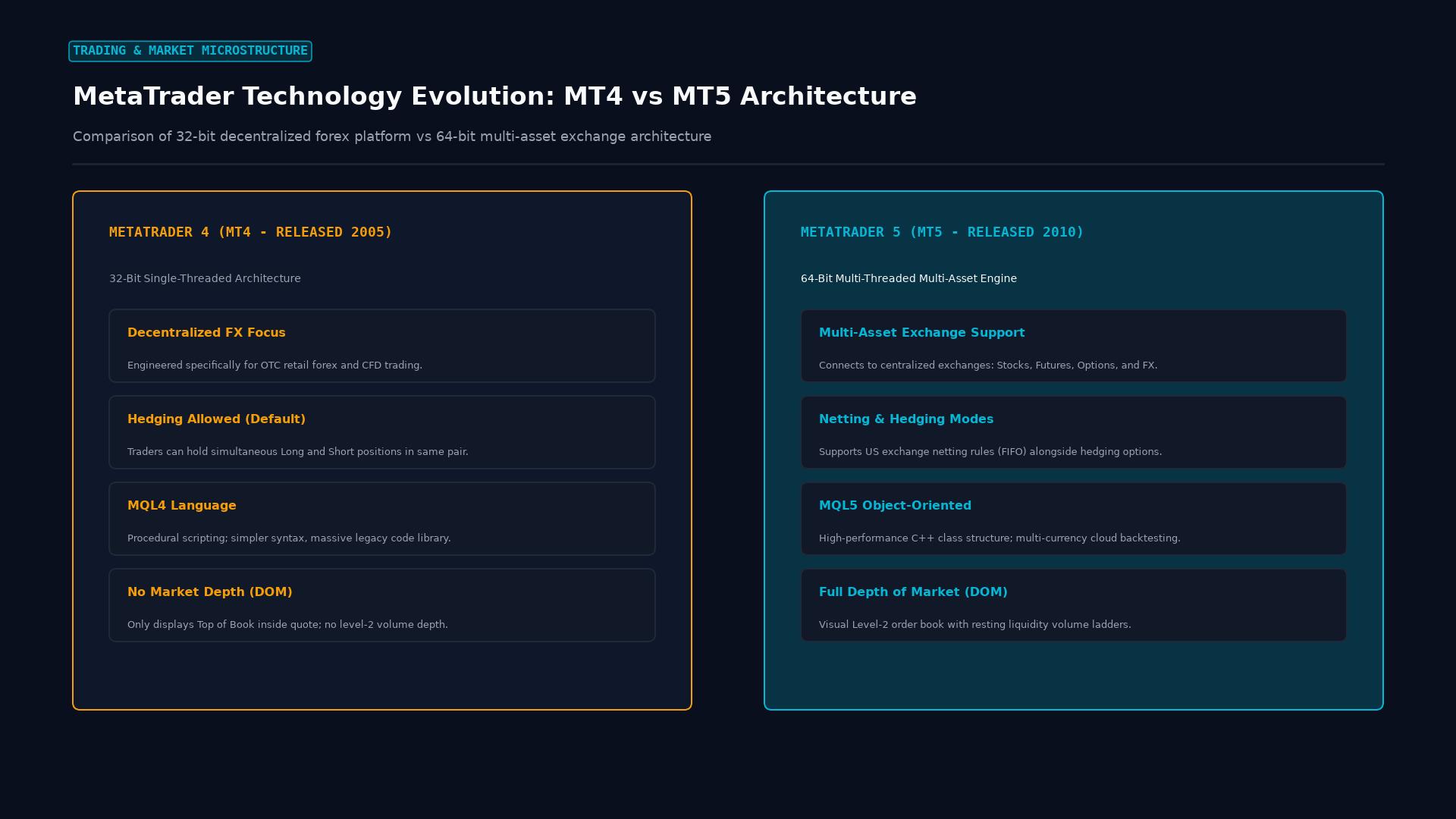 Figure: Comparative analysis of MT4 (32-bit, single-threaded, hedging default) and MT5 (64-bit multi-asset, distributed strategy tester, exchange gateway).
Key Takeaways
- The MQL Algorithmic Revolution: MetaTrader’s proprietary programming languages—MQL4 and MQL5—democratized quantitative automated trading, spawning a multi-million-dollar global marketplace for automated trading robots (Expert Advisors) and custom indicators.
- Broker-Agnostic Familiarity: Because hundreds of licensed international brokers license the MetaTrader software, a trader can switch brokers without having to learn a new charting interface or rewrite algorithmic code.
- MT4 vs. MT5 Structural Shift: While MT4 is an order-centric platform tailored strictly for OTC currency pairs, MT5 is an institutional, multi-threaded engine designed for true multi-asset exchange trading with native order book depth.
- Virtual Private Server (VPS) Hosting: To execute automated Expert Advisors 24 hours a day without interruption from home computer power or internet outages, traders host MetaTrader instances on low-latency remote VPS servers collocated near broker data centers.
- White-Label Ecosystem: MetaQuotes does not act as a broker; it licenses server software to financial institutions who customize leverage, spreads, commission schedules, and trade execution models.
Comparative Taxonomy: MetaTrader 4 vs. MetaTrader 5 vs. Modern Alternatives
| Technical Feature | MetaTrader 4 (MT4) | MetaTrader 5 (MT5) | Modern Web (cTrader / TradingView) |
|---|---|---|---|
| Release Year | 2005 | 2010 | 2011+ |
| System Architecture | 32-bit, single-threaded | 64-bit, multi-threaded | Cloud / Modern multi-core |
| Supported Markets | Forex and CFDs only | Forex, Stocks, Futures, Options, Bonds | Forex, CFDs, Crypto |
| Programming Language | MQL4 (Procedural C-like) | MQL5 (Object-oriented C++) | C# (cTrader) / Pine Script |
| Order Accounting | Hedging only (ticket-based) | Hedging and Netting models | Hedging and Netting |
| Depth of Market (DOM) | Basic simulated DOM | Full Level 2 Exchange DOM | Comprehensive institutional DOM |
| Strategy Backtester | Single currency, single-threaded | Multi-currency, Cloud distributed | Robust web/tick engine |
| Timeframes | 9 standard intervals | 21 comprehensive intervals | Custom minute intervals |
Automated Trading: The Expert Advisor (EA) Lifecycle
The foundational competitive advantage of the MetaTrader ecosystem is the Expert Advisor (EA)—an automated trading script written in MQL that executes trades autonomously based on programmatic rules:
// Conceptual MQL5 Trading Logic Fragment
void OnTick()
{
    double maFast[], maSlow[];
    ArraySetAsSeries(maFast, true);
    ArraySetAsSeries(maSlow, true);
    CopyBuffer(fastMA_Handle, 0, 0, 2, maFast);
    CopyBuffer(slowMA_Handle, 0, 0, 2, maSlow);

    // Golden Cross Entry Condition
    if(maFast[1] <= maSlow[1] && maFast[0] > maSlow[0])
    {
        trade.Buy(0.10, _Symbol, SymbolInfoDouble(_Symbol, SYMBOL_ASK),
                  SymbolInfoDouble(_Symbol, SYMBOL_BID) - 200 * _Point,
                  SymbolInfoDouble(_Symbol, SYMBOL_BID) + 400 * _Point,
                  "Automated EA Entry");
    }
}
The script monitors incoming price ticks from the broker server (OnTick()), calculates indicator arrays, evaluates entry and exit triggers, and sends instant execution requests to the broker’s matching engine without human intervention.
Real-World Case Study: The Prop Firm Industry Boom on MetaTrader
Between 2020 and 2024, the retail trading landscape was reshaped by modern Proprietary Trading Evaluation Firms (such as FTMO and Funded Engineer).
- The Infrastructure Choice: Prop firms required a standardized, fraud-resistant trading engine with universal accessibility. Over 90% of prop firms standardized their evaluation challenges exclusively on MetaTrader 4 and 5.
- Trader Adoption: Because millions of retail traders already possessed years of muscle memory and proprietary MQL indicators on MT4/MT5, onboarding friction was zero.
- Automated Risk Compliance: Prop firms deployed server-side risk modules linked to MetaTrader back-ends to automatically track daily drawdowns (e.g., maximum 5% loss limit) and overall equity targets tick-by-tick.
- The MetaQuotes Crackdown (2024): In early 2024, MetaQuotes strictly enforced license compliance, banning brokers from offering MT4/MT5 feeds to unregulated U.S. prop firm challenges, prompting a rapid industry migration toward alternative platforms like cTrader and DXtrade.
Critical Risks and Operational Traps
- The Virtual Dealer Plugin Controversy: In past regulatory actions, certain unscrupulous “B-Book” retail brokers were found to use third-party server plugins (such as the controversial Virtual Dealer Plugin) to artificially delay executions by hundreds of milliseconds, inducing negative slippage on profitable scalpers.
- Execution Latency in News Events: Running a desktop MetaTrader terminal over residential Wi-Fi introduces 50 to 150 milliseconds of network ping. During volatile economic releases, this delay guarantees substantial slippage; institutional algorithmic trading requires collocated VPS hosting.
Frequently Asked Questions (FAQ)
Can I run MT4 automated Expert Advisors on MT5?
No. MQL4 and MQL5 are distinct programming languages with incompatible compilers and object models. An Expert Advisor written in MQL4 must be rewritten or ported to MQL5 before it can run on a MetaTrader 5 terminal.
Is MetaTrader a broker?
No. MetaQuotes Software Corp. is purely a software and technology provider. MetaQuotes does not hold customer funds, execute trades, or provide financial brokerage services. You must open a trading account with a licensed financial broker to use MetaTrader with real capital.
Why is MetaTrader 4 still popular if MetaTrader 5 is newer?
Despite MetaQuotes ceasing the sale of new MT4 broker server licenses in 2018, MT4 remains beloved by millions of traders due to its immense library of free legacy MQL4 code, lightweight system footprint, and simple ticket-based order model.
Ready to trade forex?
Open a free demo account with a regulated broker. Practice with virtual funds before risking real money.