Broker
A forex broker is a company that provides retail traders access to the interbank currency market by acting as an intermediary — connecting client orders to liquidity providers and executing trades on their behalf. Brokers generate revenue through the spread, commissions, or both. Choosing the right broker is one of the most consequential decisions a retail forex trader makes.
What a Forex Broker Actually Does
Banks don’t take retail calls from individuals who want to buy €10,000. The minimum transaction size in the interbank market runs to millions. Retail forex brokers solve this problem by aggregating thousands of small retail orders, managing the combined exposure, and accessing interbank pricing on behalf of their client base.
The broker is your gateway to the market — but also a business that needs to make money from your trading activity. Understanding how brokers make money helps you evaluate whether their incentives align with yours.
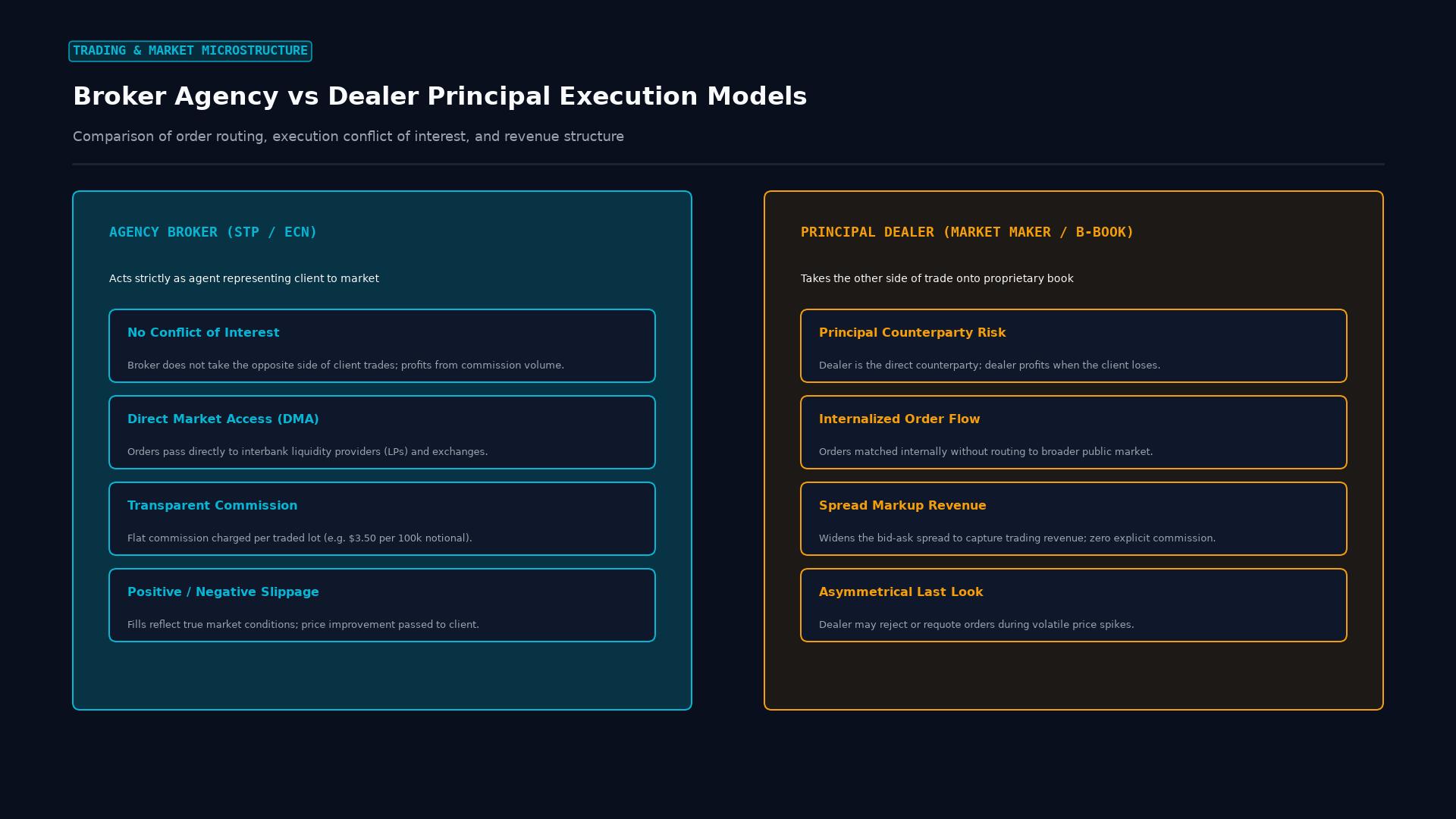 Figure: Execution model contrast: conflict-free agency brokers routing to external liquidity venues versus principal market makers internalizing order flow.
The Two Main Broker Models
Market Maker (Dealing Desk — DD)
The broker acts as the counterparty to your trade. When you buy EUR/USD, the market maker sells it to you directly. They profit from the spread and from client losses — because when you lose, they win (since they took the other side). The conflict of interest is real, though well-regulated brokers hedge their exposure in the interbank market rather than simply hoping clients lose.
Market makers offer stable spreads and faster execution in normal conditions. The concerns: potential for price manipulation, requotes during fast markets, and the structural conflict of interest between broker and client.
ECN/STP Broker (Non-Dealing Desk — NDD)
ECN (Electronic Communication Network) and STP (Straight-Through Processing) brokers route orders directly to liquidity providers — banks, hedge funds, other market participants — without a dealing desk intermediary. The broker doesn’t take the other side of trades; they simply pass your order through and earn a small commission per trade.
Advantages: no conflict of interest, real interbank pricing (often 0.0-0.3 pip raw spread on EUR/USD), positive slippage is possible. Disadvantages: commission charged per lot (~$3-7 per standard lot per side), spreads can widen significantly during news events, minimum deposits may be higher.
For active traders, ECN accounts almost always offer better value despite the commission — the raw spread advantage more than compensates at most trading volumes.
How Brokers Make Money
| Revenue Source | Market Maker | ECN Broker |
|---|---|---|
| Spread markup | Primary revenue | Minimal (pass-through) |
| Commission per trade | Usually none | Primary revenue |
| Client losing trades | Secondary (when not hedged) | None |
| Financing (swap rates) | Markup on overnight swaps | Markup on overnight swaps |
| Inactivity fees | Common | Common |
Understanding this table explains broker behavior. A market maker has limited incentive to execute your stop-loss at the best possible price; an ECN broker does (their revenue depends on your trading volume, not your losses).
Key Criteria for Evaluating a Broker
Regulation: The single most important factor. Regulated brokers must meet capital requirements, segregate client funds, and submit to regular audits. Top-tier regulators: FCA (UK), ASIC (Australia), CySEC (EU), CFTC/NFA (US). Offshore brokers (Vanuatu, Seychelles, Marshall Islands) have minimal oversight — use them only with full awareness of the reduced protection.
Spreads and commissions: Request the actual live spreads during the London-New York overlap, not the “typical” spreads advertised. Compare the total cost (spread + commission) on a standard lot trade.
Execution quality: Test with a small account before committing. Measure slippage on market orders and stop-losses over 20-30 trades. Consistent negative slippage is a red flag.
Withdrawal reliability: Read independent reviews (Trustpilot, ForexPeaceArmy) specifically for withdrawal processing times and any disputes. A broker that processes deposits instantly but delays withdrawals by weeks is a warning sign regardless of their regulatory status.
Platform: Most retail brokers offer MetaTrader 4 and/or 5. cTrader is the main alternative. Proprietary platforms exist but limit your flexibility (can’t use third-party EAs or tools). MT4 remains the industry standard.
Negative balance protection: Particularly important for leveraged trading — ensures your losses are capped at your account balance and can’t go negative.
Common Broker Red Flags
- Promising unusually high returns or guaranteed profits
- Requesting you recruit others in exchange for commissions
- Difficulty withdrawing funds or unexplained withdrawal delays
- No verifiable regulatory license or a license from a jurisdiction with no meaningful oversight
- Persistent requotes on market orders during normal conditions
- Artificially widened spreads that differ significantly from live market quotes
Key Takeaways
- Market makers take the other side of trades (spread revenue, potential conflict of interest); ECN brokers route orders to liquidity providers (commission revenue, no conflict)
- ECN accounts are almost always more cost-effective for active traders despite the per-trade commission
- Regulation is the single most important evaluation criterion — verify licenses directly with the regulator’s website
- Test execution quality and withdrawal reliability before committing significant capital
- Negative balance protection is essential for leveraged forex trading accounts
FAQ
Is a regulated broker always safe? Regulation significantly reduces but doesn’t eliminate risk. Regulated brokers can still fail — client funds in segregated accounts are generally protected, but the process of recovery can take months. Tier-1 regulated brokers (FCA, ASIC, CFTC) with established track records of 5+ years carry meaningfully less counterparty risk than newer or lower-tier regulated entities.
What’s the minimum deposit needed to start trading? Market maker brokers often accept deposits as low as $10-50, though meaningful trading with proper risk management requires at least $500-1,000 (to accommodate micro lot sizing without over-leveraging). ECN brokers typically require $200-500 minimum, with some requiring $1,000-5,000 for true ECN pricing.
Ready to trade forex?
Open a free demo account with a regulated broker. Practice with virtual funds before risking real money.