MIP
MIP stands primarily for Mortgage Insurance Premium, the mandatory federal insurance fee paid by borrowers on Federal Housing Administration (FHA) insured loans. In capital markets, it also denotes Monthly Income Preferred Securities.
In finance, banking, and real estate credit markets, the acronym MIP stands primarily for Mortgage Insurance Premium. Under the statutory oversight of the US Department of Housing and Urban Development (HUD), MIP represents the mandatory credit risk insurance fee charged to borrowers who secure residential home financing backed by the Federal Housing Administration (FHA).
In corporate finance and capital markets, MIP (often pluralized as MIPS) also denotes Monthly Income Preferred Securities, a class of tax-advantaged hybrid debt-equity instruments pioneered on Wall Street in the 1990s. Across mortgage lending, however, MIP refers exclusively to the two-tier insurance mechanism (Upfront and Annual) designed to insulate mortgage lenders against borrower default while facilitating homeownership for buyers with modest credit profiles or low down payments.
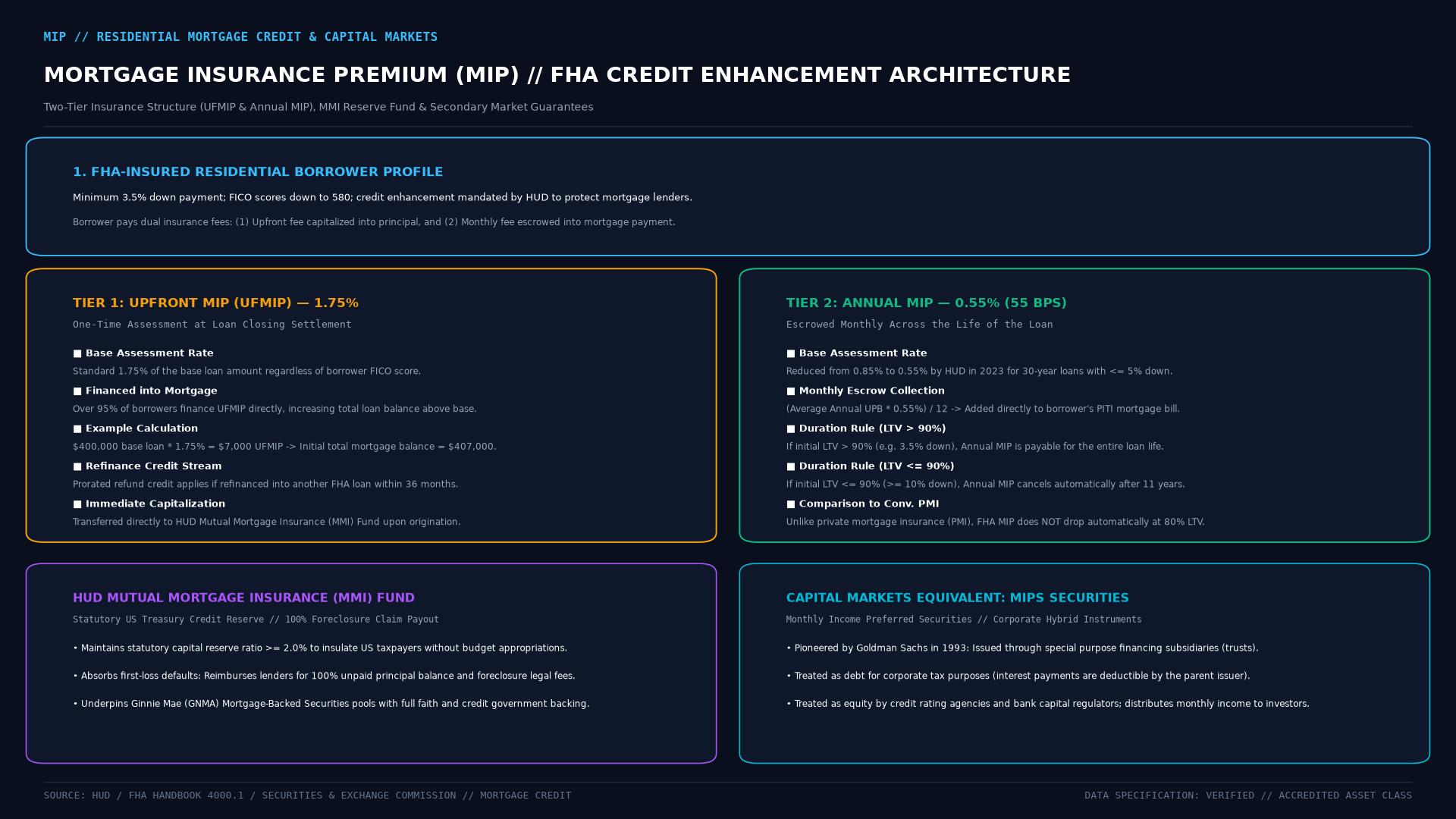 Figure: The FHA Mortgage Insurance Premium (MIP) architecture, delineating the two-tier fee structure (1.75% Upfront UFMIP and 0.55% Annual MIP), the HUD Mutual Mortgage Insurance (MMI) Fund capital reserve ratio, and secondary market liquidity via Ginnie Mae MBS pools.
The Primary Definition: FHA Mortgage Insurance Premium
The Federal Housing Administration was created by the US Congress under the National Housing Act of 1934 during the Great Depression. At that time, residential mortgage lending was paralyzed: private commercial banks demanded 50% cash down payments and short 5-year balloon loans, locking millions of working-class families out of the housing market.
The FHA transformed American homeownership by guaranteeing residential mortgages originated by approved private banks. If a borrower defaults on an FHA-insured loan and the home enters foreclosure, the FHA reimburses the lender for 100% of the unpaid principal balance, delinquent interest, and allowable legal costs from its dedicated reserve fund: the Mutual Mortgage Insurance (MMI) Fund.
To self-finance this insurance coverage without relying on federal taxpayer appropriations, HUD mandates that all FHA borrowers pay Mortgage Insurance Premiums (MIP).
The Two-Tier Architecture of FHA MIP
FHA mortgage insurance is structured into two mandatory components:
- Upfront Mortgage Insurance Premium (UFMIP): A one-time surcharge assessed at closing, historically set at 1.75% of the base loan amount. While borrowers can pay this fee in cash at closing, over 95% of FHA borrowers elect to finance the UFMIP directly into the mortgage balance, increasing the total loan amount above the initial purchase price.
- Annual Mortgage Insurance Premium (Annual MIP): An ongoing annual fee calculated as a percentage of the remaining unpaid principal balance (UPB), divided into twelve equal installments and added to the borrower’s monthly mortgage payment. In March 2023, HUD implemented a 30-basis-point reduction, reducing the standard annual MIP for most new 30-year home purchase loans with 3.5% down from 0.85% to 0.55%.
       MIP DUAL PAYMENT STRUCTURE BREAKDOWN

+---------------------------------------------------------------+
| Purchase Price: $400,000 | Down Payment (3.5%): $14,000       |
| Base Loan Amount: $386,000                                    |
+---------------------------------------------------------------+
                               |
                               v
+---------------------------------------------------------------+
| Tier 1: Upfront MIP (UFMIP)                                   |
| Calculation: $386,000 * 1.75% = $6,755                        |
| Financed Loan Balance: $386,000 + $6,755 = $392,755           |
+---------------------------------------------------------------+
                               |
                               v
+---------------------------------------------------------------+
| Tier 2: Annual MIP (First Year Estimate @ 0.55%)              |
| Calculation: ($386,000 * 0.55%) / 12 = $176.92 per month      |
| Recalculated annually based on declining amortization balance |
+---------------------------------------------------------------+
Mathematical Mechanics: Calculating UFMIP and Annual MIP
Calculating the lifetime financial cost of MIP requires separate mathematical formulations for the upfront capitalized charge and the monthly amortized expense:
1. Upfront MIP (UFMIP) Formulation
$$\text{UFMIP} = \text{Base Loan Amount} \times 0.0175$$
$$\text{Total Initial Financed Balance} = \text{Base Loan Amount} + \text{UFMIP}$$
For a $300,000 base loan:
$$\text{UFMIP} = 300,000 \times 0.0175 = $5,250$$
$$\text{Total Financed Principal} = 300,000 + 5,250 = $305,250$$
2. Monthly Amortized Annual MIP Formulation
Unlike conventional private mortgage insurance, which applies a static percentage to the original purchase price throughout its duration, FHA Annual MIP is calculated based on the projected average annual unpaid balance ($UPB$) for the upcoming twelve-month period:
$$\text{Monthly MIP Payment} = \frac{\overline{\text{UPB}}{\text{annual}} \times r{\text{MIP}}}{12}$$
Where:
- $\overline{\text{UPB}}_{\text{annual}}$ is the projected average outstanding principal balance for the specific loan year derived from the amortization schedule.
- $r_{\text{MIP}}$ is the applicable statutory Annual MIP rate (typically 0.55% for LTV > 95% on 30-year loans).
Because the principal balance declines each year through monthly amortization payments, the monthly dollar charge for Annual MIP decreases slightly with each annual loan anniversary.
       ANNUAL MIP RATE SCHEDULE (30-YEAR BASE TERM)

Loan-to-Value (LTV) Ratio    Base Loan <= $726,200    Base Loan > $726,200
----------------------------------------------------------------------------------
LTV > 95%                    0.55% (55 bps)           0.75% (75 bps)
LTV <= 95%                   0.50% (50 bps)           0.70% (70 bps)
Cancellation Rules: The Life-of-Loan Mandate
A primary source of financial confusion for retail homebuyers is the difference in cancellation rules between FHA MIP and conventional Private Mortgage Insurance (PMI):
1. Conventional PMI Cancellation (Homeowners Protection Act of 1998)
Under the federal Homeowners Protection Act (HPA), private mortgage insurance on conventional conforming mortgages (backed by Fannie Mae or Freddie Mac) must be automatically terminated once the loan balance reaches 78% of the original purchase value, or can be removed by borrower request at 80% LTV.
2. The FHA Life-of-Loan Mandate (Post-June 2013 Rules)
For all FHA case numbers assigned on or after June 3, 2013, HUD enacted strict cancellation guidelines:
- Down Payment Less Than 10% ($LTV > 90%$ at Origination): The Annual Mortgage Insurance Premium cannot be canceled. It remains in effect for the entire 30-year life of the mortgage, regardless of how much the home appreciates in market value or how much principal the borrower repays. The only way to eliminate Annual MIP is to pay off the mortgage in full or refinance out of the FHA loan into a conventional mortgage.
- Down Payment 10% or Greater ($LTV \le 90%$ at Origination): Annual MIP is mandated for a fixed period of 11 years, after which it automatically expires.
       FHA ANNUAL MIP DURATION MATRIX

+------------------------------+---------------------------------------+
| Initial Loan-to-Value (LTV)  | Annual MIP Required Duration          |
+------------------------------+---------------------------------------+
| LTV > 90% (Down Payment <10%)| Life of the Loan (Full 30-Year Term)  |
| LTV <= 90% (Down Payment >=10%)| 11 Calendar Years                   |
+------------------------------+---------------------------------------+
Comparison: FHA MIP vs Conventional PMI vs VA and USDA
The residential mortgage market features distinct mortgage credit insurance mechanisms:
| Feature | FHA MIP | Conventional PMI | VA Funding Fee | USDA Guarantee Fee |
|---|---|---|---|---|
| Upfront Fee | 1.75% (Financed) | Zero standard | 1.25% - 3.30% | 1.00% (Financed) |
| Annual Monthly Fee | 0.55% (Avg) | 0.30% - 1.50% | Zero (No Monthly Fee) | 0.35% |
| Removal Trigger | Never (if <10% down) | 78% - 80% LTV (HPA) | N/A | Life of the Loan |
| Min Credit Score | 580 (for 3.5% down) | Typically 620+ | No statutory floor | Typically 640+ |
| Governing Entity | HUD / FHA | Private Insurers | Dept of Veterans Affairs | US Dept of Agriculture |
Secondary Definition: Monthly Income Preferred Securities (MIPS)
In corporate finance, MIP (or MIPS) refers to Monthly Income Preferred Securities, created by Goldman Sachs in 1993 for Texaco.
MIPS were engineered as hybrid financial instruments to achieve regulatory and tax arbitrage:
- Corporate Structure: A multinational corporation established an offshore special-purpose subsidiary (often in the Cayman Islands or Delaware).
- Security Issuance: The subsidiary issued preferred shares (MIPS) paying monthly cash dividends to public retail and institutional investors.
- Inter-Company Loan: The subsidiary loaned the entire proceeds back to the parent corporation in exchange for long-term subordinated debentures.
- Tax Arbitrage: Because the parent company made interest payments on the debenture to the subsidiary, the interest expense was fully deductible against corporate income taxes under IRS rules. Meanwhile, credit rating agencies (Moody’s and S&P) treated the preferred shares as partial equity on the corporate balance sheet, improving corporate credit leverage metrics.
Congress and the IRS subsequently tightened corporate interest deduction regulations under IRC Section 163, reducing the tax advantages of legacy MIPS and prompting corporations to issue modern trust preferred securities (TruPS) and junior subordinated hybrid debt.
Real-World Case Study: FHA vs Conventional Financing Comparison
Consider an urban first-time homebuyer, Marcus Chen, evaluating financing options for a $350,000 residential townhouse in 2024. Marcus has a 660 FICO credit score and has saved $15,000 for a down payment (4.28% down, resulting in an initial LTV of 95.72%).
+--------------------------------------------------------------------+
|               FHA LOAN VS CONVENTIONAL MORTGAGE AUDIT              |
+--------------------------------------------------------------------+
| Scenario Parameters:                                               |
| - Home Purchase Price: $350,000 | Down Payment: $15,000 (4.28%)   |
| - Base Loan Amount: $335,000                                       |
| - Borrower Credit Profile: 660 FICO Score                          |
+--------------------------------------------------------------------+
| Option A: FHA 30-Year Fixed Loan                                   |
| - Upfront MIP (1.75% financed): $5,862.50                          |
| - Total Starting Balance: $340,862.50                              |
| - Note Interest Rate: 6.25%                                        |
| - Monthly Principal & Interest (P&I): $2,099.60                    |
| - Monthly Annual MIP (0.55% / 12): +$153.54                        |
| - Total Monthly Payment: $2,253.14                                 |
+--------------------------------------------------------------------+
| Option B: Conventional 30-Year Fixed Loan (HomeReady / Home Possible)|
| - Upfront Fee: $0.00                                               |
| - Total Starting Balance: $335,000.00                              |
| - Note Interest Rate (Credit Adjusted): 6.875%                     |
| - Monthly Principal & Interest (P&I): $2,200.75                    |
| - Monthly Private Mortgage Insurance (PMI @ 0.95% for 660 FICO): +$265.20
| - Total Monthly Payment: $2,465.95                                 |
+--------------------------------------------------------------------+
| Financial Decision Analysis:                                       |
| - The FHA loan saves Marcus $212.81 per month in initial cash flow |
|   due to a lower note rate and significantly cheaper monthly MIP.  |
| - However, the FHA Annual MIP remains for all 30 years.            |
| - Strategic Path: Marcus selects the FHA loan to capture lower     |
|   immediate payments, planning to refinance into a conventional    |
|   loan once domestic home equity reaches 20% to eliminate MIP.     |
+--------------------------------------------------------------------+
Frequently Asked Questions
Can an FHA borrower get a refund of their Upfront Mortgage Insurance Premium (UFMIP)?
If an FHA borrower refinances their existing FHA loan into a new FHA loan (known as an FHA Streamline Refinance) within 36 months of the initial closing date, they are entitled to a prorated refund credit of their original Upfront MIP applied against the new loan’s UFMIP. The refund percentage decreases by two percentage points per month (e.g., 80% refund in month 1, declining to 10% in month 35). Borrowers who refinance into a conventional loan or sell the home receive zero refund.
Why did HUD reduce the Annual MIP rate by 30 basis points in 2023?
In March 2023, the Biden-Harris administration and HUD lowered the annual MIP rate from 0.85% to 0.55% to improve housing affordability for low- and moderate-income borrowers confronting high mortgage interest rates. HUD concluded that the FHA Mutual Mortgage Insurance (MMI) Fund capital reserve ratio had expanded beyond 10% (well above the statutory 2.0% minimum threshold), allowing the agency to reduce premium costs without risking solvency.
How does MIP affect a borrower’s debt-to-income (DTI) ratio during loan qualification?
Annual MIP is included directly in the borrower’s total monthly housing expense payment (Principal, Interest, Taxes, and Insurance, or PITI + MIP). When lenders compute the front-end DTI ratio (housing expense divided by gross monthly income) and back-end DTI ratio (all recurring debt payments divided by gross income), the monthly MIP payment increases the required income threshold, potentially reducing the maximum loan amount a borrower can qualify for.
Ready to trade forex?
Open a free demo account with a regulated broker. Practice with virtual funds before risking real money.