MIT
MIT stands for Market-If-Touched in electronic trading, a conditional order that triggers an unconstrained market order when an asset trades at or touches a specified price floor or ceiling.
In financial markets, electronic order routing, and algorithmic trading, the acronym MIT stands primarily for Market-If-Touched. An MIT order is a conditional hybrid order type designed to capture favorable market price levels without requiring constant manual screen monitoring. It remains dormant on the broker’s server or exchange matching engine until the market price touches or trades at a predetermined trigger price. Once that threshold is reached, the order immediately converts into an unconstrained market order executed at the best prevailing bid or ask price.
In historical investment management, MIT also designates the Massachusetts Investors Trust, the landmark Boston investment vehicle that established the modern open-end mutual fund in 1924. Across electronic dealing desks, futures exchanges (such as CME Group and ICE), and modern brokerage platforms, however, MIT is utilized as a tactical order execution instrument to buy dips or sell rallies with guaranteed execution upon trigger activation.
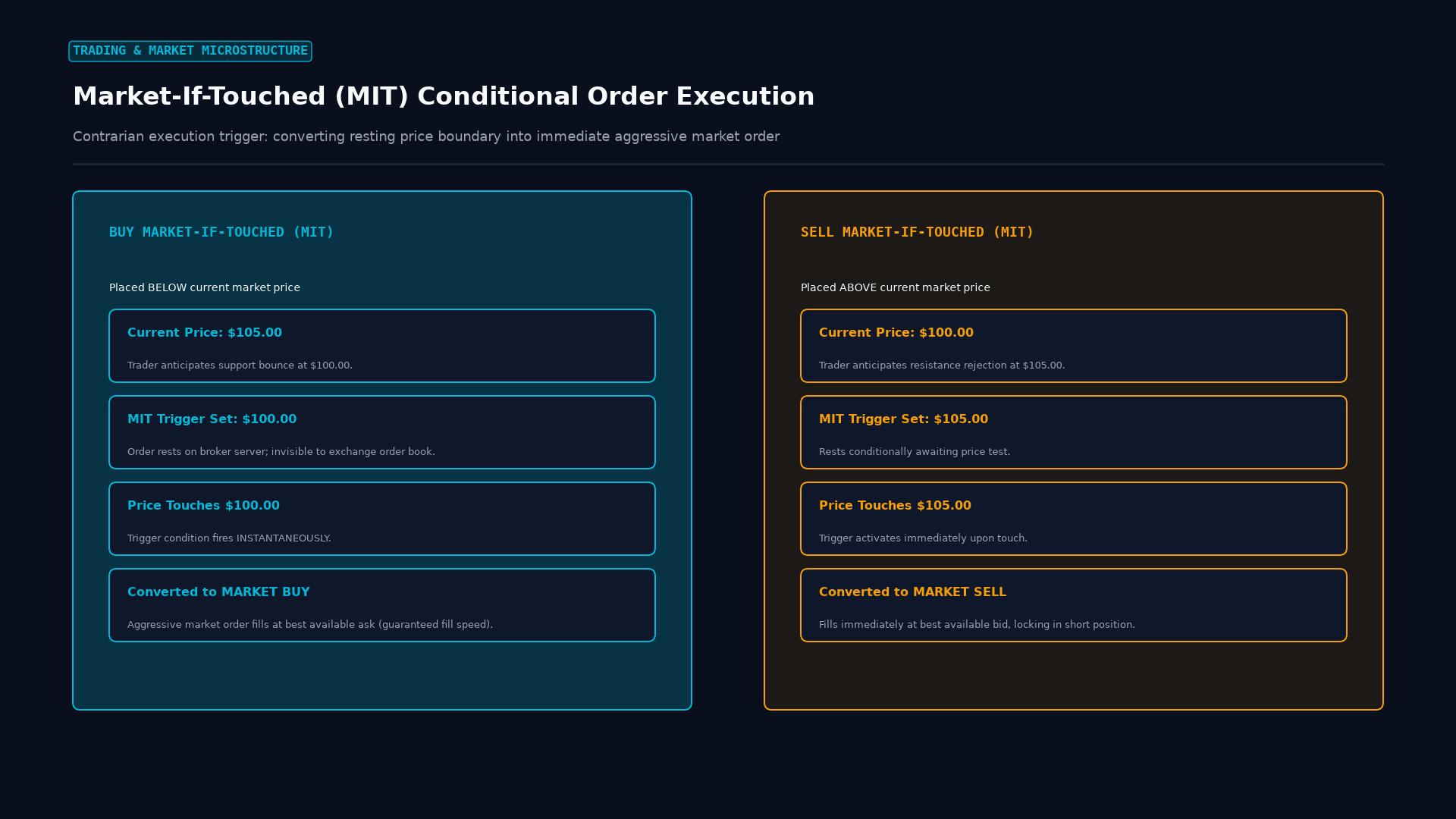 Figure: MIT order mechanics: resting inactive until the specified trigger price is touched, immediately converting into an aggressive market order.
Order Mechanics: Buy MIT vs Sell MIT
Market-If-Touched orders operate on the opposite side of the prevailing market price compared to standard Stop-Loss orders, functioning as aggressive mean-reversion instruments:
1. Buy Market-If-Touched (Buy MIT)
A Buy MIT order is placed with a trigger price below the current market price. A trader anticipates that an asset will experience a temporary price pullback to a technical support level, followed by an immediate upward rebound:
- Current Market Price: $105.00
- Buy MIT Trigger Price: $100.00
- Operational Sequence: The order sits dormant while the asset trades above $100.00. If the price drops and a transaction executes at $100.00 (or lower), the trigger activates. The order instantly converts into a Market Buy Order, buying immediately from available ask liquidity in the order book.
2. Sell Market-If-Touched (Sell MIT)
A Sell MIT order is placed with a trigger price above the current market price. A trader holding a long position uses it as a profit-taking exit, or an aggressive short seller uses it to initiate a short position at technical resistance:
- Current Market Price: $105.00
- Sell MIT Trigger Price: $110.00
- Operational Sequence: If the market rallies and a trade executes at $110.00 (or higher), the order activates immediately. It converts into a Market Sell Order, selling into the best available bids.
       ORDER TRIGGER GEOMETRY COMPARISON

Price Level
   ^
   |        [Sell MIT Trigger]  <- Profit target / Short entry (Sells on rally)
   |        [Buy Stop Trigger]  <- Breakout entry (Buys on upside surge)
   |
   |  ====> CURRENT MARKET PRICE ($100.00)
   |
   |        [Buy MIT Trigger]   <- Dip entry / Rebound buy (Buys on pullback)
   |        [Sell Stop Trigger] <- Stop-loss exit / Breakdown short (Sells on drop)
   +------------------------------------------------------------------------>
   Time
Critical Distinctions: MIT vs Limit Orders vs Stop Orders
Traders frequently confuse Market-If-Touched orders with Limit Orders and Stop Orders. The structural differences reside in the trade execution priority and fill guarantees:
1. MIT vs Limit Order
- Limit Order: Guarantees price, but does not guarantee execution. If a trader places a Buy Limit at $100.00, the order enters the public order book at $100.00. The trader will never pay more than $100.00, but if the market touches $100.00 and immediately bounces before the trader’s position in the queue is filled, the trade is missed.
- MIT Order: Guarantees execution, but does not guarantee price. When $100.00 is touched, the MIT converts into a market order. The trader is guaranteed an immediate fill, but if market liquidity is thin, the fill price may slip to $100.05 or $100.10.
2. MIT vs Stop Order
- Stop Order: Placed in the direction of market momentum. A Buy Stop is placed above the market (buying breakouts), while a Sell Stop is placed below the market (protecting downside).
- MIT Order: Placed against prevailing market momentum. A Buy MIT is placed below the market (buying pullbacks), while a Sell MIT is placed above the market (selling rallies).
       COMPARISON MATRIX: CONDITIONAL ORDER TYPES

Order Type      Placement Relative to Market    Trigger Conversion   Execution Guarantee
----------------------------------------------------------------------------------
Buy MIT         Below Market Price              Market Buy Order     Guaranteed (Slippage possible)
Sell MIT        Above Market Price              Market Sell Order    Guaranteed (Slippage possible)
Buy Limit       Below Market Price              Remains Limit Order  No (Price guaranteed)
Sell Limit      Above Market Price              Remains Limit Order  No (Price guaranteed)
Buy Stop        Above Market Price              Market Buy Order     Guaranteed (Slippage possible)
Sell Stop       Below Market Price              Market Sell Order    Guaranteed (Slippage possible)
Algorithmic Architecture and Order Book Microstructure
In high-frequency and electronic derivatives trading, the physical location of the MIT trigger logic is critical:
1. Server-Side Synthetic Execution vs Native Exchange Orders
Certain derivatives exchanges (such as the Chicago Mercantile Exchange, CME) historically supported native MIT order types directly inside the matching engine. However, to reduce order book memory overhead, modern exchanges frequently require brokers to maintain MIT orders as Server-Side Synthetic Orders:
- The retail or institutional broker’s server monitors the market data feed (e.g., NASDAQ TotalView or CME MDP 3.0).
- The order remains completely hidden from the public limit order book, preventing predatory high-frequency algorithms from detecting the trader’s price target.
- When the broker’s server confirms a qualifying trade execution at the trigger price, it injects a standard FIX protocol
NewOrderSinglemessage withOrdType=1(Market Order) into the exchange gateway.
2. The Slippage Equation in Fast Markets
Because an MIT converts into an unconstrained market order, the realized execution price ($P_{\text{fill}}$) can diverge from the trigger price ($P_{\text{trigger}}$) during high-volatility events:
$$\text{Slippage} = P_{\text{fill}} - P_{\text{trigger}}$$
For a Buy MIT:
- If market depth is deep, $\text{Slippage} \approx 0$.
- In a fast-moving, cascade-driven market (e.g., following an interest rate decision), the market order sweeps multiple tiers of the limit order book, resulting in positive slippage (higher purchase price):
$$P_{\text{fill}} = \frac{\sum_{i=1}^{k} P_i \times Q_i}{\sum_{i=1}^{k} Q_i}$$
Where $P_i$ and $Q_i$ represent the ascending price and available volume across book levels $1$ to $k$.
       ORDER BOOK SWEEP ON MIT TRIGGER

Limit Order Book (Ask Side)
Price       Size (Contracts)
----------------------------
$100.08     50 contracts     <-- Level 3 Sweep
$100.04     30 contracts     <-- Level 2 Sweep
$100.01     20 contracts     <-- Level 1 Sweep
----------------------------
Trigger Touched at $100.00
Trader MIT Order for 100 Contracts Converts to Market Buy
Average Realized Fill: (20*100.01 + 30*100.04 + 50*100.08) / 100 = $100.054
Realized Slippage: +$0.054 per contract
Real-World Case Study: E-Mini S&P 500 Futures Mean Reversion
To observe the operational utility of an MIT order, consider a quantitative futures trader, Elena Rostova, trading the CME E-mini S&P 500 futures contract (ES).
+--------------------------------------------------------------------+
|               ELENA ROSTOVA E-MINI S&P 500 MIT TRADE               |
+--------------------------------------------------------------------+
| 1. Market Context: S&P 500 futures trade at 5,025.00 in a defined  |
|    intraday trading channel with solid technical support at 5,000. |
| 2. Order Structuring: Elena wants to enter long at support, but    |
|    knows fast algorithmic algorithms often bounce off 5,000.00 in  |
|    under 200 milliseconds, risking non-fill on a Limit Order.      |
| 3. Execution Vehicle: Submits Buy MIT order for 10 ES contracts    |
|    with Trigger Price = 5,000.00.                                  |
| 4. Market Action: Institutional selling pushes ES down:            |
|    5,008.00 -> 5,004.00 -> 5,000.00.                              |
| 5. Trigger Activation: A single trade executes at 5,000.00.        |
| 6. Execution: The CME gateway instantly converts Elena's order     |
|    into a Market Buy Order.                                        |
| 7. Fill Realization: The order sweeps 6 contracts at 5,000.25 and  |
|    4 contracts at 5,000.50, generating an average fill at 5,000.35.|
| 8. Rebound: Within 90 seconds, the market bounces to 5,012.00.     |
+--------------------------------------------------------------------+
Had Elena submitted a standard Limit Order at 5,000.00, she would have joined the back of a queue containing 4,000 contracts; because only 800 contracts traded at 5,000.00 before the market rebounded, her Limit Order would have expired unfilled. The MIT order accepted minor slippage (0.35 index points) to guarantee execution, capturing an 11-point profit.
Frequently Asked Questions
Can a Market-If-Touched order be placed as a Limit order instead of a Market order?
Yes. Professional trading platforms offer an advanced derivative of the MIT order known as a Limit-If-Touched (LIT) order. When the trigger price is touched, an LIT order converts into a Limit Order with a specified price ceiling or floor rather than a Market Order. While an LIT eliminates execution slippage, it sacrifices the fill guarantee if the market moves away from the limit price before the order can be filled.
What happens to an MIT order if a stock gaps over the trigger price overnight?
If an equity or futures contract gaps past an MIT trigger price during the pre-market or market open (e.g., closing at $105, opening at $98 on earnings news, bypassing a $100 Buy MIT trigger), the trigger condition is satisfied immediately on the opening print. The order converts into a Market Order and executes at the prevailing open price (e.g., $98 or lower), meaning the trader may purchase the asset at a price significantly different from the original trigger.
Where is an MIT order held before it is triggered?
In modern electronic brokerage architectures, MIT orders are held on the brokerage firm’s centralized Risk Management System (RMS) or dedicated order routing servers. Because the order has not yet converted into a live market order, it is not displayed in the public exchange Level 2 market depth or consolidated order book. This keeps the trader’s price intentions concealed from other market participants until execution occurs.
Ready to trade forex?
Open a free demo account with a regulated broker. Practice with virtual funds before risking real money.