MITS
MITS stands primarily for Market-If-Touched Sell in electronic trading, a conditional order placed above the current market price that converts into an unconstrained market sell order once triggered.
In financial markets, electronic order execution, and derivatives trading, the acronym MITS stands primarily for Market-If-Touched Sell. It is a specialized, conditional sell-side order type placed at a price level higher than the prevailing market price. The order remains hidden and inactive on the broker’s server or exchange gateway until the asset touches or trades at the specified trigger price. Once triggered, the MITS converts into an unconstrained market sell order, selling into the best available bids on the central limit order book.
In exchange technology and regulatory compliance, MITS also designates a Market Information Tracking System, an automated audit-trail engine deployed by regulatory bodies (such as the SEC, FINRA, and CFTC) to detect cross-market manipulation, spoofing, and insider trading. Within active trading terminals and electronic broker order management systems, however, MITS is deployed as an automated order to lock in profits or initiate short positions during upward price surges.
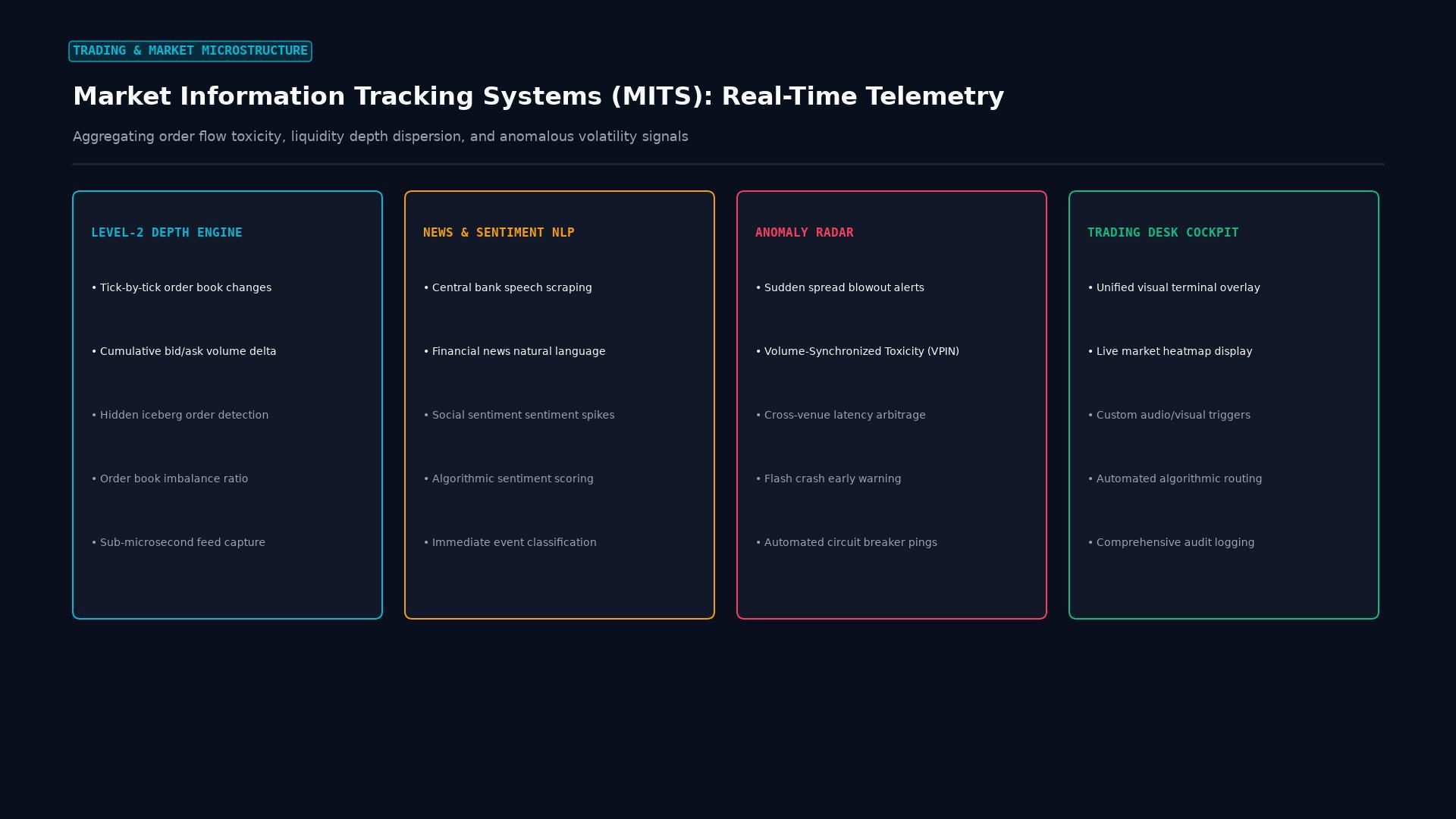 Figure: MITS order workflow: resting above the market to automatically sell at market upon an upside test of institutional resistance.
Core Mechanics and Trading Applications
The Market-If-Touched Sell order is designed to solve a fundamental problem in active trading: capturing profit targets or executing short sales at technical resistance levels without risking non-execution:
1. The Profit-Taking Liquidation Mandate
A trader holding a long position in a stock or commodity futures contract establishes a price target at a known technical resistance level. If the trader utilizes a standard Sell Limit Order, the order enters the public order book at the designated price, waiting in line behind other limit orders:
- If market buying volume at that price level is insufficient to clear the entire queue, the price may touch the limit price and reverse downward without filling the trader’s order.
- By utilizing a MITS Order, the moment a single trade occurs at the target price, the order transforms into a market order, instantly selling into available bids and guaranteeing that the trader exits the long position.
2. Aggressive Short-Sale Entry
Traders deploying mean-reversion strategies use MITS orders to initiate short positions into rapid buying surges or short squeezes:
- As the market spikes into overhead liquidity pools, the MITS order activates immediately.
- The trader secures short execution at the top of the price impulse without needing to wait for a bearish candlestick reversal or manual order entry.
       MITS TRIGGER GEOMETRY VS ALTERNATIVE SELL ORDERS

Price Level
   ^
   |        [MITS Trigger: $110.00]  <- Sells into rally (Guarantees execution)
   |        [Sell Limit:   $110.00]  <- Sells into rally (Guarantees price, not fill)
   |
   |  ====> CURRENT MARKET PRICE ($102.00)
   |
   |        [Sell Stop:    $95.00]   <- Sells on breakdown (Downside protection)
   +------------------------------------------------------------------------>
   Time
Comparative Analysis: MITS vs Sell Limit vs Sell Stop
Traders must understand the distinct operational properties of MITS relative to other sell orders:
1. MITS vs Sell Limit
- Sell Limit: The order is posted publicly on the ask side of the limit order book. It guarantees that the seller will receive at least the specified price (or better). However, it does not guarantee execution; if buying momentum stalls before the order’s turn in the queue, the order remains unfilled.
- MITS: The order is held privately on a server until the price is touched. It guarantees immediate execution, but does not guarantee the exact price; in a fast-moving market, the fill price may experience slippage below the trigger price.
2. MITS vs Sell Stop
- Sell Stop: Placed below the current market price. It is used as a stop-loss to limit downside losses or as a momentum breakdown entry.
- MITS: Placed above the current market price. It is used to sell into upward price momentum, operating as a profit target or resistance short entry.
       COMPARISON OF SELL ORDER SPECIFICATIONS

Order Type      Price Placement      Conversion Trigger   Primary Risk
----------------------------------------------------------------------------------
MITS            Above Market Price   Market Sell Order    Execution Slippage
Sell Limit      Above Market Price   Remains Limit Order  Non-Execution (Left Behind)
Sell Stop       Below Market Price   Market Sell Order    Execution Slippage on Drop
Sell Stop Limit Below Market Price   Limit Sell Order     Unfilled in Fast Crash
Execution Dynamics and Bid-Side Order Book Sweeps
When a MITS order is triggered, it sweeps across the bid side of the Central Limit Order Book (CLOB). The realized average execution price ($P_{\text{fill}}$) is determined by the volume-weighted average price of the bids consumed:
$$P_{\text{fill}} = \frac{\sum_{i=1}^{k} P_{\text{bid},i} \times Q_{\text{bid},i}}{\sum_{i=1}^{k} Q_{\text{bid},i}}$$
Where:
- $P_{\text{bid},i}$ represents the price of bid level $i$.
- $Q_{\text{bid},i}$ represents the quantity of shares or contracts available at bid level $i$.
The realized slippage on a MITS order is defined as:
$$\text{Slippage} = P_{\text{trigger}} - P_{\text{fill}}$$
If the bid depth is deep and resilient, slippage is minimal. However, if a sudden liquidity vacuum occurs (such as during high-frequency quote cancellations), the MITS market sell order sweeps through multiple bid tiers, filling below the trigger price.
       MITS BID LIQUIDITY SWEEP

Central Limit Order Book (Bid Side)
Bid Price   Available Size
--------------------------
$109.98     40 contracts   <-- Filled first
$109.95     35 contracts   <-- Filled second
$109.90     25 contracts   <-- Filled third
--------------------------
Total Consumed = 100 contracts
MITS Trigger Price: $110.00 | Total Size: 100 contracts
Volume-Weighted Execution Price:
[(40 * 109.98) + (35 * 109.95) + (25 * 109.90)] / 100 = $109.9495
Realized Slippage: $110.00 - $109.95 = -$0.05 per contract
Secondary Domain: Market Information Tracking Systems (MITS) in Regulation
In capital markets surveillance and regulatory infrastructure, MITS denotes a Market Information Tracking System.
Securities and derivatives regulators (including the US Commodity Futures Trading Commission - CFTC, the Securities and Exchange Commission - SEC, and the European Securities and Markets Authority - ESMA) deploy MITS platforms to maintain transparent cross-market oversight:
- Consolidated Audit Trail (CAT): Ingests billions of daily order lifecycle events (quotes, order submissions, modifications, cancellations, and executions) across lit exchanges and dark pools.
- Spoofing and Layering Detection: Under the Dodd-Frank Act (7 U.S.C. § 6c(a)(5)), high-frequency algorithms that submit non-bona-fide limit orders to create a false impression of market depth and cancel them before execution are flagged by MITS pattern-recognition algorithms.
- Insider Trading and Front-Running Surveillance: MITS scans cross-asset transaction timings, identifying suspicious out-of-the-money options purchases executed immediately prior to public corporate merger announcements.
               REGULATORY MITS SURVEILLANCE PIPELINE

+--------------------------------------------------------------+
| Multi-Exchange Data Feeds (Equities, Futures, Options, OTC) |
+--------------------------------------------------------------+
                               |
                               v Real-Time Feed Ingestion
+--------------------------------------------------------------+
| Market Information Tracking System (MITS Analytics Engine)  |
| - Reconstructs Full Order Book State Microseconds by Microsec|
| - Machine Learning Pattern Matching for Manipulative Tactics |
+--------------------------------------------------------------+
                               |
      +------------------------+------------------------+
      |                        |                        |
      v Spoofing Detection     v Wash-Sale Flagging     v Insider Flow Alerts
+--------------------+   +--------------------+   +--------------------+
| Algorithmic quote  |   | Cross-account self |   | Pre-M&A abnormal   |
| stuffing & cancels |   | matching trades    |   | option volume surge|
+--------------------+   +--------------------+   +--------------------+
Real-World Case Study: FX Macro Trader Executing MITS on EUR/USD
Consider an institutional foreign exchange trader, Marcus Lind, managing a macro currency book during a European Central Bank (ECB) rate decision.
+--------------------------------------------------------------------+
|                 MARCUS LIND EUR/USD MITS TRADE                     |
+--------------------------------------------------------------------+
| 1. Market Environment: EUR/USD trades at 1.0940 in quiet morning   |
|    dealing. Technical resistance sits at the psychological 1.1000  |
|    parity barrier, heavily defended by institutional option bks.   |
| 2. Strategy: Marcus believes the ECB rate hike is already priced   |
|    in. If the euro rallies into 1.1000 on the initial headline,    |
|    he anticipates aggressive institutional selling and a reversal. |
| 3. Execution Setup: Marcus submits a MITS Order for $20,000,000    |
|    EUR/USD with Trigger Price = 1.1000.                            |
| 4. News Catalyst: Headline rate hike released; algorithmic traders |
|    buy EUR/USD, driving spot prices up: 1.0970 -> 1.0995 -> 1.1000 |
| 5. Trigger Activation: Interbank matching engine prints 1.1000.    |
|    The MITS converts immediately into a Market Sell Order for $20M.|
| 6. Execution: Fills across three interbank liquidity providers:    |
|    - $10M filled at 1.1000                                         |
|    - $6M filled at 1.0999                                          |
|    - $4M filled at 1.0998                                          |
|    - Average Fill: 1.09993 (0.7 pips slippage; highly acceptable). |
| 7. Reversal: As anticipated, option barrier defense triggers heavy |
|    selling; EUR/USD drops to 1.0920 over the next two hours,       |
|    yielding a profit of +79.3 pips ($158,600) on the position.     |
+--------------------------------------------------------------------+
Had Marcus submitted a Sell Limit order at 1.1000, his order would have competed with massive institutional sell orders at the round number; the market touched 1.1000 for less than 150 milliseconds before reversing, which would have resulted in an unfilled limit order. The MITS order accepted 0.7 pips of slippage to ensure trade capture.
Frequently Asked Questions
Can a MITS order be cancelled before it is triggered?
Yes. As long as the market price has not touched or traded through the designated trigger price, the MITS order remains in a pending dormant state on the broker’s server. The trader can modify the trigger price, adjust the quantity, or cancel the order at any time with zero fee penalty.
What is the difference between a MITS order and a Limit-If-Touched Sell (LITS) order?
A MITS order converts into an unconstrained market sell order once triggered, guaranteeing execution but accepting potential slippage. A Limit-If-Touched Sell (LITS) order converts into a Sell Limit order once triggered, guaranteeing that the sale will only occur at or above the specified limit price. If buying volume evaporates immediately after the trigger, an LITS order can be left stranded unfilled.
Does a MITS order appear on Level 2 market depth screens?
No. MITS orders are server-side synthetic orders. Until the trigger price is touched, the order is held on the broker’s internal risk management server and is not broadcast to the public exchange or interbank network. Other market participants and automated trading algorithms cannot see the order on Level 2 depth feeds.
Ready to trade forex?
Open a free demo account with a regulated broker. Practice with virtual funds before risking real money.