MIV
MIV stands primarily for Microfinance Investment Vehicle in impact finance, an investment fund pooling capital for microfinance institutions in developing nations. In derivatives trading, it denotes Market Implied Volatility.
In international development finance, impact investing, and asset management, the acronym MIV stands primarily for Microfinance Investment Vehicle. An MIV is a specialized collective investment fund or structured debt entity that mobilizes capital from institutional investors, development finance institutions (DFIs), sovereign wealth funds, and private wealth endowments, channeling these resources to Microfinance Institutions (MFIs) operating in emerging and frontier economies.
In quantitative financial engineering and options trading, MIV also designates Market Implied Volatility, the annualized standard deviation of asset returns derived by inverting observable options prices through pricing models such as the Black-Scholes-Merton framework. Within global asset allocation and development banking, however, an MIV is recognized as a blended finance vehicle that bridges institutional capital markets with unbanked entrepreneurs across the Global South.
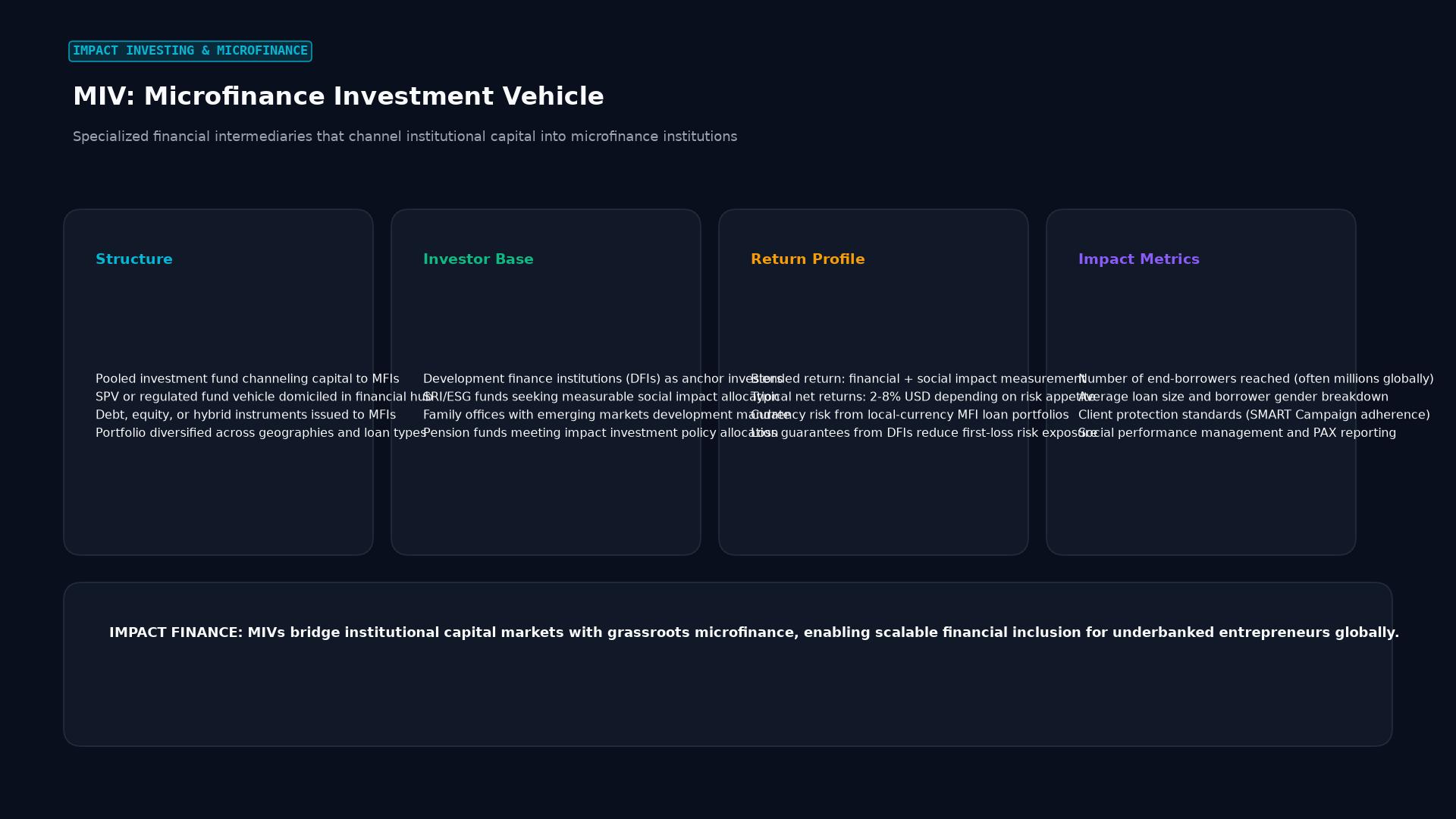 Figure: Specialized financial intermediaries that channel institutional capital into microfinance institutions
Primary Domain: Microfinance Investment Vehicles (MIVs)
Microfinance originated as a donor-funded, philanthropic movement pioneered by Muhammad Yunus and the Grameen Bank in Bangladesh during the 1970s. However, as demand for small-scale microcredit expanded across Latin America, Sub-Saharan Africa, and Southeast Asia, philanthropic grants proved insufficient to meet the credit needs of hundreds of millions of unbanked micro-entrepreneurs.
This capital constraint led to the creation of the first commercial Microfinance Investment Vehicles in the late 1990s and early 2000s (such as responsAbility, BlueOrchard, Symbiotics, and Incofin). Today, MIVs manage over $18 billion in aggregate assets under management (AUM), serving as an established asset class in institutional alternative portfolios.
1. Legal and Domicile Structuring
The majority of MIVs are domiciled in specialized European fund jurisdictions:
- Luxembourg: Domiciles over 60% of global MIV assets, utilizing structures such as the Société d’Investissement à Capital Variable (SICAV), the Specialised Investment Fund (SIF), and the Reserved Alternative Investment Fund (RAIF).
- The Netherlands: Utilizes the Fonds voor Gemene Rekening (FGR) or corporate cooperative foundations.
- Switzerland: Domiciles specialized asset managers regulated by the Swiss Financial Market Supervisory Authority (FINMA).
2. Capital Allocation: Debt vs Equity Strategies
MIVs deploy capital through distinct investment instruments:
- Fixed-Income Debt (80% to 85% of Assets): Senior loans and subordinated debt extended to qualifying MFIs. Loan tenors typically range from one to five years, featuring quarterly or semi-annual interest coupon distributions.
- Direct Equity (10% to 15% of Assets): Minority equity stakes acquired in high-growth, transforming commercial microfinance banks, providing strategic board governance and long-term capital appreciation.
- Guarantees and Letters of Credit: Credit enhancement facilities issued to local commercial banks, encouraging them to lend local currency directly to domestic MFIs.
       MIV ASSET ALLOCATION BREAKDOWN

Instrument Type         Portfolio Weight     Typical Tenor    Risk Profile
----------------------------------------------------------------------------------
Senior Debt             70% - 75%            1 - 3 Years      Low (First Priority)
Subordinated Debt       10% - 15%            3 - 5 Years      Medium (Mezzanine)
Direct Equity           10% - 15%            5 - 10 Years     High (Residual Return)
Credit Guarantees       5%                   1 - 3 Years      Contingent Liability
The Currency Mismatch Dilemma and TCX Hedging
The primary financial risk confronting an MIV is foreign exchange (FX) volatility. Institutional investors fund MIVs in “hard currencies” (US dollars, euros, or Swiss francs). However, end-borrowers in emerging economies earn income and repay micro-loans exclusively in volatile local currencies (such as Kenyan shillings, Peruvian soles, or Indian rupees).
If an MIV lends to an MFI in US dollars, the MFI must bear the currency risk. A sharp local currency devaluation increases the MFI’s local-currency debt burden, triggering institutional insolvency.
To solve this dilemma, MIVs partner with specialized currency hedging institutions, primarily The Currency Exchange Fund (TCX):
- TCX is a specialized multilateral hedging vehicle created in 2007 by global development banks.
- TCX acts as a market maker for long-tenor cross-currency swaps and non-deliverable forwards (NDFs) in over one hundred frontier currencies where commercial investment banks refuse to provide liquidity.
- The MIV lends to the MFI in local currency, simultaneously executing a cross-currency swap with TCX to convert local cash flows back into fixed US dollars or euros, completely neutralizing exchange rate risk.
               TCX CURRENCY HEDGING MECHANISM

       +-------------------------------------------------+
       | Microfinance Investment Vehicle (MIV)           |
       | Holds Capital in US Dollars ($10,000,000 USD)   |
       +-------------------------------------------------+
                               |
            +------------------+------------------+
            |                                     |
            v USD Principal                       v Local Currency Loan
+-----------------------+             +-----------------------+
| The Currency Exchange |             | Local Microfinance    |
| Fund (TCX Hedge)      |             | Institution (MFI)     |
| Converts USD to Local |             | Receives 1.3 Billion  |
| Currency Swap Fixed   |             | Kenyan Shillings (KES)|
+-----------------------+             +-----------------------+
            ^                                     |
            | KES Swap Flows                      v Microcredit Repayments
            +-------------------------------------+
       Zero FX Risk Borne by Local Low-Income Entrepreneurs
Blended Finance Architecture: Risk Tranching
To attract conservative institutional investors (such as public pension funds and insurance companies), MIVs deploy Blended Finance capital structures. The fund capital is divided into three distinct risk tiers:
- Junior / First-Loss Equity Tranche (Catastrophic Buffer): Subscribed by philanthropic foundations and bilateral development agencies (e.g., USAID, KfW). This tranche agrees to absorb the first 10% to 15% of any portfolio loan defaults, earning zero or sub-market returns.
- Mezzanine Tranche: Subscribed by multilateral development finance institutions (e.g., IFC, EBRD), absorbing secondary losses while capturing a moderate blended yield.
- Senior Commercial Debt Tranche: Subscribed by commercial institutional pension funds. Because the junior and mezzanine tranches absorb initial credit impairments, the senior tranche achieves an investment-grade risk rating, unlocking low-cost private institutional capital at scale.
Secondary Domain: Market Implied Volatility (MIV) in Derivatives
In options trading and quantitative volatility arbitrage, MIV stands for Market Implied Volatility. It represents the market’s forward-looking expectation of the annualized volatility of the underlying asset over the lifespan of an options contract.
1. Inverting the Black-Scholes-Merton Equation
Unlike historical realized volatility, which is calculated directly from past price movements, implied volatility is not directly observable. It must be solved numerically by equating the Black-Scholes-Merton (BSM) theoretical formula to the observed market price of the option ($C_{\text{market}}$):
$$C_{\text{market}} = S_0 N(d_1) - K e^{-r T} N(d_2)$$
Where:
- $d_1 = \frac{\ln(S_0 / K) + (r + \frac{\sigma^2}{2}) T}{\sigma \sqrt{T}}$
- $d_2 = d_1 - \sigma \sqrt{T}$
Because the pricing function cannot be inverted analytically for $\sigma$, quantitative pricing engines use iterative numerical algorithms, such as the Newton-Raphson Method, to extract the Market Implied Volatility:
$$\sigma_{n+1} = \sigma_n - \frac{C_{\text{BSM}}(\sigma_n) - C_{\text{market}}}{\nu_{\text{BSM}}(\sigma_n)}$$
Where $\nu_{\text{BSM}} = \frac{\partial C}{\partial \sigma} = S_0 \sqrt{T} N’(d_1)$ represents the option’s Vega (the first derivative of option price with respect to volatility).
       NEWTON-RAPHSON NUMERICAL EXTRACTION OF MIV

Option Price ($)
   ^
   |                     * Theoretical BSM Price Curve
   |                    /
C_mkt|.................X................... Market Quoted Option Price
   |                 / |
   |                /  |
   |               /   |
   |              /    |
   +-------------+-----+--------------------------------------->
   0            s_0   MIV (Implied Volatility %)
Real-World Case Study: Global Impact Debt MIV Deployment
Consider a Luxembourg-domiciled debt MIV, the Global Inclusion Credit Fund (GICF), managing $250,000,000 in assets. The fund evaluates a $10,000,000, 3-year senior debt facility to Banco Solidario, an MFI operating in Latin America.
+--------------------------------------------------------------------+
|               GICF MICROFINANCE LOAN STRUCTURING                   |
+--------------------------------------------------------------------+
| 1. Borrower Profile: Banco Solidario serves 120,000 micro-clients |
|    (average loan size: $1,200; 65% rural female business owners).  |
| 2. Capital Need: $10,000,000 equivalent in local currency (PEN).   |
| 3. FX Risk Mitigation: Direct USD lending would expose the MFI     |
|    to severe balance sheet currency mismatch.                      |
| 4. Hedging Structure: GICF contracts a 3-year cross-currency swap |
|    with TCX. GICF disburses 37,500,000 Peruvian Soles (PEN) at an  |
|    effective local interest rate of 11.50%.                        |
| 5. Blended Return Mechanics:                                       |
|    - TCX receives local PEN coupon payments; remits 6.25% fixed    |
|      USD payments back to GICF.                                    |
|    - GICF pays 4.25% to its Senior Institutional Noteholders.      |
|    - GICF retains 2.00% gross margin to cover fund operating costs |
|      and credit loss reserves.                                     |
| 6. Social Performance Audit: The MFI demonstrates a 98.6% on-time  |
|    repayment rate and satisfies SPTF Client Protection standards,  |
|    achieving both financial return and verified social impact.     |
+--------------------------------------------------------------------+
The MIV structure successfully delivered local-currency liquidity to rural entrepreneurs, provided a 4.25% stable yield to European pension investors, and eliminated foreign exchange risk through development finance hedging.
Frequently Asked Questions
What are the primary credit risks associated with investing in an MIV?
The primary credit risks include political and regulatory intervention (such as sudden sovereign interest rate caps imposed by emerging-market governments), macroeconomic shocks (inflation eroding real borrower disposable income), and severe climate disasters destroying agricultural livelihoods. MIVs mitigate these risks by diversifying portfolios across thirty to forty developing nations and conducting rigorous on-site due diligence of MFI underwriting standards.
How do MIVs measure social and environmental impact?
MIVs utilize standardized frameworks developed by the Social Performance Task Force (SPTF) and the Global Impact Investing Network (GIIN) through IRIS+ metrics. Key audit indicators include the percentage of female borrowers reached, rural poverty outreach ratios, client loan retention rates, adherence to fair collection practices, and transparent interest rate disclosures.
Why does Market Implied Volatility differ across strike prices?
Under the classical Black-Scholes-Merton model, implied volatility is assumed to be constant across all strike prices for a given expiration date. In real financial markets, however, options display a Volatility Smile or Volatility Skew: out-of-the-money put options trade at substantially higher implied volatilities than at-the-money or out-of-the-money call options. This occurs because market participants demand higher insurance premiums against sudden downward market crashes and fat-tail risk events.
Ready to trade forex?
Open a free demo account with a regulated broker. Practice with virtual funds before risking real money.