MJT
MJT stands primarily for Multi-Jurisdictional Trading in global capital markets, the regulatory and operational framework governing cross-border execution. In foreign exchange dealing, it also designates Mid-Japan Time.
The acronym MJT occupies two vital roles within international capital markets, cross-border electronic execution, and global currency trading:
- In Cross-Border Securities Execution and Regulatory Law: MJT stands for Multi-Jurisdictional Trading. It refers to the operational, technical, and regulatory architecture that governs institutional electronic trading across multiple sovereign legal jurisdictions, reconciling disparate compliance rules, trade reporting mandates, clearing systems, and cross-border currency flows.
- In Foreign Exchange Dealing and Asian Macro Trading: MJT designates Mid-Japan Time (often synonymous with Market Japanese Time, UTC+9). Interbank currency trading desks use MJT to reference the Tokyo trading session, specifically the critical 09:55 AM Tokyo Fix (Gotobi fixing) when commercial corporations and banks settle domestic corporate foreign exchange obligations.
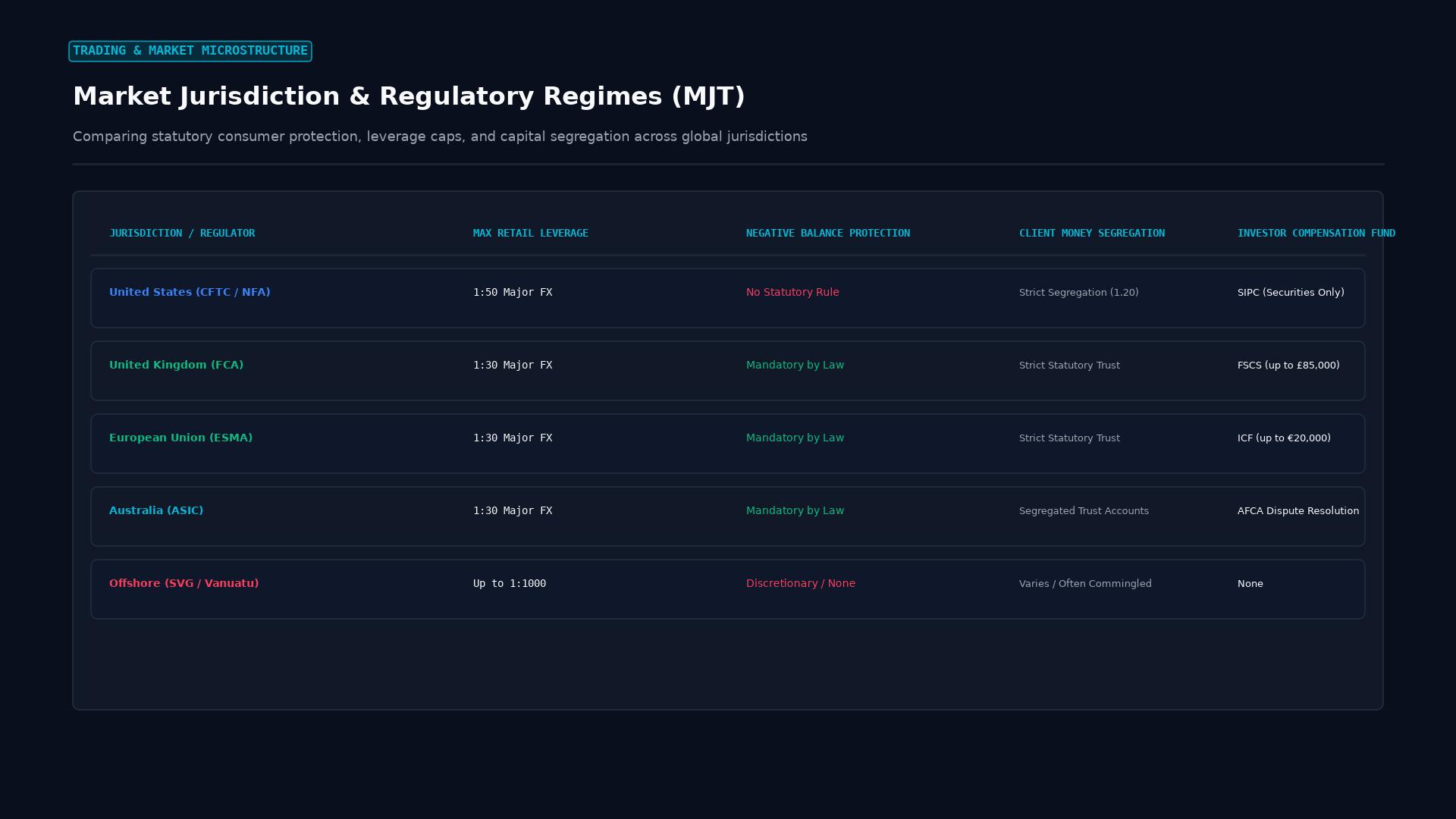 Figure: MJT execution protocol: immediate market order generation upon a single price tick contact at designated liquidity support or resistance.
Primary Domain: Multi-Jurisdictional Trading (MJT)
As capital markets transitioned from physical national exchanges to interconnected global electronic communication networks, institutional asset managers and quantitative hedge funds expanded operations across borders. A quantitative fund in New York routinely executes trades across the New York Stock Exchange, the London Stock Exchange (LSE), Euronext Paris, the Tokyo Stock Exchange (TSE), and the Hong Kong Exchanges and Clearing (HKEX) simultaneously.
Operating in a multi-jurisdictional trading environment requires market participants to manage four structural friction pillars:
1. Market Microstructure and Best Execution Rules
Execution mandates diverge sharply across sovereign borders:
- United States: Governed by SEC Regulation NMS (National Market System). Rule 611 (The Order Protection Rule) legally mandates that brokers route orders to execute against the National Best Bid and Offer (NBBO) across all registered lit exchanges.
- European Union: Governed by the Markets in Financial Instruments Directive (MiFID II). Rather than enforcing a rigid rule-based price routing mandate, MiFID II enforces a principles-based “Best Execution” standard (RTS 27 and RTS 28), requiring investment firms to take all sufficient steps to obtain the best possible result, factoring in price, execution cost, speed, settlement probability, and market impact.
2. Divergent Short-Selling Regulations
One of the most complex operational hazards in MJT is managing short positions across regulatory boundaries:
- US SEC Regulation SHO: Requires broker-dealers to obtain a validated “locate” confirming the security can be borrowed before executing a short sale, alongside automated pre-borrow lists.
- European Short Selling Regulation (EU SSR No 236/2012): Enforces a strict ban on uncovered (“naked”) sovereign and equity short sales, requiring legally enforceable borrow agreements. In parallel, it imposes mandatory public disclosures: net short positions exceeding 0.1% or 0.2% of issued share capital must be reported to the national competent authority, with public disclosure triggered at 0.5%.
       SHORT SELLING RULES: US VS EUROPEAN UNION

Regulatory Feature      US SEC Regulation SHO            European Union (EU SSR)
----------------------------------------------------------------------------------
Borrow Requirement      Reasonable "Locate" Standard     Enforceable Legal Agreement
Public Short Disclosure Only aggregate monthly data      Individual public notification
Emergency Bans          Rare (Restricted to 2008 bank run)Frequent national regulator bans
Reporting Threshold     Broker-dealer internal records   0.1% private / 0.5% public
3. Cross-Border Financial Transaction Taxes (FTT)
Trading desks executing multi-jurisdictional strategies must calculate national transaction taxes:
- French Financial Transaction Tax: Levies a 0.30% tax on the acquisition of equity securities issued by French companies with market capitalizations exceeding 1 billion euros.
- Italian Financial Transaction Tax (Tobin Tax): Assesses a 0.10% tax on electronic on-venue equity purchases and a 0.20% tax on over-the-counter transactions, alongside specialized micro-taxes on high-frequency trading modifications.
- UK Stamp Duty Reserve Tax (SDRT): Imposes a 0.50% tax on electronic stock transfers of UK-incorporated corporations.
Algorithmic Smart Order Routers (SORs) deployed in multi-jurisdictional trading must factor these statutory transaction taxes directly into their arbitrage equations; a gross cross-border price discrepancy of 25 basis points between London and Paris results in an immediate net loss once national taxes are deducted.
4. Smart Order Routing (SOR) Architecture in MJT
To trade across borders, quantitative institutions deploy multi-jurisdictional smart order routers that evaluate:
- Physical fiber-optic latency between global financial hubs (e.g., transatlantic cables between Equinix LD4 in Slough, UK, and Equinix NY4 in Secaucus, New Jersey).
- Real-time foreign exchange triangular cross-rates to convert quotes dynamically into a single base currency.
- Local exchange clearing fees and depository charges (DTC in the US, Euroclear in Europe, JASDEC in Japan).
               MULTI-JURISDICTIONAL SMART ORDER ROUTER

       +-------------------------------------------------+
       | Central Quantitative Portfolio Management Desk  |
       | Inputs Order: Arbitrage ASML NV (Dual-Listed)   |
       +-------------------------------------------------+
                               |
                               v
       +-------------------------------------------------+
       | Multi-Jurisdictional Smart Order Router (SOR)   |
       | - Ingests Euronext Amsterdam (EUR) Live Book    |
       | - Ingests NASDAQ Global Select (USD) Live Book  |
       | - Ingests Real-Time EUR/USD Interbank Spot Feed |
       +-------------------------------------------------+
                               |
            Tax, Regulatory, and Clearing Friction Check
                               v
       +-------------------------+-----------------------+
       | Market Venue A: Euronext| Market Venue B: NASDAQ|
       | Dutch Security Law      | SEC Reg NMS / Reg SHO |
       | Euroclear Settlement    | DTC Clearance         |
       +-------------------------+-----------------------+
Secondary Domain: Mid-Japan Time (MJT) in Currency Trading
In the global foreign exchange market, Mid-Japan Time represents the primary Asian dealing session. Trading desks operating in London, New York, Singapore, and Sydney align their algorithms to Mid-Japan Time (UTC+9) during the early trading day.
The 09:55 AM Tokyo Fix (Gotobi Days)
The focal point of the Mid-Japan Time trading session is the 09:55 AM Tokyo Fix. At this exact time, Japanese commercial banks establish the official reference exchange rates applied to retail, commercial, and corporate transactions for the day.
This event generates predictable order flows on specific calendar dates known as Gotobi days:
- Gotobi refers to days of the month ending in 5 or 0 (the 5th, 10th, 15th, 20th, 25th, and 30th).
- Japanese corporate accounting traditions mandate that commercial companies settle international invoices on Gotobi dates.
- Because Japan is a net importer of crude energy, natural gas, and industrial raw materials priced in US dollars, major Japanese industrial conglomerates and oil importers must buy massive quantities of US dollars from domestic banks.
- Commercial banks anticipate this client demand by purchasing USD/JPY spot contracts on the interbank market between 09:00 AM and 09:55 AM Mid-Japan Time, creating an established upward price bias on the USD/JPY pair leading into the fix.
       THE GOTOBI 09:55 AM TOKYO FIX DYNAMICS

USD/JPY
Spot Price
   ^
   |                     * 09:55 AM Fix (Commercial Banks Complete Purchases)
   |                    / \
   |                   /   \  Post-Fix Mean Reversion
   |                  /     \ (Speculators Unwind Positions)
   |  * 09:00 AM     /       \
   |    Tokyo Open  /         \
   +---------------+-----------+------------------------------------->
   08:30 AM      09:00 AM    09:55 AM (MJT)                     11:00 AM
Real-World Case Study: Dual-Listed Arbitrage Across US and European Regimes
Consider a quantitative trading fund, Meridian Capital, executing a cross-border statistical arbitrage strategy between ordinary shares of a semiconductor equipment manufacturer listed on Euronext Amsterdam and its American Depositary Shares (ADS) listed on NASDAQ.
+--------------------------------------------------------------------+
|               MERIDIAN CAPITAL CROSS-BORDER MJT TRADE              |
+--------------------------------------------------------------------+
| 1. Dual Listing: Semiconductor leader trades on Euronext Amsterdam |
|    (EUR) and NASDAQ (USD) at a 1:1 share ratio.                    |
| 2. Market Mispricing (14:30 UTC): US market opens; European trading|
|    is active (overlap window).                                     |
|    - Euronext Quote: 850.00 EUR                                    |
|    - Spot EUR/USD Exchange Rate: 1.0800                            |
|    - Implied USD Price: 850.00 * 1.0800 = $918.00                  |
|    - NASDAQ Actual Quote: $923.50                                  |
| 3. Gross Discrepancy: +$5.50 per share (+60 basis points).         |
| 4. Regulatory & Execution Compliance Engine:                       |
|    - Leg 1: Buys 20,000 shares on Euronext at 850.00 EUR.          |
|    - Leg 2: Sells short 20,000 shares on NASDAQ at $923.50.        |
|    - Reg SHO Locate: Confirmed through prime broker borrow desk.   |
|    - Dutch Financial Transaction Tax: 0.00% (exempt market maker). |
|    - Currency Hedge: Sells EUR/USD forward to lock in 1.0800 parity.|
| 5. Settlement & Conversion: Meridian instructs custodian BNY Mellon|
|    to convert European ordinary shares into NASDAQ ADSs, delivering|
|    them to close the short position.                               |
| 6. Net Profit Capture: $110,000 gross gain minus $14,000 cross-    |
|    border clearing, FX, and exchange fees = $96,000 net profit.    |
+--------------------------------------------------------------------+
Without an automated multi-jurisdictional trading system capable of instantly verifying SEC locate rules, executing cross-currency FX hedges, and calculating European clearing charges, this cross-border arbitrage opportunity could not have been captured.
Frequently Asked Questions
What are the main technical challenges in multi-jurisdictional electronic trading?
The primary technical hurdles are network latency, time-zone synchronization, and data normalization. When routing orders between London, New York, and Tokyo, physical light-speed fiber transmission delays require algorithms to forecast order book states hundreds of milliseconds into the future. In addition, trading systems must normalize disparate data protocols (e.g., FIX, ITCH/OUCH, and specialized proprietary exchange APIs) into a unified internal data format.
Why do currency traders monitor Gotobi days in Mid-Japan Time so closely?
Gotobi days represent one of the few institutional calendar anomalies in the foreign exchange market with consistent structural order flow. Because Japanese corporations must settle foreign-denominated invoices on these dates, commercial banks consistently buy US dollars against the Japanese yen between 09:00 AM and 09:55 AM Mid-Japan Time, creating quantifiable trading opportunities for algorithmic and momentum traders.
How does the US Section 871(m) rule affect multi-jurisdictional derivative trading?
Section 871(m) of the US Internal Revenue Code treats dividend equivalent payments made on equity derivatives (such as total return swaps, options, and structured notes referencing US equities) as US-source dividends. Foreign institutions trading US equity derivatives outside the United States are subject to mandatory 30% statutory withholding tax unless reduced by an applicable bilateral Double Taxation Treaty, requiring multi-jurisdictional trading desks to maintain complex tax-withholding software systems.
Ready to trade forex?
Open a free demo account with a regulated broker. Practice with virtual funds before risking real money.