MKD
MKD is the ISO 4217 currency code for the Macedonian denar, the official fiat currency of North Macedonia, managed under a de facto fixed exchange rate peg to the euro.
The acronym MKD is the official three-letter international currency code defined by the International Organization for Standardization (ISO 4217, numeric code: 807) for the Macedonian denar. The denar serves as the legal tender of the Republic of North Macedonia, issued and regulated by the National Bank of the Republic of North Macedonia (NBRNM) from its headquarters in Skopje.
In foreign exchange dealing, financial telecommunications (SWIFT), and international banking databases, MKD denotes the Macedonian currency, which operates under an established de facto fixed exchange rate peg to the euro at an anchor target of approximately 61.50 MKD per 1 EUR. In domestic commerce, the currency is represented by the Cyrillic symbol “ден” and is divided into 100 deni, although physical deni coins were retired from circulation due to inflation.
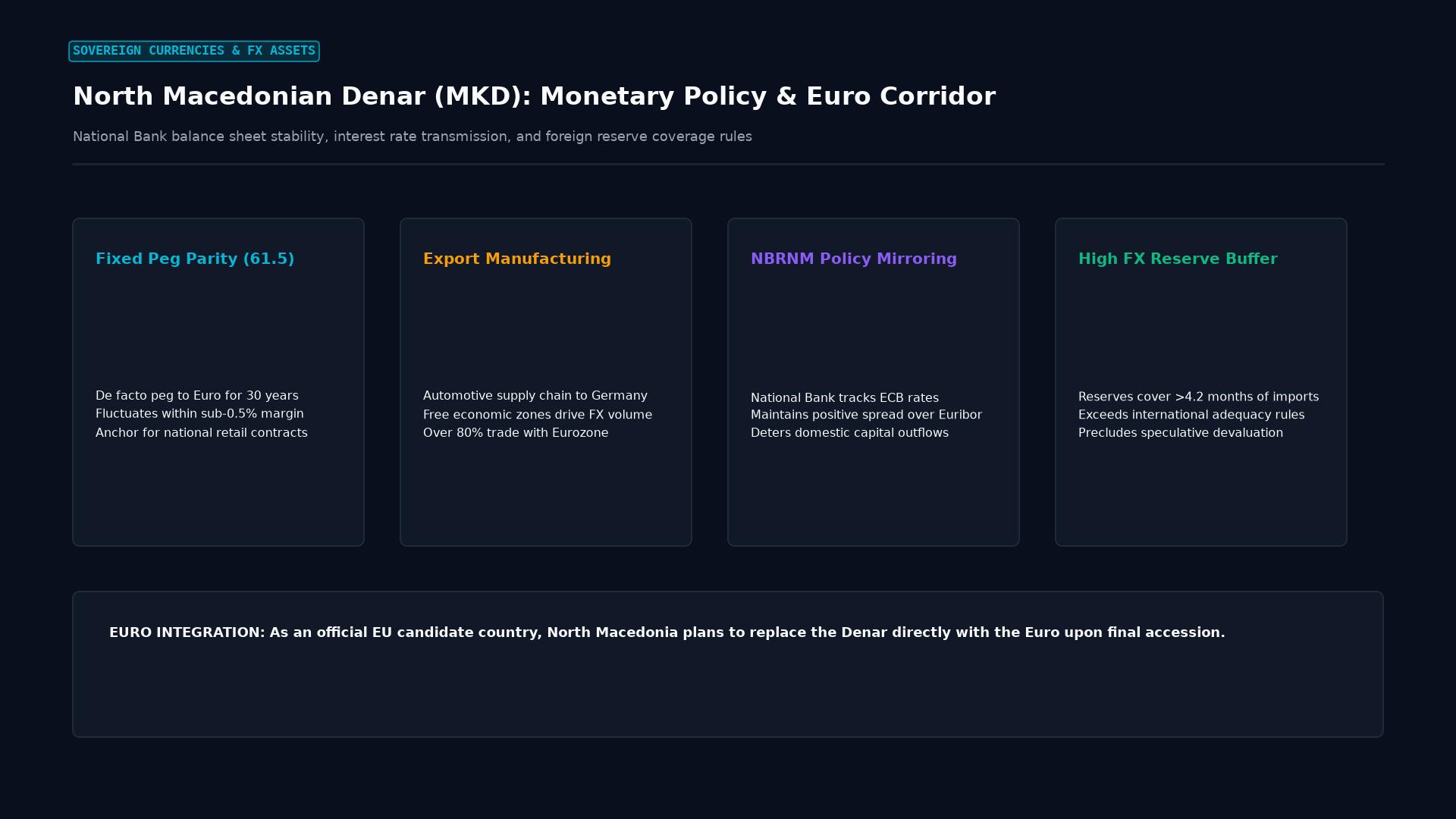 Figure: National Bank balance sheet stability, interest rate transmission, and foreign reserve coverage rules
Historical Lineage of the MKD Code
The monetary code MKD was designated following the independence of North Macedonia during the dissolution of Yugoslavia:
1. The Post-Yugoslav Monetary Crisis (1991–1992)
Prior to independence, the territory utilized the Yugoslav dinar (YUD). The collapse of the Yugoslav federation triggered hyperinflation, monetary disruption, and regional trade embargoes. In April 1992, the Macedonian parliament declared monetary independence, issuing provisional paper coupons (the first denar) at a 1:1 ratio against the Yugoslav dinar to insulate the domestic economy from regional monetary instability.
2. Monetary Reform and ISO 4217 Registration (1993)
In May 1993, the Macedonian government enacted comprehensive monetary stabilization:
- A new denar was introduced at a redenomination ratio of 1 new denar = 100 old coupon units.
- The ISO registered the official three-letter code MKD, derived from the country’s historical ISO country code (MK) and currency initial (D).
- In October 1995, the NBRNM shifted monetary policy away from a managed float toward an explicit external anchor, linking the MKD to the Deutsche Mark (DEM) at 31 MKD = 1 DEM.
3. Transition to the Euro Anchor (1999–Present)
When the euro was launched as an electronic accounting currency on January 1, 1999, the peg transitioned automatically to 61.50 MKD per EUR. Aside from an isolated, planned adjustment in July 1997, this exchange rate parity has remained stable for over three decades, surviving the 2001 domestic security crisis, the 2008 global financial crash, the 2020 pandemic dislocation, and the 2022 European energy inflation shock.
       CHRONOLOGY OF THE MKD CURRENCY CODE

Year        Monetary Event                       Anchor / Parity
----------------------------------------------------------------------------------
1992        Provisional Denar Coupons Issued     Parity with Yugoslav Dinar (1:1)
1993        Second Denar & ISO 4217 Registration Redenominated 100:1 (Code: MKD)
1995        Peg to the Deutsche Mark (DEM)       Fixed Parity: 31 MKD = 1 DEM
1999        Transition to Euro (EUR) Anchor      Fixed Parity: ~61.50 MKD = 1 EUR
2020        North Macedonia Accedes to NATO      Reinforces institutional stability
Macroeconomic Mechanics of the MKD Peg
Maintaining the MKD peg to the euro requires the NBRNM to align its monetary policy with the European Central Bank (ECB) while managing foreign exchange reserves to offset trade deficits:
1. Central Bank Bills (CB Bills) as the Policy Lever
The primary operational instrument utilized by the NBRNM to steer interbank liquidity is the 28-day Central Bank (CB) Bills Auction. By altering the interest rate on CB bills, the central bank influences the spread between domestic MKD interest rates and ECB policy rates:
$$i_{\text{MKD}} = i_{\text{ECB}} + \text{Risk Premium} + \theta(\Delta \text{FX Reserves})$$
Where:
- $i_{\text{MKD}}$ is the NBRNM CB bill interest rate.
- $i_{\text{ECB}}$ is the European Central Bank benchmark rate.
- $\theta(\Delta \text{FX Reserves})$ is an intervention coefficient that tightens rates when official foreign currency reserves decline.
When market demand for foreign currency increases, threatening to weaken the MKD past 61.50, the NBRNM raises the CB bill rate, absorbing excess denar liquidity from domestic commercial banks, while selling euros from official reserves.
2. Balance of Payments Inflows Supporting the MKD
North Macedonia experiences a persistent merchandise trade deficit, importing energy, vehicles, and industrial raw materials. The sustainability of the MKD peg relies upon three capital inflow pillars:
- Private Cash Remittances: Transfers from the substantial Macedonian diaspora living in Germany, Switzerland, Italy, and Austria contribute between 12% and 16% of GDP annually.
- Automotive and Electronics FDI: Global industrial manufacturers in Technological Industrial Development Zones (TIRZ) export automotive components to Western Europe, generating substantial euro revenues.
- Sovereign Eurobonds and Multilateral Loans: The Ministry of Finance issues foreign-currency sovereign debt on international exchanges to maintain foreign exchange reserves well above the prudential benchmark of four months of prospective imports.
                  MKD BALANCE OF PAYMENTS FLOWS

+---------------------------------------------------------------+
| Outflow Deficit: Heavy Import of Energy, Oil, Machinery       |
+---------------------------------------------------------------+
                               ^
                               | Counterbalanced By
                               v
+---------------------------------------------------------------+
| Inflow Surplus Pillars:                                       |
| 1. Diaspora Cash Transfers (EUR remitted by emigrant workers) |
| 2. Industrial Manufacturing Exports from TIRZ Free Zones      |
| 3. Foreign Direct Investment (FDI) & Sovereign Eurobonds      |
| 4. IMF Precautionary and Liquidity Lines (PLL)                |
+---------------------------------------------------------------+
Real-World Case Study: The 2022 Energy Shock Defense
In 2022, as global natural gas and electricity prices surged following geopolitical conflict in Eastern Europe, North Macedonia faced a severe terms-of-trade deterioration:
+--------------------------------------------------------------------+
|               NBRNM POLICY DEFENSE OF THE MKD (2022)               |
+--------------------------------------------------------------------+
| 1. Import Price Explosion: Energy import costs surged by >100%,    |
|    draining euro reserves from the domestic banking system.        |
| 2. Retail Panic Buying: Domestic citizens rushed to licensed       |
|    exchange bureaus to purchase physical euro banknotes.           |
| 3. Reserve Depletion: NBRNM sold over 400 million euros net from   |
|    official reserves during the first half of 2022.                |
| 4. Policy Tightening: NBRNM lifted the CB bill policy rate from    |
|    1.25% to 4.75% across aggressive consecutive monetary hikes.    |
| 5. International Support: The IMF approved a 530 million euro      |
|    Precautionary and Liquidity Line (PLL) to backstop reserves.    |
| 6. Parity Preservation: The MKD exchange rate held perfectly at    |
|    61.50 per EUR; reserves rebounded to record highs in 2023.      |
+--------------------------------------------------------------------+
The decisive actions of the central bank prevented a currency devaluation, proving the credibility of the fixed exchange rate anchor.
Comparison: MKD vs Regional Balkan Currencies
| Currency Code | Full Name | FX Regime | Anchor Parity | Central Bank |
|---|---|---|---|---|
| MKD | Macedonian Denar | De Facto Fixed Peg | ~61.50 EUR | NBRNM |
| RSD | Serbian Dinar | Managed Float | ~117.20 EUR | National Bank of Serbia |
| ALL | Albanian Lek | Free Float | Market Driven | Bank of Albania |
| BAM | Bosnia Convertible Mark | Currency Board | 1.95583 EUR | Central Bank of BiH |
| BGN | Bulgarian Lev | Currency Board | 1.95583 EUR | Bulgarian National Bank |
Frequently Asked Questions
Can foreign individuals freely trade MKD on international forex platforms?
No. The Macedonian denar is not an internationally deliverable currency traded on retail ECN platforms or international MetaTrader brokers. Cross-border capital transactions involving MKD are governed by national foreign exchange regulations enforced by the NBRNM. International exposure to North Macedonia is executed through institutional Non-Deliverable Forwards (NDFs) or by purchasing foreign-currency Macedonian sovereign Eurobonds.
What is the long-term outlook for the MKD regarding the Euro?
As an official candidate for European Union accession, North Macedonia has committed to eventual integration into the Eurozone. Once full EU membership is achieved, North Macedonia will participate in the European Exchange Rate Mechanism (ERM II) for a minimum of two years. Following the fulfillment of the Maastricht convergence criteria on inflation, fiscal deficits, and long-term interest rates, the MKD will be retired and replaced by the euro.
Why does North Macedonia maintain high reserve requirements on foreign currency bank deposits?
To reduce the high degree of domestic euroization and protect financial stability, the NBRNM enforces differentiated reserve requirements. Commercial banks must hold significantly higher mandatory reserves (typically 15% to 20%) against foreign-currency customer deposits compared to domestic MKD deposits (typically 5% to 8%). This policy encourages commercial banks to offer attractive interest rates on local MKD savings accounts, promoting dedollarization.
Ready to trade forex?
Open a free demo account with a regulated broker. Practice with virtual funds before risking real money.